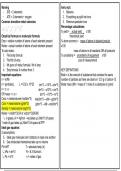
Naming Ionic eq’s:
- IDE = 2 elements 1. Balance
- ATE = 2 elements + oxygen 2. Everything aq split into ions
Common transition metal valencies: 3. Remove spectator ions
Percentage calculations:
% yield = actual yield _ x100
Empirical formula vs molecular formula: theoretical yield
Emp = relative number of atoms of each element present % atom economy = mass of atoms in desired product
Molec = actual number of atoms of each element present x100
To calc molec: mass of atoms in all reactants OR all products
1. Find emp formula % uncertainty = uncertainty of equipment x100
2. Find Mr of emp size of measurement
3. Mr given of molec formule / Mr of emp
4. Emp formula X number from 3. KEY DEFINITIONS
Important equations: Mole = is the amount of substance that contains the same
n = m/Mr number of particles as there are atoms in 12.0 g of carbon-12
n = particles/L L = 6.02 x 10^23 cm^3 →/10^3→dm^3 Molar mass (Mr) = mass of 1 mole of a substance in g/mol
n=cxv dm^3 →x10^3→cm^3
OR mass = c x v dm^3 →/10^3→m^3
Conc = moles/volume (mol/dm^3) mol/dm^3 →xMr→g/dm^3
Conc = mass/volume (g/dm^3) g/dm^3 →/Mr→mol/dm^3
Density = mass/volume (kg/m^3)
Moles = vol(dm^3)/24 or vol(cm^3)/24000
⤷ in gases, Ar = 4g/mol →4g takes up 24dm^3 of space
1 mole of gas takes up 24dm^3 of space at RTP
Ideal gas equation:
2 assumptions:
5. Ideal gas molecules don’t attracts or repel one another
6. Gas molecules themselves take up no volume
PV=nRT T = absolute temp (k)
⤷ kPa = dm^3 R = 8.314J/mol k
⤷ Pa = m^3 n = moles of gas
- IDE = 2 elements 1. Balance
- ATE = 2 elements + oxygen 2. Everything aq split into ions
Common transition metal valencies: 3. Remove spectator ions
Percentage calculations:
% yield = actual yield _ x100
Empirical formula vs molecular formula: theoretical yield
Emp = relative number of atoms of each element present % atom economy = mass of atoms in desired product
Molec = actual number of atoms of each element present x100
To calc molec: mass of atoms in all reactants OR all products
1. Find emp formula % uncertainty = uncertainty of equipment x100
2. Find Mr of emp size of measurement
3. Mr given of molec formule / Mr of emp
4. Emp formula X number from 3. KEY DEFINITIONS
Important equations: Mole = is the amount of substance that contains the same
n = m/Mr number of particles as there are atoms in 12.0 g of carbon-12
n = particles/L L = 6.02 x 10^23 cm^3 →/10^3→dm^3 Molar mass (Mr) = mass of 1 mole of a substance in g/mol
n=cxv dm^3 →x10^3→cm^3
OR mass = c x v dm^3 →/10^3→m^3
Conc = moles/volume (mol/dm^3) mol/dm^3 →xMr→g/dm^3
Conc = mass/volume (g/dm^3) g/dm^3 →/Mr→mol/dm^3
Density = mass/volume (kg/m^3)
Moles = vol(dm^3)/24 or vol(cm^3)/24000
⤷ in gases, Ar = 4g/mol →4g takes up 24dm^3 of space
1 mole of gas takes up 24dm^3 of space at RTP
Ideal gas equation:
2 assumptions:
5. Ideal gas molecules don’t attracts or repel one another
6. Gas molecules themselves take up no volume
PV=nRT T = absolute temp (k)
⤷ kPa = dm^3 R = 8.314J/mol k
⤷ Pa = m^3 n = moles of gas