

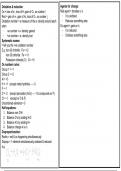
Oxidation & reduction Agents for change:
Ox = loss of e-, loss of H2 gain of O2, ox number ↑ Red agent = donates e-’s
Red = gain of e-, gain of H2, loss of O2, ox number ↓ - It is oxidised
Oxidation number = a measure of the e- density around each - Reduces something else
atom Ox agent = gains e-’s
- -ve number = e- density gained - It is reduced
- +ve number = e- density lost - Oxidises something else
Systematic names:
= tell you the +ve oxidation number
E.g. iron (ll) chloride: Fe = +2
iron (lll) chloride: Fe = +3
Potassium chlorate (V): Cl = +5
Ox numbers rules:
Group 1 = +1
Group 2 = +2
Al = +3
H = +1 (except metal hydrides → -1)
F = -1
O = -2 (except peroxides (H2O2) → -1 & compounds w/ F)
Cl = -1 (except w/ O & F)
Uncombined elements = 0
Half equations:
1. Balance non O/H
2. Balance O’s by adding H2O
3. Balance H’s by adding H+
4. Balance charge w/ e-’s
Disproportionation:
Redox = red & ox happening simultaneously
Disprop = 1 element simultaneously oxidised & reduced
e.g.
Ox = loss of e-, loss of H2 gain of O2, ox number ↑ Red agent = donates e-’s
Red = gain of e-, gain of H2, loss of O2, ox number ↓ - It is oxidised
Oxidation number = a measure of the e- density around each - Reduces something else
atom Ox agent = gains e-’s
- -ve number = e- density gained - It is reduced
- +ve number = e- density lost - Oxidises something else
Systematic names:
= tell you the +ve oxidation number
E.g. iron (ll) chloride: Fe = +2
iron (lll) chloride: Fe = +3
Potassium chlorate (V): Cl = +5
Ox numbers rules:
Group 1 = +1
Group 2 = +2
Al = +3
H = +1 (except metal hydrides → -1)
F = -1
O = -2 (except peroxides (H2O2) → -1 & compounds w/ F)
Cl = -1 (except w/ O & F)
Uncombined elements = 0
Half equations:
1. Balance non O/H
2. Balance O’s by adding H2O
3. Balance H’s by adding H+
4. Balance charge w/ e-’s
Disproportionation:
Redox = red & ox happening simultaneously
Disprop = 1 element simultaneously oxidised & reduced
e.g.


