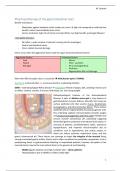
M. Casteels
Pharmacotherapy of the gastrointestinal tract
Benefit-risk balance
- Medication against headache which makes you vomit high risk compared to relatively low
benefit, rather have headache than vomit.
- Cancer treatment, high risk of chemo and side effects, but high benefit, prolonged lifespan!
“acid peptic diseases”
- GE-reflux = acidic content of stomach coming into the esophagus.
- Gastric and duodenal ulcers.
- Stress related mucosal damage.
Ulcers occur when the aggression factors take the upper hand of protective factors:
Aggression factors Protection factors
- Acid - Mucus
- Pepsin - HCO3—secretion
- Bile (gal) - PG (= prostaglandins)
- Perfusion
- Regeneration after cell damage
More than 90% of peptic ulcers is caused by Helicobacter pylori / NSAIDs.
Treatment: acid production ↘, mucosa protection, eradicating infection
GERD = GastroEsophageal Reflux Disease Treatment: lifestyle changes, diet, avoiding irritants such
as coffee, nicotine, alcohol, fruit juice, fatty foods, etc. also losing weight.
Pathophysiological Features of the Gastroduodenal
Mucosa. A layer of alkaline mucus gel is a key feature of
gastroduodenal mucosal defense. Beneath this lining are
surface epithelial cells that secrete mucus, bicarbonate,
prostaglandins, and other protective factors. These surface
epithelial cells are regenerated by mucosal progenitor cells.
The underlying capillary microcirculation provides oxygen
and produces prostaglandins and nitric oxide. Multiple acid
sensors monitor extracellular pH, potentially triggering
diminished gastrin production and reduced acid output. In
seriously ill patients, proinflammatory states, splanchnic
hypoperfusion, and impaired microcirculation due to
conditions such as hypovolemia, low cardiac output, or
shock can induce ischemia, reperfusion injury, and low
gastric intramucosal pH. These factors can converge to impair the integrity of the mucosal lining,
causing unchecked gastric acidity. Gastric acid is often considered to precipitate, perpetuate, or be a
predisposing factor in gastrointestinal bleeding in hospitalized patients; however, disruption of the
mucosal barrier may be the most salient factor in the genesis of such bleeding.
- NSAIDs (gastro-)toxicity very high mortality rate! = silent epidemic.
- Hospitalizations due to NSAIDs in elderly really high!
1
, M. Casteels
Pharmacotherapy: “Acid peptic disease”
- Acid secretion↘
- Mucosa protection↗
- Eradication therapy if H.pylori
Here on the left, you can see where the different drugs
have their impact.
Anti-cholinergic drugs (e.g. Atropine): decrease
stimulation of acid secretion to treat ulcers => but
doesn’t solve everything!
Vagotomy: less cholinergic stimulation => also doesn’t
solve anything!
Histamine-antagonist => good! Neutral pH in stomach!
Release of histamine is stimulated by gastrine and
acetylcholine. Which then stimulates acid secretion.
Agents affecting peptic diseases.
- H2-receptor antagonists ( not available in EU)
- Proton Pump Inhibitors (PPI) -Prazole = PPIs
o Omeprazole, pantoprazole, etc.
- Misoprostol
- Antacids
- Antibiotics
H2 receptor antagonists Ranitidine
Inhibit histamine actions on the gastric acid secretion (competitive H2 blockers are no longer
inhibitor H2 receptor). This results in a reduced acid and pepsin on the market in Belgium.
secretion. Structurally H2 blockers are related to histamine.
Pharmacodynamics=PD:
Competitively antagonizes the parietal H2 receptor and thus inhibit the action of histamine on gastric
acid secretion; both basal and food-stimulated acid secretion is inhibited by more than 90%, there is
also an impact on the pepsin secretion.
Histamine is synthesized in histaminocytes which reside in the gastric mucosa. Histamine release is
stimulated by gastrin and acetylcholine. And thus these 3 all stimulate HCl secretion.
The effect of histamine is mediated by the H2 receptor at the level of the parietal cell. H2 blockers are
selective antagonists of this receptor (they do not have affinity for the H1 receptor).
The interaction between histamine, gastrin and acetylcholine has not been fully elucidated…
Pharmacokinetics=PK:
H2 antagonists are characterized by a good bioavailability (F). relatively hydrophilic molecules that
hardly cross the Blood-Brain-Barrier (BBB), and thus show little central side effects.
2
, M. Casteels
Side effects and interactions:
Inhibition of the metabolism of various drugs (inhibition of cytochrome P450 in the liver): oral
anticoagulants, phenytoin, carbamazepine, quinidine, and theophylline.
Clinical use:
- Treatment of gastric and duodenal ulcers (possibly in combination with antibiotics to eradicate
H. pylori)
- Gastroesophageal reflux (GERD, however PPIs are preferred, especially in erosive esophagitis)
- Prevention of ulcers caused by NSAIDs.
- Prevention of bleeding of stress ulcers.
Proton Pump Inhibitors = PPIs
Irreversible inhibitors of K/H ATPase (i.e., the proton pump) enzyme present in the parietal cells in
the gastric mucosa and thus they directly inhibit the acid secretion.
- Omeprazole, esomeprazole, lansoprazole, pantoprazole, rabeprazole, etc. -prazole = PPIs
Pharmacokinetics & dynamics :
Short plasma half-life (1.5 hours) but provide 24-hour long inhibition of basal and stimulated HCl-
production. Logic as it is an irreversible inhibitor so new pumps need to be newly synthesized to regain
acid secretion levels. Bioavailability (F) is half when taken with food and therefore PPIs are best taken
on an empty stomach, 1 hour before meals (maximal acid secretion coincides with peak plasma
concentration).
PPIs work fast and suppress acid secretion long-term through their irreversible bonding. PPIs are both
curative and preventive for recurring ulcers and are the product of choice in reflux esophagitis.
Indications:
- Treatment of gastric and duodenal ulcers (possibly in combination with antibiotics to eradicate
H. pylori)
- Gastroesophageal reflux esophagitis (PPIs are first choice) -> GERD
- Zollinger-Ellison syndrome (high dosage !)
- Prevention of erosions and ulcers caused by NSAIDs therapy in risk populations.
Side effects:
Nausea, diarrhea, headache, tinnitus, and skin eruptions => rare!
In general, PPIs are well tolerated! Although prolonged use increases the risk for osteoporosis,
fractures, infections with clostridium difficile and pneumonia.
Interactions:
- All PPIs are metabolized by CYP450.
- PPIs can inhibit CYP2C19 inhibits the conversion of clopidogrel into its active metabolite.
This leads to a decrease in the anti-aggregating effect.
- pH increase can have effects on the absorption of other drugs.
- Important to stop use of PPIs when it’s no longer necessary!
3
, M. Casteels
Misoprostol
A stable analog of prostaglandin E1 (PGE1)
Its effect is two-part:
- Inhibits acid secretion.
- Has a cytoprotective effect. It improves the vascularization of the mucosa, increases mucus
production, and increases the resistance of the stomach mucosa to harmful external factors.
It also induces faster healing of the mucosa.
Side effects:
Think about the side effects of prostaglandins (PGs): nausea, vomiting, diarrhea, uterus contractions
and miscarriage.
Pregnancy is an absolute contra-indication because of uterine contractions and
teratogenicity! never prescribed to pregnant women (↔ abortion)
Off label indications:
- After miscarriage: expulsion of remaining tissue
- Prevention of postpartum bleeding
- Induction of labor in case of fetal death, mola (+MTX)
Antacids
Neutralize gastric acid: NaHCO3, CaCO3, Al(OH)3, Mg(OH)2
Symptomatic relief because they block the pain at the level of the ulcer, caused by the exposure, but
can only be used as adjuvant treatment for ulcers (usually OTC).
Purely symptomatic cannot be used to cure ulcers!
Active for short time (2 hours), represent a major salt-load for the patient (be careful in patients with
heart failure!), may cause secondary increase in acid secretion and may interact with other drugs in
the GI tract. Mg(OH)2 may cause diarrhea and Al(OH)3 may cause constipation.
Important interaction greatly reduced uptake of drugs when taken simultaneously e.g.,
tetracycline antibiotics (due to chelation).
Antibiotics
Eradication of H. pylori. Taken together with PPIs, recommendation is to take this for 10 days.
(Gastro)-prokinetics
Dopamine-2-receptor antagonists Domperidon, metoclopramide
Cause an accelerated gastric emptying, and through the D2-receptor block in the chemoreceptor
trigger zone, also an anti-nausea and anti-emetic effect.
4
Pharmacotherapy of the gastrointestinal tract
Benefit-risk balance
- Medication against headache which makes you vomit high risk compared to relatively low
benefit, rather have headache than vomit.
- Cancer treatment, high risk of chemo and side effects, but high benefit, prolonged lifespan!
“acid peptic diseases”
- GE-reflux = acidic content of stomach coming into the esophagus.
- Gastric and duodenal ulcers.
- Stress related mucosal damage.
Ulcers occur when the aggression factors take the upper hand of protective factors:
Aggression factors Protection factors
- Acid - Mucus
- Pepsin - HCO3—secretion
- Bile (gal) - PG (= prostaglandins)
- Perfusion
- Regeneration after cell damage
More than 90% of peptic ulcers is caused by Helicobacter pylori / NSAIDs.
Treatment: acid production ↘, mucosa protection, eradicating infection
GERD = GastroEsophageal Reflux Disease Treatment: lifestyle changes, diet, avoiding irritants such
as coffee, nicotine, alcohol, fruit juice, fatty foods, etc. also losing weight.
Pathophysiological Features of the Gastroduodenal
Mucosa. A layer of alkaline mucus gel is a key feature of
gastroduodenal mucosal defense. Beneath this lining are
surface epithelial cells that secrete mucus, bicarbonate,
prostaglandins, and other protective factors. These surface
epithelial cells are regenerated by mucosal progenitor cells.
The underlying capillary microcirculation provides oxygen
and produces prostaglandins and nitric oxide. Multiple acid
sensors monitor extracellular pH, potentially triggering
diminished gastrin production and reduced acid output. In
seriously ill patients, proinflammatory states, splanchnic
hypoperfusion, and impaired microcirculation due to
conditions such as hypovolemia, low cardiac output, or
shock can induce ischemia, reperfusion injury, and low
gastric intramucosal pH. These factors can converge to impair the integrity of the mucosal lining,
causing unchecked gastric acidity. Gastric acid is often considered to precipitate, perpetuate, or be a
predisposing factor in gastrointestinal bleeding in hospitalized patients; however, disruption of the
mucosal barrier may be the most salient factor in the genesis of such bleeding.
- NSAIDs (gastro-)toxicity very high mortality rate! = silent epidemic.
- Hospitalizations due to NSAIDs in elderly really high!
1
, M. Casteels
Pharmacotherapy: “Acid peptic disease”
- Acid secretion↘
- Mucosa protection↗
- Eradication therapy if H.pylori
Here on the left, you can see where the different drugs
have their impact.
Anti-cholinergic drugs (e.g. Atropine): decrease
stimulation of acid secretion to treat ulcers => but
doesn’t solve everything!
Vagotomy: less cholinergic stimulation => also doesn’t
solve anything!
Histamine-antagonist => good! Neutral pH in stomach!
Release of histamine is stimulated by gastrine and
acetylcholine. Which then stimulates acid secretion.
Agents affecting peptic diseases.
- H2-receptor antagonists ( not available in EU)
- Proton Pump Inhibitors (PPI) -Prazole = PPIs
o Omeprazole, pantoprazole, etc.
- Misoprostol
- Antacids
- Antibiotics
H2 receptor antagonists Ranitidine
Inhibit histamine actions on the gastric acid secretion (competitive H2 blockers are no longer
inhibitor H2 receptor). This results in a reduced acid and pepsin on the market in Belgium.
secretion. Structurally H2 blockers are related to histamine.
Pharmacodynamics=PD:
Competitively antagonizes the parietal H2 receptor and thus inhibit the action of histamine on gastric
acid secretion; both basal and food-stimulated acid secretion is inhibited by more than 90%, there is
also an impact on the pepsin secretion.
Histamine is synthesized in histaminocytes which reside in the gastric mucosa. Histamine release is
stimulated by gastrin and acetylcholine. And thus these 3 all stimulate HCl secretion.
The effect of histamine is mediated by the H2 receptor at the level of the parietal cell. H2 blockers are
selective antagonists of this receptor (they do not have affinity for the H1 receptor).
The interaction between histamine, gastrin and acetylcholine has not been fully elucidated…
Pharmacokinetics=PK:
H2 antagonists are characterized by a good bioavailability (F). relatively hydrophilic molecules that
hardly cross the Blood-Brain-Barrier (BBB), and thus show little central side effects.
2
, M. Casteels
Side effects and interactions:
Inhibition of the metabolism of various drugs (inhibition of cytochrome P450 in the liver): oral
anticoagulants, phenytoin, carbamazepine, quinidine, and theophylline.
Clinical use:
- Treatment of gastric and duodenal ulcers (possibly in combination with antibiotics to eradicate
H. pylori)
- Gastroesophageal reflux (GERD, however PPIs are preferred, especially in erosive esophagitis)
- Prevention of ulcers caused by NSAIDs.
- Prevention of bleeding of stress ulcers.
Proton Pump Inhibitors = PPIs
Irreversible inhibitors of K/H ATPase (i.e., the proton pump) enzyme present in the parietal cells in
the gastric mucosa and thus they directly inhibit the acid secretion.
- Omeprazole, esomeprazole, lansoprazole, pantoprazole, rabeprazole, etc. -prazole = PPIs
Pharmacokinetics & dynamics :
Short plasma half-life (1.5 hours) but provide 24-hour long inhibition of basal and stimulated HCl-
production. Logic as it is an irreversible inhibitor so new pumps need to be newly synthesized to regain
acid secretion levels. Bioavailability (F) is half when taken with food and therefore PPIs are best taken
on an empty stomach, 1 hour before meals (maximal acid secretion coincides with peak plasma
concentration).
PPIs work fast and suppress acid secretion long-term through their irreversible bonding. PPIs are both
curative and preventive for recurring ulcers and are the product of choice in reflux esophagitis.
Indications:
- Treatment of gastric and duodenal ulcers (possibly in combination with antibiotics to eradicate
H. pylori)
- Gastroesophageal reflux esophagitis (PPIs are first choice) -> GERD
- Zollinger-Ellison syndrome (high dosage !)
- Prevention of erosions and ulcers caused by NSAIDs therapy in risk populations.
Side effects:
Nausea, diarrhea, headache, tinnitus, and skin eruptions => rare!
In general, PPIs are well tolerated! Although prolonged use increases the risk for osteoporosis,
fractures, infections with clostridium difficile and pneumonia.
Interactions:
- All PPIs are metabolized by CYP450.
- PPIs can inhibit CYP2C19 inhibits the conversion of clopidogrel into its active metabolite.
This leads to a decrease in the anti-aggregating effect.
- pH increase can have effects on the absorption of other drugs.
- Important to stop use of PPIs when it’s no longer necessary!
3
, M. Casteels
Misoprostol
A stable analog of prostaglandin E1 (PGE1)
Its effect is two-part:
- Inhibits acid secretion.
- Has a cytoprotective effect. It improves the vascularization of the mucosa, increases mucus
production, and increases the resistance of the stomach mucosa to harmful external factors.
It also induces faster healing of the mucosa.
Side effects:
Think about the side effects of prostaglandins (PGs): nausea, vomiting, diarrhea, uterus contractions
and miscarriage.
Pregnancy is an absolute contra-indication because of uterine contractions and
teratogenicity! never prescribed to pregnant women (↔ abortion)
Off label indications:
- After miscarriage: expulsion of remaining tissue
- Prevention of postpartum bleeding
- Induction of labor in case of fetal death, mola (+MTX)
Antacids
Neutralize gastric acid: NaHCO3, CaCO3, Al(OH)3, Mg(OH)2
Symptomatic relief because they block the pain at the level of the ulcer, caused by the exposure, but
can only be used as adjuvant treatment for ulcers (usually OTC).
Purely symptomatic cannot be used to cure ulcers!
Active for short time (2 hours), represent a major salt-load for the patient (be careful in patients with
heart failure!), may cause secondary increase in acid secretion and may interact with other drugs in
the GI tract. Mg(OH)2 may cause diarrhea and Al(OH)3 may cause constipation.
Important interaction greatly reduced uptake of drugs when taken simultaneously e.g.,
tetracycline antibiotics (due to chelation).
Antibiotics
Eradication of H. pylori. Taken together with PPIs, recommendation is to take this for 10 days.
(Gastro)-prokinetics
Dopamine-2-receptor antagonists Domperidon, metoclopramide
Cause an accelerated gastric emptying, and through the D2-receptor block in the chemoreceptor
trigger zone, also an anti-nausea and anti-emetic effect.
4