100% satisfaction guarantee Immediately available after payment Both online and in PDF No strings attached 4.6 TrustPilot
logo-home
Exam (elaborations)

Washington Pesticide Laws and Safety (questions and answers).

Rating
-
Sold
-
Pages
12
Grade
A+
Uploaded on
05-08-2024
Written in
2024/2025

pest a plant or animal detrimental to man; one that pesters or annoys Bordeaux mixture lime and copper sulfate; one of the most widely used fungicides worldwide DDT the original insecticide, brought about in WWII - lead to the creation of 2,4-D, aldrin, and heptachlor insecticide resistance a growing problem we are beginning to face; 500+ insects have become resistant to one or more insecticides worldwide pesticide resistance 180+ weed species and hundreds of plant pathogens have become resistant to pesticides drawbacks of pesticides some pesticides like DDT, aldrin, heptachlor, and dieldrin will accumulate in the fatty tissue of some animals; most have been taken off the market because of this side effect EPA created in 1970, they seek to regulate use of chemicals to protect the environment and the health of humans and other animals; they banned DDT in 1972 OP insecticides acutely toxic to mammals; more expensive; less persistent in the environment Integrated Pest Management (IPM) the use of all available tactics or strategies to manage pests The Five Steps of an IPM Program 1) identify the pest to be managed 2) define the management system 3) develop the management strategy 4) develop reliable monitoring techniques 5) use economic thresholds identify the pest to be managed categorize the pest into severe, occasional, potential or migratory; know the pest's life cycle (usually, only the adult or larva are susceptible to pesticides - we do not have chemicals to affect the eggs) define the management system the goal is to maintain pest numbers and the resultant damage at acceptable levels develop reliable monitoring techniques scouting and insect traps (useful for monitoring insects and their activity); weather (predicts outbreak of insects or disease); temperature (follows an insect's life cycle or developmental stages) use economic thresholds pesticide applications should be avoided when their cost is greater than the damage caused by the pest; affected by: the current value of agricultural product being produced, its stage of development, the degree of damage caused under various environmental conditions economic threshold level or density of a pest population where control measures need to be applied to prevent the pest from reaching the economic injury level economic injury level the pest population density that causes losses equal to the cost of the control measures implementing IPM strategies necessary when harmful pests have not been held in check by natural controls (weather, predators, or parasites); types of IPM control mechanical, physical, cultural, genetic, and biological mechanical controls devices that prevent the spread or reduce the infestation of pests, primarily insects and vertebrate animals; ex: hand destruction, traps screens, nets, and fences physical controls used to kill the pests, disrupt their life cycles, and make the environment unfavorable for pests; include the manipulation of water, humidity, temperature, electric shock, light, or other radiant energy; primarily used to control insects and diseases cultural control manipulation of the environment to avoid serious damage; requires knowledge of plant needs and potentials; ex: selecting plants, managing irrigation, rotating crops, and pruning; genetic controls involves the use of plants and animals that are resistant to attack by pests; uses breeding techniques and gene manipulation biological controls involve the introduction, encouragement, and artificial increases of plants and animals that are parasites or predators of a pest species; used to control insects and weeds chemical controls involves the use of naturally derived or synthetic chemicals (PESTICIDES) that kill, attract, repel, or otherwise control the growth of pest plants, animals, and microorganisms systemic pesticide inside the plant; kills from the roots; can be injected or ingested contact pesticide on surface of plant; must contact a treated area to be affected avicides to control pest birds bactericides to control bacteria fungicides to control fungi herbicides control weeds, shrubs, and trees insecticides to control insects and insect relatives miticides (acaricides) to control mites molluscicides to control snails and slugs nematicides to control nematodes piscicides to control pest fish rodenticides to control rodents defoliants chemicals that cause leaves or foliage to drop from a plant desiccants chemicals that promote drying or loss of moisture in plant tissues growth regulators substances (other than fertilizers or food) that alter the growth or development of a plant or animal

Show more Read less
Institution
Washington Pesticide Laws And Safety
Course
Washington Pesticide Laws and Safety

Content preview

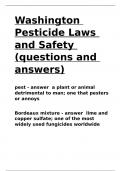
Washington
Pesticide Laws
and Safety
(questions and
answers)
pest - answer a plant or animal
detrimental to man; one that pesters
or annoys


Bordeaux mixture - answer lime and
copper sulfate; one of the most
widely used fungicides worldwide

, DDT - answer the original
insecticide, brought about in WWII -
lead to the creation of 2,4-D, aldrin,
and heptachlor


insecticide resistance - answer a
growing problem we are beginning to
face; 500+ insects have become
resistant to one or more insecticides
worldwide


pesticide resistance - answer 180+
weed species and hundreds of plant
pathogens have become resistant to
pesticides


drawbacks of pesticides - answer
some pesticides like DDT, aldrin,
heptachlor, and dieldrin will
accumulate in the fatty tissue of
some animals; most have been taken

Written for

Institution
Washington Pesticide Laws and Safety
Course
Washington Pesticide Laws and Safety

Document information

Uploaded on
August 5, 2024
Number of pages
12
Written in
2024/2025
Type
Exam (elaborations)
Contains
Questions & answers

Subjects

Get to know the seller

Seller avatar
Reputation scores are based on the amount of documents a seller has sold for a fee and the reviews they have received for those documents. There are three levels: Bronze, Silver and Gold. The better the reputation, the more your can rely on the quality of the sellers work.
BRAINBOOSTERS Howard Community College
View profile
Follow You need to be logged in order to follow users or courses
Sold
677
Member since
2 year
Number of followers
251
Documents
23509
Last sold
20 hours ago

In this page you will find all documents , flashcards and package deals offered by seller BRAINBOOSTERS

4.5

342 reviews

5
267
4
30
3
21
2
5
1
19

Recently viewed by you

Why students choose Stuvia

Created by fellow students, verified by reviews

Quality you can trust: written by students who passed their tests and reviewed by others who've used these notes.

Didn't get what you expected? Choose another document

No worries! You can instantly pick a different document that better fits what you're looking for.

Pay as you like, start learning right away

No subscription, no commitments. Pay the way you're used to via credit card and download your PDF document instantly.

Student with book image

“Bought, downloaded, and aced it. It really can be that simple.”

Alisha Student

Frequently asked questions