100% satisfaction guarantee Immediately available after payment Both online and in PDF No strings attached 4.2 TrustPilot
logo-home
Exam (elaborations)

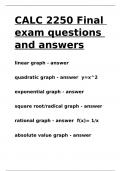
CALC 2250 Final exam questions and answers.

Rating
-
Sold
-
Pages
10
Grade
A
Uploaded on
05-08-2024
Written in
2024/2025

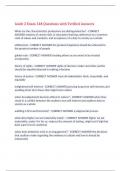
linear graph quadratic graph y=x^2 exponential graph square root/radical graph rational graph f(x)= 1/x absolute value graph continuity steps 1. plug x into f(x) and find answer 2. take limit as x--># and see if it is equal to (1) 3. if they are equal, then they are continuous chain rule f'(x)=f'(g(x)) x g'(x) d/dx (sin(x))= =cos(x) d/dx (cos(x))= =-sin(x) d/dx (tan(x))= =sec^2(x) d/dx (sec(x))= =sec(x)tan(x) d/dx (csc(x))= =-csc(x)cot(x) d/dx (cot(x))= =-csc^2(x) csc(x)= 1/sin(x) sec(x)= 1/csc(x) cot(x)= 1/tan(x)=cos(x)/sin(x) d/dx(arcsinx)= 1/sqrt(1-x^2) d/dx(arccosx)= -1/sqrt(1-x^2) d/dx(arctanx)= 1/(1+x^2) average velocity equation change in position/change in time OR (pos. at time b)-(pos. at time a)/(b-a) instantaneous velocity equation v(t)=lim t-->a (h(t)-h(a))/(t-a) displacement s(t) velocity v(t) acceleration a(t) s'(t)= v(t) v'(t)= a(t) When do you use log differentiation? when variable is in base and exponent relative extrema does not include... endpoints, only critical points if tangent line is below curve, then... concave up if tangent line is above curve, then... concave down closed interval method steps 1. find critical points using first deriv 2. evaluate f(x) at endpoints and critical points 3. largest of those is abs. max and smallest is abs. min increasing/decreasing test steps 1. find critical points using first deriv 2. evaluate f(x) at its critical points 3. sections where number is positive means graph is inc. and sections where number is negative means graph is dec. first derivative test steps 1. find critical points using first deriv 2. evaluate f(x) at critical points 3. pos. # = inc and neg. # = dec. 4. at those breaks are where relative extrema of f(x) are concavity test steps 1. find critical points using second derivative 2. evaluate f''(x) to see if each section is positive or negative 3. if positive, graph is concave up, and if negative, graph is concave down second derivative test steps 1. find critical points using first derivative 2. evaluate f''(x) to see if each section is positive or negative 3. if positive, graph is concave up, and if negative, graph is concave down inflection points are where... concave up/down changes when finding inverse of a graph, mirror over... y=x line optimization steps 1. picture! 2. variables (label pic) 3. constraint 4. function 5. goal 6. solve for 1 variable in constraint 7. plug that value for that variable into the function and simplify 8. domain 9. derivative of function 10. set=0 to solve for critical points 11. first deriv. test, second deriv. test, or closed interval method 12. statement! related rates steps 1. picture! 2. write what you're given and variables in pic 3. goal! 4. equation and take deriv. 5. plug given values in to deriv. and solve for unknown 6. take value for unknown and plug in to equation to solve for goal 7. statement! lim x-->+- infinity (1/x) = 0 to find vertical asymptote... set denominator = 0 to find horizontal asymptote... take limit and plug 0 into x and solve sum of n from k=1 (c) = c x n sum of n from k=1 (k^2) = n(n+1)(2n+1)/6

Show more Read less
Institution
UGA Math Placement
Course
UGA Math Placement


Whoops! We can’t load your doc right now. Try again or contact support.

Written for

Institution
UGA Math Placement
Course
UGA Math Placement

Document information

Uploaded on
August 5, 2024
Number of pages
10
Written in
2024/2025
Type
Exam (elaborations)
Contains
Questions & answers

Subjects

Content preview

CALC 2250 Final
exam questions
and answers
linear graph - answer


quadratic graph - answer y=x^2


exponential graph - answer


square root/radical graph - answer


rational graph - answer f(x)= 1/x


absolute value graph - answer

, continuity steps - answer 1. plug x
into f(x) and find answer 2. take limit
as x--># and see if it is equal to (1)
3. if they are equal, then they are
continuous


chain rule - answer f'(x)=f'(g(x)) x
g'(x)


d/dx (sin(x))= - answer =cos(x)


d/dx (cos(x))= - answer =-sin(x)


d/dx (tan(x))= - answer =sec^2(x)


d/dx (sec(x))= - answer
=sec(x)tan(x)


d/dx (csc(x))= - answer =-
csc(x)cot(x)

Get to know the seller

Seller avatar
Reputation scores are based on the amount of documents a seller has sold for a fee and the reviews they have received for those documents. There are three levels: Bronze, Silver and Gold. The better the reputation, the more your can rely on the quality of the sellers work.
BRAINBOOSTERS Chamberlain College Of Nursing
View profile
Follow You need to be logged in order to follow users or courses
Sold
666
Member since
2 year
Number of followers
250
Documents
23197
Last sold
4 days ago

In this page you will find all documents , flashcards and package deals offered by seller BRAINBOOSTERS

4.5

341 reviews

5
265
4
30
3
21
2
5
1
20

Recently viewed by you

Why students choose Stuvia

Created by fellow students, verified by reviews

Quality you can trust: written by students who passed their tests and reviewed by others who've used these notes.

Didn't get what you expected? Choose another document

No worries! You can instantly pick a different document that better fits what you're looking for.

Pay as you like, start learning right away

No subscription, no commitments. Pay the way you're used to via credit card and download your PDF document instantly.

Student with book image

“Bought, downloaded, and aced it. It really can be that simple.”

Alisha Student

Frequently asked questions