

100% satisfaction guarantee Immediately available after payment Both online and in PDF No strings attached 4.2 TrustPilot
logo-home
Exam (elaborations)

BIO-310 TESU EXAM 1- Chapter 1 Questions And Answers With 100% Correct Answers

Rating
-
Sold
-
Pages
3
Grade
A+
Uploaded on
04-08-2024
Written in
2024/2025

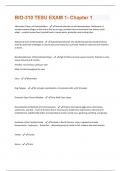
Alternative Theory of Domestication - Natural selection to self domestication. Settlement of semipermanent villages at the end of the last ice age, provided new environment that wolves could adapt. --surplus human food, spoiled foods, human waste, protection and nesting sites. Behavioral traits of DD bonding - Subordinate behavior into adulthood and decreased tendency towards dominate challenges as sexual and social maturity is achieved. Need for maternal care manifest as bond. Breeding Behavior of Domesticated Dogs - High fertility and early sexual maturity. Puberty is early, sexual maturity 6-9 months. Females- two estrous cycles per year Male- Fertile throughout the year Class - Mammalia Dog Puppies - Do not gain coordination or locomotor skills until 10 weeks. Domestic Dog's Closest Relative - Gray Wolf-Canis Lupus Domestication & Methods of Communication - Posture that signals aggression, dominance, submission, and fear .. level of stimulus that is necessary to evoke these expressions, intensity and completeness. Significantly better at responding to human social cues- gesturing, pointing, and gazing. Evolution of the Canidae Family - Evolved in North America. Later, migrated to Eurasia. Hesperocyon.. Leptocyon .. Tomarctus... dominate group of canids in NA..modern day canid species. Family - Caniae Genus - CanisGreeting of dog puppies - less intensive and more reserved frenzied in greeting other dogs. Higher response for their human caretakers. Greeting of wolf pups - intense and effusive "greeting frenzy" towards elderly pack members. Body posture and facial expressions show submission. Hesperocyon - Western Dog; Oldest member of the canidae family. 36-38 million years ago. Long legged, agile, predator, walked on toes. 1st miacids.. 2nd miacines... 3rd .. hesperocyon. Location of Domestication - Eurasia and Americas Mesomorphic Remodeling Theory - Traits of domestic dogs are not in wolves. Arrested at some point during its adolescence or metamorphic period. Behavioral flexibility and plasticity Miacidae Family- - Diverse group of predatory mammals. Small & tree dwelling. 62 million years ago. Formed the ancestral family for all Carivora. Walked on palms/soles (plantigrade), long bodies, slim, carnassial teeth Order - Carnivore Phyla - Animalia Primary Socialization - social bonds are easily and strongly established. Beginning of stage fearless.. end fearful. Novel Stimuli-- new sights, smells, other animals Process of Domestication - breeding and containment of large groups of animals are under the control of humansSocial Maturity of Domesticated Dogs - 18-24 months. Strong social bonds, onset of dominance relationships, and active defense of territory Socialization of Puppies - 5-12 weeks develop social bonds- creates strong attachment behaviors and allows for training later. If no interaction with humans will cause timidness. By 12-14 weeks if no interaction normal relationships are severely compromised. Rather human attention Socialization of Wolf pups - Bonding to the dam, littermates, and other pack members. Highly curious of environment and explore and investigate without wariness. Long flight distance and traveling from pack - fears. Rather other wolves. Species - Familaris Theory of Pedomorphosis - the morphological and behavioral changes from wolf-dog. Physical attributes- decreased body size, altered jaw size & strength, decreased number and size of teeth, prominent forehead, shortened limbs, and diminished secondary sexual characteristics in male. Neotenized- adaptability, subordinate behavior Time Period of Domestication - Late Mesolithic Period- 12,000-15,000 years ago Traditional Theory of Domestication - hunters & wolves competed for the same prey species. Recognized superior hunting abilities- captured, raised, and tamed pups for hunting aids. Selection of the more tamable, trainable, and the isolation left the alternations of structure and behavior.

Show more Read less
Institution
BIO-310 TESU
Course
BIO-310 TESU


Whoops! We can’t load your doc right now. Try again or contact support.

Written for

Institution
BIO-310 TESU
Course
BIO-310 TESU

Document information

Uploaded on
August 4, 2024
Number of pages
3
Written in
2024/2025
Type
Exam (elaborations)
Contains
Questions & answers

Content preview

BIO-310 TESU EXAM 1- Chapter 1
Alternative Theory of Domestication - Natural selection to self domestication. Settlement of
semipermanent villages at the end of the last ice age, provided new environment that wolves could
adapt. --surplus human food, spoiled foods, human waste, protection and nesting sites.


Behavioral traits of DD bonding - Subordinate behavior into adulthood and decreased tendency
towards dominate challenges as sexual and social maturity is achieved. Need for maternal care manifest
as bond.


Breeding Behavior of Domesticated Dogs - High fertility and early sexual maturity. Puberty is early,
sexual maturity 6-9 months.

Females- two estrous cycles per year

Male- Fertile throughout the year


Class - Mammalia


Dog Puppies - Do not gain coordination or locomotor skills until 10 weeks.


Domestic Dog's Closest Relative - Gray Wolf-Canis Lupus


Domestication & Methods of Communication - Posture that signals aggression, dominance,
submission, and fear .. level of stimulus that is necessary to evoke these expressions, intensity and
completeness. Significantly better at responding to human social cues- gesturing, pointing, and gazing.


Evolution of the Canidae Family - Evolved in North America. Later, migrated to Eurasia.
Hesperocyon.. Leptocyon .. Tomarctus... dominate group of canids in NA..modern day canid species.


Family - Caniae


Genus - Canis

Get to know the seller

Seller avatar
Reputation scores are based on the amount of documents a seller has sold for a fee and the reviews they have received for those documents. There are three levels: Bronze, Silver and Gold. The better the reputation, the more your can rely on the quality of the sellers work.
Brainarium Delaware State University
View profile
Follow You need to be logged in order to follow users or courses
Sold
1826
Member since
2 year
Number of followers
1043
Documents
22338
Last sold
1 day ago

3.8

317 reviews

5
147
4
60
3
54
2
16
1
40

Recently viewed by you

Why students choose Stuvia

Created by fellow students, verified by reviews

Quality you can trust: written by students who passed their tests and reviewed by others who've used these notes.

Didn't get what you expected? Choose another document

No worries! You can instantly pick a different document that better fits what you're looking for.

Pay as you like, start learning right away

No subscription, no commitments. Pay the way you're used to via credit card and download your PDF document instantly.

Student with book image

“Bought, downloaded, and aced it. It really can be that simple.”

Alisha Student

Frequently asked questions

