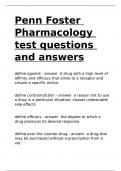
Penn Foster
Pharmacology
test questions
and answers
define agonist - answer A drug with a high level of
affinity and efficacy that binds to a receptor and
casues a specific action.
define contraindiction - answer a reason not to use
a drug in a particular situation, causes undesirable
side effects
define efficacy - answer the degree to which a
drug produces its desired response.
define over the counter drug - answer a drug that
may be purchased without a prescription from a
vet
,define prescription drug - answer a drug that must
be prescribed by a vet and taken while under the
supervision of a vet
define receptor - answer a molecule located on a
cell that binds with drugs or neurotransmitters to
cause an effect
define therapeutic index - answer the relationship
between a drug's ability to achieve the desired
effect compared to its tendency to produce toxic
effects. Expressed as a ration between the LD and
the ED. LD/ED 50% of the time.
define withdrawal time - answer the amount of
time that must elapse between the end of drug
therapy and the elimination of that drug from the
patients tissue or products.
define veterinarian client patient relationship -
answer the relationship that must exist between
the veterinarians, hris or her patient and the
patient's owner before prescription drugs may be
dispensed
,List four sources of drugs used in veterinary
medicine - answer animal products, plant
products, minerals, and synthetic products
what are four components of a drug regimen -
answer includes the dose, the route of
administration, the frequency of administration,
and the duration of administration
discuss the conditions that must be met before a
valid veterinarian-client-patient relationship can be
shown to exist. - answer 1. the vet must assume
responsibility for making clinical judgements in
relation to the health of the animal. 2. the vet must
have recently seen the animal and be acquainted
with its care and 3. the vet must be available for
follow up care of the animal.
discuss the responsibilities of a veterinary
technician in the administration of drug orders. -
answer carry out orders correctly, read the drug
label 3x to ensure that the proper drug is being
adminstered and take care to administer the
correct dose by the correct route. be aware of
, posibble side effects and monitor patient in a
responsible way.
Describe the sequense of events that a drug
undergoes from administration to excretion. -
answer a drug is first absorbed or directly placed
into the bloodstream. In the blood, the drug may
bind with a plasma protein or exist in the free
state. The circulating blood distributes the drug to
the capillary level, where the drug leaves the
circulation and enters the interstitial fluid. The
interstitial fluid bathes the cell or bind with surface
receptors. The drug then exits the cell or its
surface, moves back to interstitial fluid, reenters
circulation and then is metabolized in the liver and
sent to the kidneys for excretion.
List 11 possible routes for administering a drug and
discuss the advatages and/or disadvantages of
each. - answer 1. oral route 2. SQ 3.IM 4. IV 5. IP 6.
IA, intraarterial 7. IC, intracardiac 8. IM,
intramedullary 9. Inhalation 10. topical 11.
intradermal
List some of the factors that influence drug
absorption - answer 1. method of absorbtion, 2.
Pharmacology
test questions
and answers
define agonist - answer A drug with a high level of
affinity and efficacy that binds to a receptor and
casues a specific action.
define contraindiction - answer a reason not to use
a drug in a particular situation, causes undesirable
side effects
define efficacy - answer the degree to which a
drug produces its desired response.
define over the counter drug - answer a drug that
may be purchased without a prescription from a
vet
,define prescription drug - answer a drug that must
be prescribed by a vet and taken while under the
supervision of a vet
define receptor - answer a molecule located on a
cell that binds with drugs or neurotransmitters to
cause an effect
define therapeutic index - answer the relationship
between a drug's ability to achieve the desired
effect compared to its tendency to produce toxic
effects. Expressed as a ration between the LD and
the ED. LD/ED 50% of the time.
define withdrawal time - answer the amount of
time that must elapse between the end of drug
therapy and the elimination of that drug from the
patients tissue or products.
define veterinarian client patient relationship -
answer the relationship that must exist between
the veterinarians, hris or her patient and the
patient's owner before prescription drugs may be
dispensed
,List four sources of drugs used in veterinary
medicine - answer animal products, plant
products, minerals, and synthetic products
what are four components of a drug regimen -
answer includes the dose, the route of
administration, the frequency of administration,
and the duration of administration
discuss the conditions that must be met before a
valid veterinarian-client-patient relationship can be
shown to exist. - answer 1. the vet must assume
responsibility for making clinical judgements in
relation to the health of the animal. 2. the vet must
have recently seen the animal and be acquainted
with its care and 3. the vet must be available for
follow up care of the animal.
discuss the responsibilities of a veterinary
technician in the administration of drug orders. -
answer carry out orders correctly, read the drug
label 3x to ensure that the proper drug is being
adminstered and take care to administer the
correct dose by the correct route. be aware of
, posibble side effects and monitor patient in a
responsible way.
Describe the sequense of events that a drug
undergoes from administration to excretion. -
answer a drug is first absorbed or directly placed
into the bloodstream. In the blood, the drug may
bind with a plasma protein or exist in the free
state. The circulating blood distributes the drug to
the capillary level, where the drug leaves the
circulation and enters the interstitial fluid. The
interstitial fluid bathes the cell or bind with surface
receptors. The drug then exits the cell or its
surface, moves back to interstitial fluid, reenters
circulation and then is metabolized in the liver and
sent to the kidneys for excretion.
List 11 possible routes for administering a drug and
discuss the advatages and/or disadvantages of
each. - answer 1. oral route 2. SQ 3.IM 4. IV 5. IP 6.
IA, intraarterial 7. IC, intracardiac 8. IM,
intramedullary 9. Inhalation 10. topical 11.
intradermal
List some of the factors that influence drug
absorption - answer 1. method of absorbtion, 2.