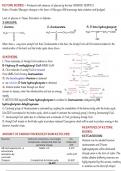
KETONE BODIES -> Produced with absence of glucose by the liver (ENERGY SUPPLY)
Ratio of Insulin/Glucagon changes in the favor of Glucagon (Will encourage beta oxidation and lipolysis).
Lack of glucose in Tissue: Starvation or diabetes
3 GROUPS:
1. Acetone 2. Acetoacetate. 3. D-beta-hydroxybutyrate
When there is way more acetyl-CoA than Oxaloacetate in the liver, the Acetyl-CoA will form ketone bodies (in the
mitochondria of the liver) and the krebs cycle slows down.
SYNTHESIS:
1. Three molecules of Acetyl-CoA combine to form
B-Hydroxy-B-methylglutaryl-CoA (HMG-CoA)
2. One molecule of acetyl-CoA is removed
from HMG-CoA forming Acetoacetate.
3. Via decarboxylation Acetone is obtained
or via reduction D-beta-hydroxybutyrate is obtained.
4. Ketone bodies travel through our blood
stream to tissues, enter the mitochondria and act as energy
supply.
5. (KETOLYSIS begins).D-beta-hydroxybutyrate is oxidised to Acetoacetate catalyzed by DB
hydroxybutyrate-dehydrogenase.
6. Carboxyl group of Acetoacetate is activated by coupling the metabolism of the ketone body with the krebs cycle
(As GDP is produced in the krebs cycle, which is used to activate the carboxyl group.), forming Acetoacetyl-CoA.
7. Acetoacetyl-CoA splits due to a thiolase and a molecule of CoA, producing Acetyl-CoA.
8. Acetyl-CoA travels to the Krebs cycle to produce reduced Coenzymes which will be used to produce energy in the
electron transfer chain.
NEGATIVES OF KETONE
BODIES:
AMOUNT OF ENERGY PRODUCED FROM KETOLYSIS:
KETOACIDOSIS:
Acetone can be exhaled however
acetoacetate and D-beta-
hydroxybutyrate will be eliminated
through urine in the form of salts. (The
bodies alkaline buffering reserves are
highly impaired by this excess, resulting
in acidosis as the blood ph drops)
Ratio of Insulin/Glucagon changes in the favor of Glucagon (Will encourage beta oxidation and lipolysis).
Lack of glucose in Tissue: Starvation or diabetes
3 GROUPS:
1. Acetone 2. Acetoacetate. 3. D-beta-hydroxybutyrate
When there is way more acetyl-CoA than Oxaloacetate in the liver, the Acetyl-CoA will form ketone bodies (in the
mitochondria of the liver) and the krebs cycle slows down.
SYNTHESIS:
1. Three molecules of Acetyl-CoA combine to form
B-Hydroxy-B-methylglutaryl-CoA (HMG-CoA)
2. One molecule of acetyl-CoA is removed
from HMG-CoA forming Acetoacetate.
3. Via decarboxylation Acetone is obtained
or via reduction D-beta-hydroxybutyrate is obtained.
4. Ketone bodies travel through our blood
stream to tissues, enter the mitochondria and act as energy
supply.
5. (KETOLYSIS begins).D-beta-hydroxybutyrate is oxidised to Acetoacetate catalyzed by DB
hydroxybutyrate-dehydrogenase.
6. Carboxyl group of Acetoacetate is activated by coupling the metabolism of the ketone body with the krebs cycle
(As GDP is produced in the krebs cycle, which is used to activate the carboxyl group.), forming Acetoacetyl-CoA.
7. Acetoacetyl-CoA splits due to a thiolase and a molecule of CoA, producing Acetyl-CoA.
8. Acetyl-CoA travels to the Krebs cycle to produce reduced Coenzymes which will be used to produce energy in the
electron transfer chain.
NEGATIVES OF KETONE
BODIES:
AMOUNT OF ENERGY PRODUCED FROM KETOLYSIS:
KETOACIDOSIS:
Acetone can be exhaled however
acetoacetate and D-beta-
hydroxybutyrate will be eliminated
through urine in the form of salts. (The
bodies alkaline buffering reserves are
highly impaired by this excess, resulting
in acidosis as the blood ph drops)