TEST BANK FOR MEDICAL SURGICAL NURSING 7TH EDITION BY LINTON
MATTESON(ALL CHAPTERS 1-63/COMPLETE ANSWERS)
,Table of Contents
Chapter 01: Aspects Of Medical-Surgical Nursing ....................................................................................... 4
Chapter 02: Medical-Surgical Practice Settings ........................................................................................... 9
Chapter 03: Medical-Surgical Patients: Individuals, Families, And Communities.................................... 23
Chapter 04: Health, Illness, Stress, And Coping ........................................................................................ 37
Chapter 05: Immunity, Inflammation, And Infection: .............................................................................. 60
Chapter 06: Fluid, Electrolyte, And Acid–Base Imbalance ........................................................................ 75
Chapter 07: The Patient With Cancer ........................................................................................................ 89
Chapter 08: Pain ....................................................................................................................................... 105
Chapter 09: Shock..................................................................................................................................... 119
Chapter 10: The Older Adult Patient ....................................................................................................... 129
Chapter 11: Falls ....................................................................................................................................... 139
Chapter 12: Immobility ............................................................................................................................ 154
Chapter 13: Delirium And Dementia ....................................................................................................... 169
Chapter 14: Incontinence ......................................................................................................................... 183
Chapter 15: Nutrition ............................................................................................................................... 197
Chapter 16: Intravenous Therapy ............................................................................................................ 204
Chapter 17: Surgery .................................................................................................................................. 218
Chapter 18: The Patient With An Ostomy ............................................................................................... 232
Chapter 19: Palliative And Hospice CARE ................................................................................................ 246
Chapter 20: Complementary And Alternative Therapies ....................................................................... 260
Chapter 21: Neurologic System Introduction .......................................................................................... 265
Chapter 22: Neurologic Disorders............................................................................................................ 273
Chapter 23: Cerebrovascular Accident .................................................................................................... 281
Chapter 24: Spinal Cord Injury ................................................................................................................. 297
Chapter 25: Respiratory System Introduction......................................................................................... 310
Chapter 26: Upper Respiratory Disorders ............................................................................................... 328
Chapter 27: Acute Lower Respiratory Tract Disorders............................................................................ 335
Chapter 28: Chronic Lower Respiratory Tract Disorders......................................................................... 339
Chapter 29: Hematologic System Introduction ....................................................................................... 352
Chapter 30: Hematologic Disorders ......................................................................................................... 359
Chapter 31: Immunologic System Introduction ...................................................................................... 366
Chapter 32: Immunologic Disorders ........................................................................................................ 373
,Chapter 33: Cardiovascular System Introduction ................................................................................... 391
Chapter 34: Cardiac Disorders ................................................................................................................. 415
Chapter 35: Vascular Disorders................................................................................................................ 420
Chapter 36: Hypertension ........................................................................................................................ 427
Chapter 37: Digestive System Introduction............................................................................................. 442
Chapter 38: Upper Digestive Tract Disorders .......................................................................................... 449
Chapter 39: Lower Digestive Tract Disorders .......................................................................................... 455
Chapter 40: Liver, Gallbladder, And Pancreatic Disorders ...................................................................... 462
Chapter 41: Urologic System Introduction .............................................................................................. 475
Chapter 42: Urologic Disorders ................................................................................................................ 481
Chapter 43: Musculoskeletal System Introduction ................................................................................. 491
Chapter 44: Connective Tissue Disorders ................................................................................................ 495
Chapter 45: Fractures ............................................................................................................................... 507
Chapter 46: Amputations ......................................................................................................................... 522
Chapter 47: Endocrine System Introduction ........................................................................................... 536
Chapter 48: Pituitary And Adrenal Disorders .......................................................................................... 540
Chapter 49: Thyroid And Parathyroid Disorders ..................................................................................... 551
Chapter 50: Diabetes And Hypoglycemia ................................................................................................ 562
Chapter 51: Female Reproductive System Introduction ......................................................................... 577
Chapter 52: Female Reproductive Disorders........................................................................................... 581
Chapter 53: Male Reproductive System Introduction ............................................................................ 589
Chapter 54: Male Reproductive Disorders .............................................................................................. 595
Chapter 55: Sexually Transmitted Infections .......................................................................................... 602
Chapter 56: Integumentary System Introduction ................................................................................... 615
Chapter 57: Skin Disorders ....................................................................................................................... 620
Chapter 58: Special Senses Introduction ................................................................................................. 629
Chapter 59: Eye And Vision Disorders ..................................................................................................... 647
Chapter 60: Ear And Hearing Disorders ................................................................................................... 652
Chapter 61: Psychobiological Disorders .................................................................................................. 657
Chapter 62: Substance Abuse .................................................................................................................. 670
Chapter 63: First Aid, Emergency CARE, And Disaster Management ..................................................... 683
,Medical Surgical Nursing 7th Edition By Linton Test Bank
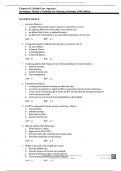
Chapter 01: Aspects Of Medical-Surgical Nursing
MULTIPLE CHOICE
1. What Provides Direction For Individualized CARE And Assures The Delivery Of Accurate, Safe
CARE Through A Definitive Pathway That Promotes The Client’s And The Support Persons’ Progress
Toward Positive Outcomes?
A. Physician’s Orders
B. Progress Notes
C. Nursing CARE Plan
D. Client Health History
ANSWER: C
The Nursing CARE Plan Provides Direction For Individualized CARE And Assures The Delivery Of Accurate,
Safe CARE Through A Definitive Pathway That Promotes The Client’s And The Support Persons’ Progress
Toward Positive Outcomes.
DIF: Cognitive Level: Comprehension REF: P. 2 OBJ: 1
TOP: Nursing CARE Plan KEY: Nursing Process Step: Planning MSC: NCLEX: Physiological Integrity:
Reduction Of Risk
2. The NURSE Is Performing Behaviors And Actions That Assist Clients And Significant Others In
Meeting Their Needs And The Identified Outcomes Of The Plan Of CARE. What Is The Correct Term For
These Nursing Behaviors?
A. Assessments
B. Interventions
C. Planning
D. Evaluation
ANSWER: B
,Caring Interventions Are Those Nursing Behaviors And Actions That Assist Clients And Significant Others
In Meeting Their Needs And The Identified Outcomes Of The Plan Of CARE.
DIF: Cognitive Level: ComprehensionREF: P. 3 OBJ: 1
TOP: Interventions KEY: Nursing Process Step: Planning MSC: NCLEX: Physiological Integrity:
Reduction Of Risk
3. The NURSE Understands The Importance Of Being Answerable For All Actions And The
Possibility Of Being Called On To Explain Or Justify Them. What Term Best Describes This Concept?
A. Reliability
B. Maturity
C. Accountability
D. Liability
ANSWER: C
Accountability Means That A Person Is Answerable For His Or Her Actions And May Be Called On To
Explain Or Justify Them.
DIF: Cognitive Level: ComprehensionREF: Pp. 6-7 OBJ: 3 | 5 | 7
TOP: Accountability KEY: Nursing Process Step: N/A MSC: NCLEX: Physiological Integrity: Reduction
Of Risk
MULTIPLE RESPONSE
1. The NURSE Manager Is Providing An Inservice About Conflict Resolution. What Modes Of
Conflict Resolution Should Be Addressed? (Select All That Apply.)
A. Suppression
B. Accommodation
C. Compromise
D. Avoidance
,E. Collaboration
F. Competition
ANSWER: B, C, D, E, F
The Modes Of Conflict Resolution Include Accommodation, Collaboration, Compromise, Avoidance, And
Competition.
DIF: Cognitive Level: Knowledge REF: P. 7|P. 8|Table 1.1
OBJ: 7 TOP: Conflict Resolution KEY: Nursing Process Step: N/A
MSC: NCLEX: N/A
2. What Are The Characteristics Of An Effective Leader? (Select All That Apply.)
A. Effective Communication
B. Rigid Rules And Regulations
C. Delegates Appropriately
D. Acts As A Role Model
E. Consistently Handles Conflict
F. Focuses On Individual Development
ANSWER: A, C, D, E
Characteristics Of An Effective Leader Include Effective Communication, Consistency In Managing
Conflict, Knowledge And Competency In All Aspects Of Delivery Of CARE, Effective Role Model For Staff,
Uses Participatory Approach In Decision Making, Shows Appreciation For A Job Well Done, Delegates
Work Appropriately, Sets Objectives And Guides Staff, Displays Caring, Understanding, And Empathy For
Others, Motivates And Empowers Others, Is Proactive And Flexible, And Focuses On Team Development.
DIF: Cognitive Level: ComprehensionREF: P. 6 OBJ: 5
TOP: Leadership KEY: Nursing Process Step: N/A MSC: NCLEX: N/A
COMPLETION
1. Is Defined As The Process By Which Information Is Exchanged Between Individuals
Verbally, Nonverbally, And/Or In Writing Or Through Information Technology.
,ANSWER:
Communication
Communication Is Defined As The Process By Which Information Is Exchanged Between Individuals
Verbally, Nonverbally, And/Or In Writing Or Through Information Technology.
DIF: Cognitive Level: Knowledge REF: P. 2 OBJ: 2 TOP: Communication KEY: Nursing
Process Step: N/A MSC: NCLEX: N/A
2. Is The Collection And Processing Of Relevant Data For The Purpose Of Appraising The
Client’s Health Status.
ANSWER:
Assessment
Assessment Is The Collection And Processing Of Relevant Data For The Purpose Of Appraising The
Client’s Health Status.
DIF: Cognitive Level: Knowledge REF: P. 2 OBJ: 1 | 2
TOP: Assessment KEY: Nursing Process Step: N/A MSC: NCLEX: N/A
3. Is Concerned With The Ethical Questions That Arise In The Context Of Health CARE.
ANSWER:
Bioethics
Bioethics Is Concerned With The Ethical Questions That Arise In The Context Of Health CARE.
DIF: Cognitive Level: Knowledge REF: P. 4 OBJ: 3
TOP: Bioethics KEY: Nursing Process Step: N/A MSC: NCLEX: N/A
,4. Place The Corresponding Letter To Each Stage Of Conflict In The Correct Order. (Place The
Events In The Appropriate Sequence With Capital Letters. Do Not Separate Answers With A Space Or
Punctuation. Example: ABCD.)
A. Outcomes
B. Conceptualization
C. Frustration
D. Action
ANSWER:
CBDA
The Stages Of Conflict In Order Are Frustration, Conceptualization, Action, And Outcomes.
DIF: Cognitive Level: ComprehensionREF: P. 7 OBJ: 7
TOP: Conflict KEY: Nursing Process Step: N/A MSC: NCLEX: N/A
5. Place The Corresponding Letter To Each Key Step In Solving An Ethical Dilemma In The Correct
Order. (Place The Events In The Appropriate Sequence. Do Not Separate Answers With A Space Or
Punctuation. Example: ABCD.)
A. Negotiate A Plan.
B. Clarify Values.
C. Ask If It Is An Ethical Dilemma.
D. Verbalize The Problem.
E. Gather Information.
F. Identify Possible Courses Of Action.
G. Evaluate The Plan Over Time.
ANSWER:
, CEBDFAG
The Key Step Of Solving An Ethical Dilemma In Order Are Ask The Question, Is It An Ethical Dilemma,
Gather Information, Clarify Values, Verbalize The Problem, Identify Possible Course Of Action, Negotiate
A Plan, And Evaluate The Plan Over Time.
DIF: Cognitive Level: Analysis REF: P. 4 OBJ: 3 TOP: Ethical Dilemma KEY: Nursing
Process Step: N/A MSC: NCLEX: N/A
Chapter 02: Medical-Surgical Practice Settings
MULTIPLE CHOICE
1. While A Home Health NURSE Is Making The Entry To A Service Assessment On A Homebound
Patient, The Spouse Of The Patient Asks Whether MediCARE Will Cover The Patient’s Ventilator Therapy
And Insulin Injections. What Is The Best Response By The NURSE?
A. “Yes, MediCARE Will Cover Both The Ventilator Therapy And The Insulin Injections.”
B. “No, MediCARE Will Not Cover Either Of These Ongoing Therapies.”
C. “MediCARE Will Cover The Ventilator Therapy, But It Does Not Cover The Insulin Injections.”
D. “MediCARE Will Cover The Ongoing Insulin Therapy, But It Does Not Cover A Highly Technical
Skill Such As Ventilator Therapy.”
ANSWER: C
MediCARE Will Cover Skilled Nursing Tasks Such As Ventilator Therapy, But Common Tasks That Can Be
Taught To The Family Or The Patient Are Not Covered.
DIF: Cognitive Level: Application REF: Pp. 12-13 OBJ: 3 | 4 TOP: MediCARE Coverage For Home
Health
KEY: Nursing Process Step: Implementation
MSC: NCLEX: Safe, Effective CARE Environment: Coordinated CARE
MATTESON(ALL CHAPTERS 1-63/COMPLETE ANSWERS)
,Table of Contents
Chapter 01: Aspects Of Medical-Surgical Nursing ....................................................................................... 4
Chapter 02: Medical-Surgical Practice Settings ........................................................................................... 9
Chapter 03: Medical-Surgical Patients: Individuals, Families, And Communities.................................... 23
Chapter 04: Health, Illness, Stress, And Coping ........................................................................................ 37
Chapter 05: Immunity, Inflammation, And Infection: .............................................................................. 60
Chapter 06: Fluid, Electrolyte, And Acid–Base Imbalance ........................................................................ 75
Chapter 07: The Patient With Cancer ........................................................................................................ 89
Chapter 08: Pain ....................................................................................................................................... 105
Chapter 09: Shock..................................................................................................................................... 119
Chapter 10: The Older Adult Patient ....................................................................................................... 129
Chapter 11: Falls ....................................................................................................................................... 139
Chapter 12: Immobility ............................................................................................................................ 154
Chapter 13: Delirium And Dementia ....................................................................................................... 169
Chapter 14: Incontinence ......................................................................................................................... 183
Chapter 15: Nutrition ............................................................................................................................... 197
Chapter 16: Intravenous Therapy ............................................................................................................ 204
Chapter 17: Surgery .................................................................................................................................. 218
Chapter 18: The Patient With An Ostomy ............................................................................................... 232
Chapter 19: Palliative And Hospice CARE ................................................................................................ 246
Chapter 20: Complementary And Alternative Therapies ....................................................................... 260
Chapter 21: Neurologic System Introduction .......................................................................................... 265
Chapter 22: Neurologic Disorders............................................................................................................ 273
Chapter 23: Cerebrovascular Accident .................................................................................................... 281
Chapter 24: Spinal Cord Injury ................................................................................................................. 297
Chapter 25: Respiratory System Introduction......................................................................................... 310
Chapter 26: Upper Respiratory Disorders ............................................................................................... 328
Chapter 27: Acute Lower Respiratory Tract Disorders............................................................................ 335
Chapter 28: Chronic Lower Respiratory Tract Disorders......................................................................... 339
Chapter 29: Hematologic System Introduction ....................................................................................... 352
Chapter 30: Hematologic Disorders ......................................................................................................... 359
Chapter 31: Immunologic System Introduction ...................................................................................... 366
Chapter 32: Immunologic Disorders ........................................................................................................ 373
,Chapter 33: Cardiovascular System Introduction ................................................................................... 391
Chapter 34: Cardiac Disorders ................................................................................................................. 415
Chapter 35: Vascular Disorders................................................................................................................ 420
Chapter 36: Hypertension ........................................................................................................................ 427
Chapter 37: Digestive System Introduction............................................................................................. 442
Chapter 38: Upper Digestive Tract Disorders .......................................................................................... 449
Chapter 39: Lower Digestive Tract Disorders .......................................................................................... 455
Chapter 40: Liver, Gallbladder, And Pancreatic Disorders ...................................................................... 462
Chapter 41: Urologic System Introduction .............................................................................................. 475
Chapter 42: Urologic Disorders ................................................................................................................ 481
Chapter 43: Musculoskeletal System Introduction ................................................................................. 491
Chapter 44: Connective Tissue Disorders ................................................................................................ 495
Chapter 45: Fractures ............................................................................................................................... 507
Chapter 46: Amputations ......................................................................................................................... 522
Chapter 47: Endocrine System Introduction ........................................................................................... 536
Chapter 48: Pituitary And Adrenal Disorders .......................................................................................... 540
Chapter 49: Thyroid And Parathyroid Disorders ..................................................................................... 551
Chapter 50: Diabetes And Hypoglycemia ................................................................................................ 562
Chapter 51: Female Reproductive System Introduction ......................................................................... 577
Chapter 52: Female Reproductive Disorders........................................................................................... 581
Chapter 53: Male Reproductive System Introduction ............................................................................ 589
Chapter 54: Male Reproductive Disorders .............................................................................................. 595
Chapter 55: Sexually Transmitted Infections .......................................................................................... 602
Chapter 56: Integumentary System Introduction ................................................................................... 615
Chapter 57: Skin Disorders ....................................................................................................................... 620
Chapter 58: Special Senses Introduction ................................................................................................. 629
Chapter 59: Eye And Vision Disorders ..................................................................................................... 647
Chapter 60: Ear And Hearing Disorders ................................................................................................... 652
Chapter 61: Psychobiological Disorders .................................................................................................. 657
Chapter 62: Substance Abuse .................................................................................................................. 670
Chapter 63: First Aid, Emergency CARE, And Disaster Management ..................................................... 683
,Medical Surgical Nursing 7th Edition By Linton Test Bank
Chapter 01: Aspects Of Medical-Surgical Nursing
MULTIPLE CHOICE
1. What Provides Direction For Individualized CARE And Assures The Delivery Of Accurate, Safe
CARE Through A Definitive Pathway That Promotes The Client’s And The Support Persons’ Progress
Toward Positive Outcomes?
A. Physician’s Orders
B. Progress Notes
C. Nursing CARE Plan
D. Client Health History
ANSWER: C
The Nursing CARE Plan Provides Direction For Individualized CARE And Assures The Delivery Of Accurate,
Safe CARE Through A Definitive Pathway That Promotes The Client’s And The Support Persons’ Progress
Toward Positive Outcomes.
DIF: Cognitive Level: Comprehension REF: P. 2 OBJ: 1
TOP: Nursing CARE Plan KEY: Nursing Process Step: Planning MSC: NCLEX: Physiological Integrity:
Reduction Of Risk
2. The NURSE Is Performing Behaviors And Actions That Assist Clients And Significant Others In
Meeting Their Needs And The Identified Outcomes Of The Plan Of CARE. What Is The Correct Term For
These Nursing Behaviors?
A. Assessments
B. Interventions
C. Planning
D. Evaluation
ANSWER: B
,Caring Interventions Are Those Nursing Behaviors And Actions That Assist Clients And Significant Others
In Meeting Their Needs And The Identified Outcomes Of The Plan Of CARE.
DIF: Cognitive Level: ComprehensionREF: P. 3 OBJ: 1
TOP: Interventions KEY: Nursing Process Step: Planning MSC: NCLEX: Physiological Integrity:
Reduction Of Risk
3. The NURSE Understands The Importance Of Being Answerable For All Actions And The
Possibility Of Being Called On To Explain Or Justify Them. What Term Best Describes This Concept?
A. Reliability
B. Maturity
C. Accountability
D. Liability
ANSWER: C
Accountability Means That A Person Is Answerable For His Or Her Actions And May Be Called On To
Explain Or Justify Them.
DIF: Cognitive Level: ComprehensionREF: Pp. 6-7 OBJ: 3 | 5 | 7
TOP: Accountability KEY: Nursing Process Step: N/A MSC: NCLEX: Physiological Integrity: Reduction
Of Risk
MULTIPLE RESPONSE
1. The NURSE Manager Is Providing An Inservice About Conflict Resolution. What Modes Of
Conflict Resolution Should Be Addressed? (Select All That Apply.)
A. Suppression
B. Accommodation
C. Compromise
D. Avoidance
,E. Collaboration
F. Competition
ANSWER: B, C, D, E, F
The Modes Of Conflict Resolution Include Accommodation, Collaboration, Compromise, Avoidance, And
Competition.
DIF: Cognitive Level: Knowledge REF: P. 7|P. 8|Table 1.1
OBJ: 7 TOP: Conflict Resolution KEY: Nursing Process Step: N/A
MSC: NCLEX: N/A
2. What Are The Characteristics Of An Effective Leader? (Select All That Apply.)
A. Effective Communication
B. Rigid Rules And Regulations
C. Delegates Appropriately
D. Acts As A Role Model
E. Consistently Handles Conflict
F. Focuses On Individual Development
ANSWER: A, C, D, E
Characteristics Of An Effective Leader Include Effective Communication, Consistency In Managing
Conflict, Knowledge And Competency In All Aspects Of Delivery Of CARE, Effective Role Model For Staff,
Uses Participatory Approach In Decision Making, Shows Appreciation For A Job Well Done, Delegates
Work Appropriately, Sets Objectives And Guides Staff, Displays Caring, Understanding, And Empathy For
Others, Motivates And Empowers Others, Is Proactive And Flexible, And Focuses On Team Development.
DIF: Cognitive Level: ComprehensionREF: P. 6 OBJ: 5
TOP: Leadership KEY: Nursing Process Step: N/A MSC: NCLEX: N/A
COMPLETION
1. Is Defined As The Process By Which Information Is Exchanged Between Individuals
Verbally, Nonverbally, And/Or In Writing Or Through Information Technology.
,ANSWER:
Communication
Communication Is Defined As The Process By Which Information Is Exchanged Between Individuals
Verbally, Nonverbally, And/Or In Writing Or Through Information Technology.
DIF: Cognitive Level: Knowledge REF: P. 2 OBJ: 2 TOP: Communication KEY: Nursing
Process Step: N/A MSC: NCLEX: N/A
2. Is The Collection And Processing Of Relevant Data For The Purpose Of Appraising The
Client’s Health Status.
ANSWER:
Assessment
Assessment Is The Collection And Processing Of Relevant Data For The Purpose Of Appraising The
Client’s Health Status.
DIF: Cognitive Level: Knowledge REF: P. 2 OBJ: 1 | 2
TOP: Assessment KEY: Nursing Process Step: N/A MSC: NCLEX: N/A
3. Is Concerned With The Ethical Questions That Arise In The Context Of Health CARE.
ANSWER:
Bioethics
Bioethics Is Concerned With The Ethical Questions That Arise In The Context Of Health CARE.
DIF: Cognitive Level: Knowledge REF: P. 4 OBJ: 3
TOP: Bioethics KEY: Nursing Process Step: N/A MSC: NCLEX: N/A
,4. Place The Corresponding Letter To Each Stage Of Conflict In The Correct Order. (Place The
Events In The Appropriate Sequence With Capital Letters. Do Not Separate Answers With A Space Or
Punctuation. Example: ABCD.)
A. Outcomes
B. Conceptualization
C. Frustration
D. Action
ANSWER:
CBDA
The Stages Of Conflict In Order Are Frustration, Conceptualization, Action, And Outcomes.
DIF: Cognitive Level: ComprehensionREF: P. 7 OBJ: 7
TOP: Conflict KEY: Nursing Process Step: N/A MSC: NCLEX: N/A
5. Place The Corresponding Letter To Each Key Step In Solving An Ethical Dilemma In The Correct
Order. (Place The Events In The Appropriate Sequence. Do Not Separate Answers With A Space Or
Punctuation. Example: ABCD.)
A. Negotiate A Plan.
B. Clarify Values.
C. Ask If It Is An Ethical Dilemma.
D. Verbalize The Problem.
E. Gather Information.
F. Identify Possible Courses Of Action.
G. Evaluate The Plan Over Time.
ANSWER:
, CEBDFAG
The Key Step Of Solving An Ethical Dilemma In Order Are Ask The Question, Is It An Ethical Dilemma,
Gather Information, Clarify Values, Verbalize The Problem, Identify Possible Course Of Action, Negotiate
A Plan, And Evaluate The Plan Over Time.
DIF: Cognitive Level: Analysis REF: P. 4 OBJ: 3 TOP: Ethical Dilemma KEY: Nursing
Process Step: N/A MSC: NCLEX: N/A
Chapter 02: Medical-Surgical Practice Settings
MULTIPLE CHOICE
1. While A Home Health NURSE Is Making The Entry To A Service Assessment On A Homebound
Patient, The Spouse Of The Patient Asks Whether MediCARE Will Cover The Patient’s Ventilator Therapy
And Insulin Injections. What Is The Best Response By The NURSE?
A. “Yes, MediCARE Will Cover Both The Ventilator Therapy And The Insulin Injections.”
B. “No, MediCARE Will Not Cover Either Of These Ongoing Therapies.”
C. “MediCARE Will Cover The Ventilator Therapy, But It Does Not Cover The Insulin Injections.”
D. “MediCARE Will Cover The Ongoing Insulin Therapy, But It Does Not Cover A Highly Technical
Skill Such As Ventilator Therapy.”
ANSWER: C
MediCARE Will Cover Skilled Nursing Tasks Such As Ventilator Therapy, But Common Tasks That Can Be
Taught To The Family Or The Patient Are Not Covered.
DIF: Cognitive Level: Application REF: Pp. 12-13 OBJ: 3 | 4 TOP: MediCARE Coverage For Home
Health
KEY: Nursing Process Step: Implementation
MSC: NCLEX: Safe, Effective CARE Environment: Coordinated CARE