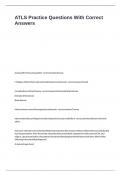
HPS111 Test With Complete Solution Encephalisation quotient - Answer quantifying the size of brain s relative to body mass to allow for comparison across species Understanding the relationship between brain and behaviour - Answer Investigate what happens when the brain is damaged (diseases or accidents) Invasive and non-invasive techniques - Answer Psychosurgery or neu roimaging Electroencephalography - Answer Recording electrodes at various l ocations on the scalp and measures electrical brain activity. Allows us to examine bra in processes and responses quickly and get a clearer picture of how they take pla ce over time When to use EEG - Answer If we wanted to see how the brain res ponds when it is repeatedly shown a particular stimulus Magnetic resonance imagining - Answer Uses magnetic fields to detect and measure different types of tissue in the brain/body. Creates a static m agnetic field, and uses pulses to measure how the hydrogen atoms respond. Can be set up to detect things such as white matter, grey matter, cerebrospinal fluid and the s kull FMRI - Answer Measures neural activity indirectly by measuring oxy genated blood versus deoxygenated blood levels within specific regions with the a ssumption that more oxygenated blood means that there's more neural activity, BOLD c ontrast. Measures which brain regions become active when people different tasks Brain positron emission tomography (PET) - Answer Involves the u se of radioactive chemicals which are injected intravenously. The radioactive materia ls bind to different molecules in the brain to provide information about how br ain processes unfold over time Transcranial magnetic stimulation - Answer Uses electromagnetic fi elds to induce current inside the brain. Used for cortical mapping studies where we can stimulate regions of the brain that represent different body parts, an d to examine psychological processes Deep brain stimulation - Answer The insertion of electrodes into the b rain. Used to treat different disorders e.g. Parkinson's disease, OCD and depression Parts of the hindbrain - Answer The medulla oblongata, the pon s, the reticular formation, the cerebellum Medulla - Answer Basic essential functions like breathing Pons - Answer REM sleep and mobility Reticular formation - Answer Sleep, wakefulness and attention. Also receives information from the body for processing Cerebellum - Answer Motor regulation, posture and balance 3 parts of mindbrain - Answer Superior colliculus: involved with aspe cts of vision and eye movements. Inferior colliculus: involved with aspects of hearin g. Tectum, tegmentum, substantia nigra: involved with movement reward and m otor control Thalamus - Answer Relay motor and sensory signals to the cerebral cortex Hypothalamus - Answer 4 F's: fighting, fleeing, feeding and mating Basal ganglia - Answer Involved with aspects of motor control, memory, e motional expression, reward Damage of basal ganglia - Answer Damage has been implicated in movemen t disorders e.g. Parkinson's disease Hippocampus - Answer Consolidates short-term memory into long-term m emory Amygdala - Answer Fear and aggression responses Sulci and gyri - Answer Parts of the cerebral cortex, increase the surface space Corpus callosum - Answer Communication between hemispheres Cerebral cortex - Answer The outer most layer of the brain, co ntains higher order abilities e.g. thinking and language Four lobes of the cortex - Answer Frontal, parietal, temporal, o ccipital Techniques used to understand the motor cortex - Answer Non- invasive brain stimulation e.g. TMS DLPFC - Answer Executive functions including problem-solving, holdin g items in working memory, engaging in deep thought, maintaining goals or r ules when performing tasks etc. Somatosensory cortex - Answer Processes incoming sensory informat ion about touch Parietal lobe - Answer Processes sensory information and interpre ts visual information Cortical blindness - Answer Unable to see/severely impaired visual fu nctioning due to damage of the occipital lobes, rather than the eyes Temporal lobe - Answer Processes auditory information and face det ection Temporal lobe damage - Answer Prosopagnosia where patients los e the ability to recognise previously familiar faces; visual agnosia Broca's area - Answer Producing articulate and fluent speech Wernicke's area - Answer Language comprehension Aphasia - Answer Broca's aphasia - impairment in the ability to produce f luent speech and wernicke's aphasia -speech is nonsensical and not meaningful Problems with a purely neurobiological approach - Answer The danger of conflating "description" with "explanation", and the danger that our current a pproach to understanding the relationship between brain and behaviour m ay be a modern expression of phrenology Types of brain cells - Answer Nerve cells called 'neurons', include sensory, motor and interneurons. Glial cells involved in providing nutrients to neurons and structural support to the nervous system Axon - Answer Myelin sheath - Answer A white fatty substance produced by sub ty pes of glial cells, insulates the electrical signal that is transmitted through the axon Nodes of ranvier - Answer Sections of the axon are unmyelinated , where the action potential occurs Synapse - Answer Where the neurons communicate, in the gap b etween the terminal buttons of the neuron and the dendrites of the next neuron 4 types of neurons - Answer 1 an unipolar neuron, has one p rojection from the cell body, which can sometimes be a dendrite or an axon depending on its function. 2. bipolar neurons, has two projections and has an important role in the visu al system. 3 multipolar neurons, many projections and most common type in the brain. 4 p seudo-unipolar neurons Grey matter - Answer Comprises of cell bodies and dendrites of neur ons White matter - Answer The myelinated axons of neurons Neuron communication as 2 steps - Answer Step A involves understan ding how electrical information is transmitted from the dendrites to the axon hillock. Step B involves the transmission of electrica l information from the axon hillock to the terminal buttons. Steps A and B comprise how infor mation is communicated within neurons. This within neuron communicati on is electrical Ion - Answer A molecule or chemical that has a charge - can be po sitive or negative
Exam (elaborations)
HPS111 Test With Complete Solution
Rating
Sold
-
Pages
30
Grade
A+
Uploaded on
02-08-2024
Written in
2024/2025
HPS111 Test With Complete Solution ...
Institution
HPS111
Course
HPS111
Whoops! We can’t load your doc right now. Try again or contact support.
Written for
- Institution
- HPS111
- Course
- HPS111
Document information
- Uploaded on
- August 2, 2024
- Number of pages
- 30
- Written in
- 2024/2025
- Type
- Exam (elaborations)
- Contains
- Questions & answers
Subjects
- encephalisation quotient
-
hps111 test with complete solution
-
understanding the relationship between brain and b
Content preview
$10.99
Get access to the full document:
100% satisfaction guarantee
Immediately available after payment
Both online and in PDF
No strings attached

Also available in package deal
Package deal
HPS111 PACKAGED EXAMS WITH COMPLETE SOLUTION
5
2024
$ 51.95
More info