Summary research methods 1
Chapter 1: psychology is a way of thinking
A research producer is someone who conducts research and writes a report about it. A
research consumer is someone who reads research reports. By understanding how to
conduct research you can become a good research producer and research consumer.
Psychological scientists are empiricists. An empiricist uses evidence from the senses or
instruments that assist the senses (thermometers, timers, surveys) as the basis for conclusions.
Empiricists should be systematic and rigorous, and their work should be independently
verifiable for others.
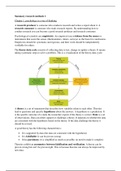
The theory-data cycle consists of collecting data to test, change or update a theory. It means
taking systematic steps to solve a problem. This is a visualisation of the theory-data cycle:
A theory is a set of statements that describes how variables relate to each other. Theories
lead to questions and specific hypotheses about the answers. A hypothesis is a prediction. It
is the specific outcome of a study the researcher expects if the theory is correct. Data is a set
of observations. Data can either support or challenge a theory. It depends on whether the data
are consistent with the hypothesis based on the theory. If the data challenge the theory it
should be revised.
A good theory has the following characteristics:
It is supported by data (the data are consistent with the hypothesis)
It is falsifiable (it can be proven wrong)
It has parsimony (it is simplified as much as possible, no need to make it complex)
Theories exhibit an asymmetry between falsification and verification. A theory can be
proven wrong but can’t be proven right. This is because theories can always be improved by
new data.
, Basic research is usually done in a controlled environment with no specific context in mind.
Translational research is the use of lessons learned from basic research, redone to come up
with a context in which the newly gathered data could be used. Applied research is done
within a specific context to test the theories/hypotheses the basic and translational research
came up with
and to solve a
specific
problem.
Research usually
leads to more
research due to
new questions.
A scientific journal consists of scientific peer-reviewed articles. Three to four experts read
and comment on the article. If the article has major flaws it won’t get published. Once the
article is published, other scientists can still comment on it by writing letters or conducting a
competing study.
Journalism has advantages and disadvantages. Journalism brings scientific research to the
general public but because some journalists aren’t well trained or because they want an eye-
catching article it isn’t always accurate. Sometimes journalists exaggerate or misinterpret the
original research.
Chapter 2: sources of information
Experience is a bad source of information. Experience has no comparison group so results
can’t be drawn from an experience in which only one value is tested. Experience is also
confounded, there are so many things going on in everyday life that it is impossible to say
what caused a change. A confound occurs when you think one thing caused an outcome but
in fact, other things changed, too, so you are confused about what the cause really was.
Research is always better than experience because it is conducted in a controlled
environment with systematic comparison.
Research is probabilistic. That means that its findings do not explain all cases all the time. It
does explain, though, a large proportion of possible cases.
Ways intuition is biased:
Being swayed by a good story (it sounds good, logical, it must be true)
Availability heuristic (things that easily pop up in our mind guide our thinking, this
causes overestimation, for example: it is more likely to die from the flu than from a
shark attack, but people will think about dying from a shark attack easier)
Present/present bias (failing to see what is absent, for example: Dr Rush only saw
the people who did receive the bloodletting treatment and did recover, but failed to
see those who didn’t receive the treatment and also recovered or those who did
receive the treatment but didn’t recover)
Confirmation bias (believing evidence only when it is consistent with our own
thoughts)
Chapter 1: psychology is a way of thinking
A research producer is someone who conducts research and writes a report about it. A
research consumer is someone who reads research reports. By understanding how to
conduct research you can become a good research producer and research consumer.
Psychological scientists are empiricists. An empiricist uses evidence from the senses or
instruments that assist the senses (thermometers, timers, surveys) as the basis for conclusions.
Empiricists should be systematic and rigorous, and their work should be independently
verifiable for others.
The theory-data cycle consists of collecting data to test, change or update a theory. It means
taking systematic steps to solve a problem. This is a visualisation of the theory-data cycle:
A theory is a set of statements that describes how variables relate to each other. Theories
lead to questions and specific hypotheses about the answers. A hypothesis is a prediction. It
is the specific outcome of a study the researcher expects if the theory is correct. Data is a set
of observations. Data can either support or challenge a theory. It depends on whether the data
are consistent with the hypothesis based on the theory. If the data challenge the theory it
should be revised.
A good theory has the following characteristics:
It is supported by data (the data are consistent with the hypothesis)
It is falsifiable (it can be proven wrong)
It has parsimony (it is simplified as much as possible, no need to make it complex)
Theories exhibit an asymmetry between falsification and verification. A theory can be
proven wrong but can’t be proven right. This is because theories can always be improved by
new data.
, Basic research is usually done in a controlled environment with no specific context in mind.
Translational research is the use of lessons learned from basic research, redone to come up
with a context in which the newly gathered data could be used. Applied research is done
within a specific context to test the theories/hypotheses the basic and translational research
came up with
and to solve a
specific
problem.
Research usually
leads to more
research due to
new questions.
A scientific journal consists of scientific peer-reviewed articles. Three to four experts read
and comment on the article. If the article has major flaws it won’t get published. Once the
article is published, other scientists can still comment on it by writing letters or conducting a
competing study.
Journalism has advantages and disadvantages. Journalism brings scientific research to the
general public but because some journalists aren’t well trained or because they want an eye-
catching article it isn’t always accurate. Sometimes journalists exaggerate or misinterpret the
original research.
Chapter 2: sources of information
Experience is a bad source of information. Experience has no comparison group so results
can’t be drawn from an experience in which only one value is tested. Experience is also
confounded, there are so many things going on in everyday life that it is impossible to say
what caused a change. A confound occurs when you think one thing caused an outcome but
in fact, other things changed, too, so you are confused about what the cause really was.
Research is always better than experience because it is conducted in a controlled
environment with systematic comparison.
Research is probabilistic. That means that its findings do not explain all cases all the time. It
does explain, though, a large proportion of possible cases.
Ways intuition is biased:
Being swayed by a good story (it sounds good, logical, it must be true)
Availability heuristic (things that easily pop up in our mind guide our thinking, this
causes overestimation, for example: it is more likely to die from the flu than from a
shark attack, but people will think about dying from a shark attack easier)
Present/present bias (failing to see what is absent, for example: Dr Rush only saw
the people who did receive the bloodletting treatment and did recover, but failed to
see those who didn’t receive the treatment and also recovered or those who did
receive the treatment but didn’t recover)
Confirmation bias (believing evidence only when it is consistent with our own
thoughts)