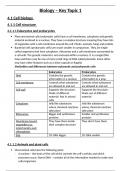
Biology – Key Topic 1
4.1 Cell biology
4.1.1 Cell structure
4.1.1.1 Eukaryotes and prokaryotes
Plant and animal cells (eukaryotic cells) have a cell membrane, cytoplasm and genetic
material enclosed in a nucleus. They have a complex structure meaning they have lots
of organelles with a cell membrane around the cell. Plants, animals, fungi and protists
Bacterial cells (prokaryotic cells) are much smaller in comparison. They are single
celled organisms that have cytoplasm, ribosomes and a cell membrane surrounded by
a cell wall. The genetic material is not enclosed within a nucleus. It is a single DNA
loop and there may be one of more small rings of DNA called plasmids. Some other
may have other features such as a slime capsule or flagella
Similarities and differences between eukaryotic and prokaryotic cells
Eukaryotes Prokaryotes
DNA Contains the genetic Contains the genetic
information in a nucleus information in a loop
Cell membrane Controls what substances Controls what substances
are allowed in and out are allowed in and out
Cell wall Supports the structure. Supports the structure.
Made of different Made out of different
material. Not in animal material
cells
Cytoplasm Jelly like substances Jelly like substances
where chemical reactions where chemical reactions
take place take place
Ribosomes Bigger and synthesises Smaller and synthesises
proteins proteins
Membrane bound They have them inside They don’t have them
organelles e.g. their complex structure
mitochondria and
chloroplasts
Size 10-100x bigger 10-100x smaller
4.1.1.2 Animals and plant cells
Most animal cells have the following parts:
- A nucleus – the brain of the cell which controls the cell’s activity and which
processes occur. Stores DNA – contains all of the information needed to make new
cells/organisms
, - A cytoplasm – where the chemical reactions take place. Contains enzymes which
control these chemical reactions
- A cell membrane – controls what passes into/out of the cell. Forms a thin
boundary between the cell cytoplasm and the outside. Semi-permeable as it only
lets some substances in
- Mitochondria – where aerobic respiration takes place
- Ribosomes – where protein synthesis occurs
In addition to the parts found in animal cells, plant cells often have:
- Chloroplasts – contains a green pigment called chlorophyll which absorbs light
energy which means that plants turn green when photosynthesis takes place
- A permanent sap vacuole filled with cell sap – provides structure and acts as a
reservoir of water, dissolved sugars, mineral ions etc
Plant and algal cells also have a cell wall made out of cellulose, which strengthens and
supports the cell. It provides the cell with structure, preventing it from bursting when
water enters. Fully permeable as it allows all substances across it
4.1.1.3 Cell specialisation
Cells may be specialised to carry out a particular function:
Nerve cells:
- function is to carry electrical signals from one part of the body to another
- they contain a very long axon which can carry the electrical impulses a very long way
before they are passed onto the next cell
- they also have myelin sheaths which thicken the cell, meaning that electrical
impulses can be transmitted across quicker
- dendrites are tree like structures at the beginning of a neuron, which helps to
increase the surface area so that the maximum amount of signals can be sent at
once. It provides loads of connections to other nerve cells
Sperm cells:
- function is to get male DNA to female DNA
- contains the nucleus in the head which helps to fertilise the egg efficiently
- it is packed with mitochondria to provide lots of energy for the cell to quickly and
efficiently reach the egg
- the acrosome stores digestive enzymes to breakdown the outer layers of the egg
- has a long tail and a streamlined head to help it swim to the egg
Muscle cells:
- contain special proteins that slide over each other making the fibres contract
- they contain many mitochondria to transfer the energy needed for the chemical
reactions that take place as the cells contract and relax
- based on a chemical that can be broken down and used in cellular respiration by the
mitochondria to transfer the energy need for the fibres to contract
Root hair cells:
4.1 Cell biology
4.1.1 Cell structure
4.1.1.1 Eukaryotes and prokaryotes
Plant and animal cells (eukaryotic cells) have a cell membrane, cytoplasm and genetic
material enclosed in a nucleus. They have a complex structure meaning they have lots
of organelles with a cell membrane around the cell. Plants, animals, fungi and protists
Bacterial cells (prokaryotic cells) are much smaller in comparison. They are single
celled organisms that have cytoplasm, ribosomes and a cell membrane surrounded by
a cell wall. The genetic material is not enclosed within a nucleus. It is a single DNA
loop and there may be one of more small rings of DNA called plasmids. Some other
may have other features such as a slime capsule or flagella
Similarities and differences between eukaryotic and prokaryotic cells
Eukaryotes Prokaryotes
DNA Contains the genetic Contains the genetic
information in a nucleus information in a loop
Cell membrane Controls what substances Controls what substances
are allowed in and out are allowed in and out
Cell wall Supports the structure. Supports the structure.
Made of different Made out of different
material. Not in animal material
cells
Cytoplasm Jelly like substances Jelly like substances
where chemical reactions where chemical reactions
take place take place
Ribosomes Bigger and synthesises Smaller and synthesises
proteins proteins
Membrane bound They have them inside They don’t have them
organelles e.g. their complex structure
mitochondria and
chloroplasts
Size 10-100x bigger 10-100x smaller
4.1.1.2 Animals and plant cells
Most animal cells have the following parts:
- A nucleus – the brain of the cell which controls the cell’s activity and which
processes occur. Stores DNA – contains all of the information needed to make new
cells/organisms
, - A cytoplasm – where the chemical reactions take place. Contains enzymes which
control these chemical reactions
- A cell membrane – controls what passes into/out of the cell. Forms a thin
boundary between the cell cytoplasm and the outside. Semi-permeable as it only
lets some substances in
- Mitochondria – where aerobic respiration takes place
- Ribosomes – where protein synthesis occurs
In addition to the parts found in animal cells, plant cells often have:
- Chloroplasts – contains a green pigment called chlorophyll which absorbs light
energy which means that plants turn green when photosynthesis takes place
- A permanent sap vacuole filled with cell sap – provides structure and acts as a
reservoir of water, dissolved sugars, mineral ions etc
Plant and algal cells also have a cell wall made out of cellulose, which strengthens and
supports the cell. It provides the cell with structure, preventing it from bursting when
water enters. Fully permeable as it allows all substances across it
4.1.1.3 Cell specialisation
Cells may be specialised to carry out a particular function:
Nerve cells:
- function is to carry electrical signals from one part of the body to another
- they contain a very long axon which can carry the electrical impulses a very long way
before they are passed onto the next cell
- they also have myelin sheaths which thicken the cell, meaning that electrical
impulses can be transmitted across quicker
- dendrites are tree like structures at the beginning of a neuron, which helps to
increase the surface area so that the maximum amount of signals can be sent at
once. It provides loads of connections to other nerve cells
Sperm cells:
- function is to get male DNA to female DNA
- contains the nucleus in the head which helps to fertilise the egg efficiently
- it is packed with mitochondria to provide lots of energy for the cell to quickly and
efficiently reach the egg
- the acrosome stores digestive enzymes to breakdown the outer layers of the egg
- has a long tail and a streamlined head to help it swim to the egg
Muscle cells:
- contain special proteins that slide over each other making the fibres contract
- they contain many mitochondria to transfer the energy needed for the chemical
reactions that take place as the cells contract and relax
- based on a chemical that can be broken down and used in cellular respiration by the
mitochondria to transfer the energy need for the fibres to contract
Root hair cells: