Biology – Key Topic 2
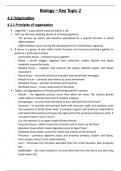
4.2 Organisation
4.2.1 Principles of organisation
Organelle – a specialised structure within a cell
Cells are the basic building blocks of all living organisms.
- The process by which cells become specialised for a specific function is called
differentiation
- Differentiation occurs during the development of a multicellular organism.
A tissue is a group of cells withs similar function and structure working together to
perform a particular function
- Connective tissue – connects tissue together
- Blood – carries oxygen, digested food molecules, carbon dioxide and waste
materials around the body
- Skeletal tissue – supports and protects the body’s delicate organs and allows
movement
- Nerve tissue – transmits electrical impulses and coordinates messages
- Muscle tissue – contracts and relaxes to cause movement
- Glandular tissue – secretes hormones and enzymes
- Epithelial tissue – covers many parts of the body
Organs are aggregations of tissues performing specific functions
- Mouth – the digestive process starts here when we chew. The salivary glands
make saliva to moisten food and it contains amylase.
- Oesophagus – to carry food and liquid to your stomach from the mouth
- Stomach – to contract and pummel food with muscular walls, and produce acids
and enzymes to break down food. It produces pepsin and produces hydrochloric
acid which kills bacteria and gives the right pH for the protease enzyme to work. It
can store food for up to 3 hours
e.g. the stomach is an organ made of these tissues:
muscular tissue – which moves the stomach wall to churn up the food
glandular tissue which makes digestive juices to digest food
epithelial tissue which covers the inside and outside of the stomach
- Pancreas – produces digestive juices and enzymes amylase, trypsin and lipase,
then releases these to the small intestine
- Liver – processes the nutrients absorbed from the small intestine. Also produces
bile
- Gallbladder – the main function is to store bile from the liver but it can also help
break down fats
, - Small intestine – the muscles mix food with digestive juices from the pancreas,
liver and intestine. The walls absorb water and digested nutrients into the
bloodstream. Produces amylase, protease and lipase to complete digestion
- Large intestine – it absorbs excess water from food and changes the waste from
liquid into stool
- Rectum – where the faeces are stored before they leave through the anus
Organs are organised into organ systems, which work together to form organisms
- Circulatory system – to transport substances around the body
- Reproductive system – to produce the next generation
- Excretory system – to remove waste made by the body
- Respiratory system – to obtain oxygen and remove carbon dioxide
- Digestive system – to break down food into small molecules and take them into
the blood
e.g. the digestive system is made up of these organs:
glands which produce digestive juices
stomach and small intestine which digest food
liver which produces bile
small intestine which absorbs the soluble food molecules
large intestine which absorbs water from undigested food, leaving faeces
- Skeletal/muscular system – to support the body and allow movement
- Nervous system – to control responses to changes in the surroundings
4.2.2 Animal tissues, organs and organ systems
4.2.2.1 The human digestive system
The digestive system is an example of an organ system in which several organs work
together to digest and absorb food
- It is adapted to its function by having a large surface area, shorter diffusion
distance and maintaining a steep concentration gradient
Enzymes are biological catalysts that catalyse specific reactions in living organisms
due to the shape of their active site
- They are all large proteins made up of chains of amino acids. These chains are
folded up into unique shapes, which enzymes need to do their job
- Enzymes have gaps called active sites. The substrate has a complementary
shape that will fit exactly into the gap – substrate-enzyme complex – lock and
key theory. If it doesn’t fit, the reaction wont be catalysed. “induced fit” in
reality the active site changes a little bit to get a tighter fit on the substrate
- Different enzymes have different 3D shapes and the substrates have different
shapes too. This means that the enzymes can only work on a specific substance
Factors that affect enzyme activity:
- pH affects the enzyme. Different enzymes work best at different pHs which is
their optimum pH. Both increases and decreases in pH will result in a reduced
4.2 Organisation
4.2.1 Principles of organisation
Organelle – a specialised structure within a cell
Cells are the basic building blocks of all living organisms.
- The process by which cells become specialised for a specific function is called
differentiation
- Differentiation occurs during the development of a multicellular organism.
A tissue is a group of cells withs similar function and structure working together to
perform a particular function
- Connective tissue – connects tissue together
- Blood – carries oxygen, digested food molecules, carbon dioxide and waste
materials around the body
- Skeletal tissue – supports and protects the body’s delicate organs and allows
movement
- Nerve tissue – transmits electrical impulses and coordinates messages
- Muscle tissue – contracts and relaxes to cause movement
- Glandular tissue – secretes hormones and enzymes
- Epithelial tissue – covers many parts of the body
Organs are aggregations of tissues performing specific functions
- Mouth – the digestive process starts here when we chew. The salivary glands
make saliva to moisten food and it contains amylase.
- Oesophagus – to carry food and liquid to your stomach from the mouth
- Stomach – to contract and pummel food with muscular walls, and produce acids
and enzymes to break down food. It produces pepsin and produces hydrochloric
acid which kills bacteria and gives the right pH for the protease enzyme to work. It
can store food for up to 3 hours
e.g. the stomach is an organ made of these tissues:
muscular tissue – which moves the stomach wall to churn up the food
glandular tissue which makes digestive juices to digest food
epithelial tissue which covers the inside and outside of the stomach
- Pancreas – produces digestive juices and enzymes amylase, trypsin and lipase,
then releases these to the small intestine
- Liver – processes the nutrients absorbed from the small intestine. Also produces
bile
- Gallbladder – the main function is to store bile from the liver but it can also help
break down fats
, - Small intestine – the muscles mix food with digestive juices from the pancreas,
liver and intestine. The walls absorb water and digested nutrients into the
bloodstream. Produces amylase, protease and lipase to complete digestion
- Large intestine – it absorbs excess water from food and changes the waste from
liquid into stool
- Rectum – where the faeces are stored before they leave through the anus
Organs are organised into organ systems, which work together to form organisms
- Circulatory system – to transport substances around the body
- Reproductive system – to produce the next generation
- Excretory system – to remove waste made by the body
- Respiratory system – to obtain oxygen and remove carbon dioxide
- Digestive system – to break down food into small molecules and take them into
the blood
e.g. the digestive system is made up of these organs:
glands which produce digestive juices
stomach and small intestine which digest food
liver which produces bile
small intestine which absorbs the soluble food molecules
large intestine which absorbs water from undigested food, leaving faeces
- Skeletal/muscular system – to support the body and allow movement
- Nervous system – to control responses to changes in the surroundings
4.2.2 Animal tissues, organs and organ systems
4.2.2.1 The human digestive system
The digestive system is an example of an organ system in which several organs work
together to digest and absorb food
- It is adapted to its function by having a large surface area, shorter diffusion
distance and maintaining a steep concentration gradient
Enzymes are biological catalysts that catalyse specific reactions in living organisms
due to the shape of their active site
- They are all large proteins made up of chains of amino acids. These chains are
folded up into unique shapes, which enzymes need to do their job
- Enzymes have gaps called active sites. The substrate has a complementary
shape that will fit exactly into the gap – substrate-enzyme complex – lock and
key theory. If it doesn’t fit, the reaction wont be catalysed. “induced fit” in
reality the active site changes a little bit to get a tighter fit on the substrate
- Different enzymes have different 3D shapes and the substrates have different
shapes too. This means that the enzymes can only work on a specific substance
Factors that affect enzyme activity:
- pH affects the enzyme. Different enzymes work best at different pHs which is
their optimum pH. Both increases and decreases in pH will result in a reduced