Biology – Key Topic 3
4.3 Infection and response
4.3.1 Communicable diseases
4.3.1.1 Communicable (infectious) diseases
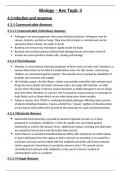
Pathogens are microorganisms that cause infectious disease. Pathogens may be
viruses, bacteria, protists or fungi. They may infect plants or animals and can be
spread by direct contact, by water or by air
Bacteria and viruses may reproduce rapidly inside the body
Bacteria may produce poisons (toxins) that damage tissues and make us feel ill
Viruses live and reproduce inside cells, causing cell damage
4.3.1.2 Viral diseases
Measles is a viral disease showing symptoms of fever and a red skin rash. Measles is a
serious illness that can be fatal if complications arise. For this reason, most young
children are vaccinated against measles. The measles virus is spread by inhalation of
droplets from sneezes and coughs
HIV initially causes a flu-like illness. Unless successfully controlled with antiretroviral
drugs the virus attacks the body’s immune cells. Late stage HIV infection, or AIDS,
occurs when the body’s immune system becomes so badly damaged it can no longer
deal with other infections or cancers. HIV is spread by sexual contact or exchange of
body fluids such as blood which occurs when drug users share needles
Tobacco mosaic virus (TMV) is a widespread plant pathogen affecting many species
of plants including tomatoes. It gives a distinctive “mosaic” pattern of discolouration
on the leaves which affects the growth of the plant due to a lack of photosynthesis
4.3.1.3 Bacterial diseases
Salmonella food poisoning is spread by bacteria ingested in food, or on food
prepared in unhygienic conditions. In the UK, poultry are vaccinated against
Salmonella to control the spread. Fever, abdominal cramps, vomiting and diarrhoea
are caused by the bacteria and the toxins they secrete.
Gonorrhoea is a sexually transmitted disease (STD) with symptoms of a thick yellow
or green discharge from the vagina or penis and pain on urinating. It is caused by a
bacterium and was easily treated with the antibiotic penicillin until many resistant
strains appeared. Gonorrhoea is spread by sexual contact. The spread can be
controlled by treatment with antibiotics or the use of a barrier method of
contraception such as a condom
4.3.1.4 Fungal diseases
4.3 Infection and response
4.3.1 Communicable diseases
4.3.1.1 Communicable (infectious) diseases
Pathogens are microorganisms that cause infectious disease. Pathogens may be
viruses, bacteria, protists or fungi. They may infect plants or animals and can be
spread by direct contact, by water or by air
Bacteria and viruses may reproduce rapidly inside the body
Bacteria may produce poisons (toxins) that damage tissues and make us feel ill
Viruses live and reproduce inside cells, causing cell damage
4.3.1.2 Viral diseases
Measles is a viral disease showing symptoms of fever and a red skin rash. Measles is a
serious illness that can be fatal if complications arise. For this reason, most young
children are vaccinated against measles. The measles virus is spread by inhalation of
droplets from sneezes and coughs
HIV initially causes a flu-like illness. Unless successfully controlled with antiretroviral
drugs the virus attacks the body’s immune cells. Late stage HIV infection, or AIDS,
occurs when the body’s immune system becomes so badly damaged it can no longer
deal with other infections or cancers. HIV is spread by sexual contact or exchange of
body fluids such as blood which occurs when drug users share needles
Tobacco mosaic virus (TMV) is a widespread plant pathogen affecting many species
of plants including tomatoes. It gives a distinctive “mosaic” pattern of discolouration
on the leaves which affects the growth of the plant due to a lack of photosynthesis
4.3.1.3 Bacterial diseases
Salmonella food poisoning is spread by bacteria ingested in food, or on food
prepared in unhygienic conditions. In the UK, poultry are vaccinated against
Salmonella to control the spread. Fever, abdominal cramps, vomiting and diarrhoea
are caused by the bacteria and the toxins they secrete.
Gonorrhoea is a sexually transmitted disease (STD) with symptoms of a thick yellow
or green discharge from the vagina or penis and pain on urinating. It is caused by a
bacterium and was easily treated with the antibiotic penicillin until many resistant
strains appeared. Gonorrhoea is spread by sexual contact. The spread can be
controlled by treatment with antibiotics or the use of a barrier method of
contraception such as a condom
4.3.1.4 Fungal diseases