15.2+ 15.3
25/02/23
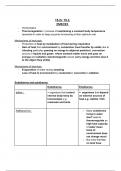
- Homeostasis
- Thermoregulation = process of maintaining a constant body temperature
(essential in order to keep enzymes functioning at their optimum rate
Mechanisms of heat gain
- Production of heat by metabolism of food during respiration
- Gain of heat from environment by conduction (heat transfer by solids due to
vibrating particules passing on energy to adjacent particles) convection
(occurs in liquids and gases where warmed matter move and pass on
energy) and radiation (electromagnetic waves carry energy and then lose it
to the object they strike)
Mechanisms of heat loss
- Evaporation of water during sweating
- Loss of heat to environment by conduction / convection / radiation
Endotherms and ectotherms
Endotherms Ectotherms
define : = organisms that control = organisms that depend
internal body temp by on external sources of
homeostasis e.g. heat e.g. reptiles / fish
mammals and birds
Additional ino: - Many ectotherms
living in water
don't need to
thermoregulate as
high heat capacity
of water mean
temp of
environment does
not change much
- But ones that live
on land have
, bigger problem
with temp
regulation due
to temp in air
drastically
changing → this
resulted in
strategies evolved
to cool down or
warm up
Control body temp by : - Homeostasis e.g. - No internal
shivering / sweating mechanisms so only
- Behaviour e.g. dog by behaviour
sticking tongue out - e,g, bask in sun
when hot (increased ( and extend legs
evaporation) or sit in and arms so
shade / sit in water maxim surface
area reach sun →
this allows them
to get warm
enough to hunt
for prey or allows
insects to fly)
- ALSO can vibrate
and contract
muscles
- OR to cool down
can go to shade or
dig a burrow
- Lizards living in
colder climated
tend to be darker
coloured than
lizards in hotter
countries so they
get warmer
Rate of metabolism - High + constant - Variable -
rate → need to dependent on
consume more exterior temp in
food to meet high environment
needs
, Activity - Not dependent on - Dependent on
environment external temp e.g.
if cold it may have
to sit still when
cold (active
when warm as
it is the
optimum temp
as for enzymes
→ aerobic
respiration →
atp → energy →
move )
Body temp - High and constant - Variable so when
regardless of environment heats ,
environment temp body heats up
Endotherms gaining heat
- Vasocntriction of blood vessels = maintain blood fliow to vital orgams and
reduce blood flow to skin → less heat loss by radiation. This is done by
narrowing the arterial near the skin surface by using a small sphincter
muscle + opening a shunt vessel which is a short cut for the blood
- Shiver = involuntary muscle contractions produce heat
- Raising of hair - thicker insulating layer of air between skin adn environment
- Increased metabolic rate = speeding of reactions such as respiration in
body → produce heat as by product
- Decrease in sweating
Endotherms losing heat
- Vasodilation =open up blood vessels so blood flow to skin → more heat lost
by radiation
- Increase in sweat
- Lowering of body hair - thinner insulating layer of air between skin and
environment
- Shelter
Hypothalamus
25/02/23
- Homeostasis
- Thermoregulation = process of maintaining a constant body temperature
(essential in order to keep enzymes functioning at their optimum rate
Mechanisms of heat gain
- Production of heat by metabolism of food during respiration
- Gain of heat from environment by conduction (heat transfer by solids due to
vibrating particules passing on energy to adjacent particles) convection
(occurs in liquids and gases where warmed matter move and pass on
energy) and radiation (electromagnetic waves carry energy and then lose it
to the object they strike)
Mechanisms of heat loss
- Evaporation of water during sweating
- Loss of heat to environment by conduction / convection / radiation
Endotherms and ectotherms
Endotherms Ectotherms
define : = organisms that control = organisms that depend
internal body temp by on external sources of
homeostasis e.g. heat e.g. reptiles / fish
mammals and birds
Additional ino: - Many ectotherms
living in water
don't need to
thermoregulate as
high heat capacity
of water mean
temp of
environment does
not change much
- But ones that live
on land have
, bigger problem
with temp
regulation due
to temp in air
drastically
changing → this
resulted in
strategies evolved
to cool down or
warm up
Control body temp by : - Homeostasis e.g. - No internal
shivering / sweating mechanisms so only
- Behaviour e.g. dog by behaviour
sticking tongue out - e,g, bask in sun
when hot (increased ( and extend legs
evaporation) or sit in and arms so
shade / sit in water maxim surface
area reach sun →
this allows them
to get warm
enough to hunt
for prey or allows
insects to fly)
- ALSO can vibrate
and contract
muscles
- OR to cool down
can go to shade or
dig a burrow
- Lizards living in
colder climated
tend to be darker
coloured than
lizards in hotter
countries so they
get warmer
Rate of metabolism - High + constant - Variable -
rate → need to dependent on
consume more exterior temp in
food to meet high environment
needs
, Activity - Not dependent on - Dependent on
environment external temp e.g.
if cold it may have
to sit still when
cold (active
when warm as
it is the
optimum temp
as for enzymes
→ aerobic
respiration →
atp → energy →
move )
Body temp - High and constant - Variable so when
regardless of environment heats ,
environment temp body heats up
Endotherms gaining heat
- Vasocntriction of blood vessels = maintain blood fliow to vital orgams and
reduce blood flow to skin → less heat loss by radiation. This is done by
narrowing the arterial near the skin surface by using a small sphincter
muscle + opening a shunt vessel which is a short cut for the blood
- Shiver = involuntary muscle contractions produce heat
- Raising of hair - thicker insulating layer of air between skin adn environment
- Increased metabolic rate = speeding of reactions such as respiration in
body → produce heat as by product
- Decrease in sweating
Endotherms losing heat
- Vasodilation =open up blood vessels so blood flow to skin → more heat lost
by radiation
- Increase in sweat
- Lowering of body hair - thinner insulating layer of air between skin and
environment
- Shelter
Hypothalamus