Chapter 13
17/11/23
Nervous pathway
- Homeostasis = maintenance of our internal environment relatively stable
through negative feedback
- This is controlled by 2 : nervous system + hormonal system
- Receptor - receive stimuli and send electrical impulse to sensory neurone →
CNS (brain + spinal chord ) → relay neuron → carried down motor neurone →
effector ( muscles - nervous response /glands - hormonal response )
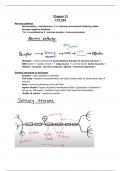
General structures of neurones
- Dendron = send impulse to cell body
- Cell body =release neurotransmitter (cell body location help us decide what type of
neuron)
- Axon = send impulse away from cell body
- myelin sheath = layers of plasma membranes (lipids / glycolipids / cholesterol ) -
can go up 100 layers - insulation layer which help speed up transmission
- Nodes of ranvier = speed up reaction
, - Blue part receiving from sensory
- Red part axons which send signal away to motor
Myelin sheath
, - Layer of lipids / plasma membrane
- Act as insulating layer
- Speeds up nerve impulse transmission (saltatory conduction) at nodes of ranvier
- The schwann cell produced the myelin sheath
13.3 Sensory receptors: pacinian corpuscle
19/11/23
Sensory receptor
= specific to 1 type of stimulus so cant receive multiple types of stimulus
- E.g. chemoreceptor - sense taste - can't sense temp change
- SR acts as transducers = things that can turn stimulus → into an electrical
impulse (this is called generator potential which is referring to impulse created
by SR . Then generator potential → turn into Action potential as
process goes on)
4 types of sensory receptors?
1) Mechanoreceptors = receptors that are sensitive to pressure / movement e.g.
skin
2) Chemoreceptors = sense chemicals e.g. smell/taste/ nose
3) Thermoreceptors = sense heat/ temp change (tongue / skin surface)
4) Photoreceptors = sense light e.g. cone and rods cells in retina of eyes
SPECIFIC example of MECHANORECEPTOR : pacinian corpuscle
- Can be found: fingertips/ feet soles/ joints/skin
- Sensitive to pressure / movement
17/11/23
Nervous pathway
- Homeostasis = maintenance of our internal environment relatively stable
through negative feedback
- This is controlled by 2 : nervous system + hormonal system
- Receptor - receive stimuli and send electrical impulse to sensory neurone →
CNS (brain + spinal chord ) → relay neuron → carried down motor neurone →
effector ( muscles - nervous response /glands - hormonal response )
General structures of neurones
- Dendron = send impulse to cell body
- Cell body =release neurotransmitter (cell body location help us decide what type of
neuron)
- Axon = send impulse away from cell body
- myelin sheath = layers of plasma membranes (lipids / glycolipids / cholesterol ) -
can go up 100 layers - insulation layer which help speed up transmission
- Nodes of ranvier = speed up reaction
, - Blue part receiving from sensory
- Red part axons which send signal away to motor
Myelin sheath
, - Layer of lipids / plasma membrane
- Act as insulating layer
- Speeds up nerve impulse transmission (saltatory conduction) at nodes of ranvier
- The schwann cell produced the myelin sheath
13.3 Sensory receptors: pacinian corpuscle
19/11/23
Sensory receptor
= specific to 1 type of stimulus so cant receive multiple types of stimulus
- E.g. chemoreceptor - sense taste - can't sense temp change
- SR acts as transducers = things that can turn stimulus → into an electrical
impulse (this is called generator potential which is referring to impulse created
by SR . Then generator potential → turn into Action potential as
process goes on)
4 types of sensory receptors?
1) Mechanoreceptors = receptors that are sensitive to pressure / movement e.g.
skin
2) Chemoreceptors = sense chemicals e.g. smell/taste/ nose
3) Thermoreceptors = sense heat/ temp change (tongue / skin surface)
4) Photoreceptors = sense light e.g. cone and rods cells in retina of eyes
SPECIFIC example of MECHANORECEPTOR : pacinian corpuscle
- Can be found: fingertips/ feet soles/ joints/skin
- Sensitive to pressure / movement