
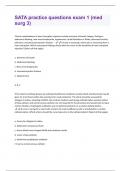
SATA practice questions exam 1 (med surg 3) Rated A+
Clinical manifestations of heart transplant rejection include shortness of breath, fatigue, fluid gain, abdominal bloating, new-onset bradycardia, hypotension, atrial fibrillation or flutter, decreased activity tolerance, and decreased ejection fraction. - A nurse is assessing a client who is recovering from a heart transplant. Which assessment findings should alert the nurse to the possibility of heart transplant rejection? (Select all that apply) a. Shortness of breath b. Abdominal bloating c. New-onset bradycardia d. Increased ejection fraction e. Hypertension A, B, C If the client has kidney disease (as indicated by BUN and creatinine results), fluids and Mucomyst may be given 12 to 24 hours before the procedure for renal protection. The client should be assessed for allergies to iodine, including shellfish; the contrast medium used during catheterization contains iodine. A foley catheter and central venous catheter are not required for the procedure and would only increase risk for infection. Prophylactic antibiotics are not administered prior to a cardiac catheterization. - A nurse is caring for a client with a history of renal insufficiency who is scheduled for a cardiac catheterization. Which actions should the nurse take prior to the catheterization? (Select all that apply) a. Assess for allergies to iodine b. Administer intravenous fluids c. Assess blood urea nitrogen (BUN) and creatinine results d. Insert a foley catheter e. Administer prophylactic antibiotic f. Insert a central venous catheterA, B, C Oxygen is an accelerant, which means it enhances combustion, so precautions are needed whenever using it. The nurse should assess if the client allows smoking near the oxygen, whether electrical cords are in good shape or are frayed, and if flammable liquids are stored (and used) in the garage away from the oxygen. Light bulbs and pets are not related to oxygen safety. - A home health nurse is visiting a new client who uses oxygen in the home For which factors does the nurse assess when determining if the client is using the oxygen safely? (Select all that apply) a. The client does not allow smoking in the house. b. Electrical cords are in good working order. c. Flammable liquids are stored in the garage. d. Household light bulbs are the fluorescent type. e. The client does not have pets inside the home. A, B, C, D The ventilator bundle is a group of care measures to prevent ventilator-associated pneumonia. Actions in the bundle include using proper hand hygiene, giving anti-ulcer medications, elevating the head of the bed, providing frequent oral care per policy, preventing aspiration, and providing pulmonary hygiene measures. Suctioning is done as needed. - The nurse caring for mechanically ventilated clients uses best practices to prevent ventilator-associated pneumonia. What actions are included in this practice? (Select all that apply) a. Adherence to proper hand hygiene b. Administering anti-ulcer medication c. Elevating the head of the bed d. Providing oral care per protocol e. Suctioning the client on a regular schedule A, B, C, E
Document information
- Uploaded on
- July 29, 2024
- Number of pages
- 16
- Written in
- 2023/2024
- Type
- Exam (elaborations)
- Contains
- Questions & answers


