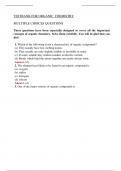
Organic Chemistry ACS Exam Set 2024 Update Questions with Correct Answers Graded A+
Organic Chemistry ACS Exam Set 2024 Update Questions with Correct Answers Graded A+ Acetylenic hydrogens can be deprotonated with relatively strong bases (NaNH2) - Answer NaNH2, in liquid NH3 Alcohols have similar acidities to water; sterically hindered alochols are less acidic - Answer conjugate base is not well solvated so it is not as stable Alcohols usually show a M+ 18 peak from - Answer loss of water Aldehydes and ketones are reduced to 1o and 2o alcohols respectively - Answer Aldehydes and ketones are reduced relatively easily; the mild reducing agent sodium borohydride (NaBH4) is typically used LAH and hydrogenation with a metal catalyst can also be used Are alkanes, alkenes, or alkynes the most acidic? - Answer Alkynes (pka 25, alakene pka = 44 , alkanes pka =50 Because of steric hindrance, how must H's be removed for elimination? - Answer Anticoplanar ~~ Can you explain why fluorine and iodine are not used in radical formation? - Answer Fluorination has a low value for Eact for the first step and is extremely exothermic therefore fluorination reactions are explosive Chlorination and bromination ahve increasinlgly higher values of Energy of activation and lower delta H values which makes these halogenation reactions less vigorous Iodonination has a prohibitively high value for Eact of the first step and the reaction does not occur Carbonyl compounds can undergo a mclafferty rearrangement - Answer Carbonyl groups and alcohol groups can be interconverted by oxidation and reduction reactions - Answer Primary alcohols --> oxidized to aldehyde Aldehyde --> reduced to primary alcohol Chlorine as a halogenating reagent - Answer -Chlorine is relatively unselective and doesn't greately distinguish between type of hydrogen --> leads to monochlorinated product (and more substituted product) +polychlorinated products +hcl Does nitrogen count in the IHD formula? - Answer Yes EDG ______ the rate of reaction - Answer increase
Written for
- Institution
- Organic Chemistry for Life
- Course
- Organic Chemistry for Life
Document information
- Uploaded on
- July 28, 2024
- Number of pages
- 24
- Written in
- 2023/2024
- Type
- Exam (elaborations)
- Contains
- Questions & answers
Subjects
-
organic chemistry acs exam