Automatism
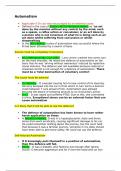
Applicable if D’s act was encouraged by an external cause.
Defined in the case of Bratty v AG for Northern Ireland as “an act
done by the muscles without any control by the mind, such
as a spasm, a reflex action or convulsion; or an act done by
a person who is not conscious of what he is doing such as an
act done whilst suffering from concussion or whilst
sleepwalking.
In the Hill v Baxter, a plea of automatism was successful where the
D had been attacked by a swarm of bees.
Actions must be completely involuntary
AG’s Reference (No. 2 of 1992) – Lorry driver crashed into some cars
on the hard shoulder. He raised the defence of automatism on the
basis that he was ‘driving without awareness’ induced by repetitive
visual stimulus. The defence was not available because reduced or
impaired control is not enough for a defence of automatism. There
must be a ‘total destruction of voluntary control’.
The cause must be external
R v Wholley – D sneezed causing him to lose control of his steering.
His lorry bumped into the car in front which in turn led to a domino
crash between 7 cars ahead of him. Automatism was allowed
because the attack of sneezing amount to an involuntary action.
R v T – D was raped and suffered PTSD. Due to this, she committed
a crime. Exceptional stress can be an external factor that can
cause automatism.
Is it likely that D will be able to use the defence?
The defence of automatism has been known to have rather
harsh application on times.
In Broome v Perkins, D was in a hyperglycaemic state and drove
home from work erratically, causing significant damage to his car.
He could remember nothing about the journey, but the court held
that because it was a familiar journey, someone in his state should
have been able to get home safely. He could not use the defence.
Self-Induced Automatism
If D knowingly puts themself in a position of automatism,
then the defence will fail.
Bailey – D was a diabetic who failed to eat enough after taking
insulin. D became aggressive and hit V over the head with an iron
Applicable if D’s act was encouraged by an external cause.
Defined in the case of Bratty v AG for Northern Ireland as “an act
done by the muscles without any control by the mind, such
as a spasm, a reflex action or convulsion; or an act done by
a person who is not conscious of what he is doing such as an
act done whilst suffering from concussion or whilst
sleepwalking.
In the Hill v Baxter, a plea of automatism was successful where the
D had been attacked by a swarm of bees.
Actions must be completely involuntary
AG’s Reference (No. 2 of 1992) – Lorry driver crashed into some cars
on the hard shoulder. He raised the defence of automatism on the
basis that he was ‘driving without awareness’ induced by repetitive
visual stimulus. The defence was not available because reduced or
impaired control is not enough for a defence of automatism. There
must be a ‘total destruction of voluntary control’.
The cause must be external
R v Wholley – D sneezed causing him to lose control of his steering.
His lorry bumped into the car in front which in turn led to a domino
crash between 7 cars ahead of him. Automatism was allowed
because the attack of sneezing amount to an involuntary action.
R v T – D was raped and suffered PTSD. Due to this, she committed
a crime. Exceptional stress can be an external factor that can
cause automatism.
Is it likely that D will be able to use the defence?
The defence of automatism has been known to have rather
harsh application on times.
In Broome v Perkins, D was in a hyperglycaemic state and drove
home from work erratically, causing significant damage to his car.
He could remember nothing about the journey, but the court held
that because it was a familiar journey, someone in his state should
have been able to get home safely. He could not use the defence.
Self-Induced Automatism
If D knowingly puts themself in a position of automatism,
then the defence will fail.
Bailey – D was a diabetic who failed to eat enough after taking
insulin. D became aggressive and hit V over the head with an iron