Insanity
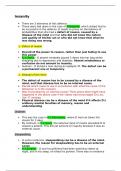
There are 3 elements of this defence.
These were laid down in the case of M’Naghten, which stated that to
be successful in the defence, D needs to prove on the balance of
probabilities that s/he had a defect of reason, caused by a
disease of the mind and that s/he did not know the nature
and quality of his/her act or s/he did not know that what he
was doing was wrong.
1. Defect of reason
Devoid of the power to reason, rather than just failing to use
this power.
R v Clarke – D absent-mindedly placed 3 items into her bag whilst
shopping due to depression and diabetes. Absent mindedness or
confusion do not amount to insanity.
Sullivan – D kicked a man during an epileptic fit. The defect can be
a permanent one or temporary.
2. Disease of the mind
The defect of reason has to be caused by a disease of the
mind, and that disease has to be an internal cause.
Decide which cases to use in accordance with what the cause of the
behaviour is in the scenario.
Was D provoked by an internal cause? Think about what might have
happened in the above case if the videos had encouraged D to act.
Use ‘if’ analogy.
Physical disease can be a disease of the mind if it affects D’s
ordinary mental faculties of memory, reason and
understanding.
Diabetes
This was the case in R v Hennessey, where D had not taken hid
insulin for 3 days.
By contrast, in R v Quick, the external input of insulin provoked D to
assault a patient. This did not amount to insanity because it was an
external cause.
Sleepwalking
In some instances, sleepwalking can be a disease of the mind.
However, the reason for sleepwalking has to be an external
cause.
R v Burgess – D and his girlfriend had been watching videos at
night, and in his sleep, he killed his partner. There was no evidence
There are 3 elements of this defence.
These were laid down in the case of M’Naghten, which stated that to
be successful in the defence, D needs to prove on the balance of
probabilities that s/he had a defect of reason, caused by a
disease of the mind and that s/he did not know the nature
and quality of his/her act or s/he did not know that what he
was doing was wrong.
1. Defect of reason
Devoid of the power to reason, rather than just failing to use
this power.
R v Clarke – D absent-mindedly placed 3 items into her bag whilst
shopping due to depression and diabetes. Absent mindedness or
confusion do not amount to insanity.
Sullivan – D kicked a man during an epileptic fit. The defect can be
a permanent one or temporary.
2. Disease of the mind
The defect of reason has to be caused by a disease of the
mind, and that disease has to be an internal cause.
Decide which cases to use in accordance with what the cause of the
behaviour is in the scenario.
Was D provoked by an internal cause? Think about what might have
happened in the above case if the videos had encouraged D to act.
Use ‘if’ analogy.
Physical disease can be a disease of the mind if it affects D’s
ordinary mental faculties of memory, reason and
understanding.
Diabetes
This was the case in R v Hennessey, where D had not taken hid
insulin for 3 days.
By contrast, in R v Quick, the external input of insulin provoked D to
assault a patient. This did not amount to insanity because it was an
external cause.
Sleepwalking
In some instances, sleepwalking can be a disease of the mind.
However, the reason for sleepwalking has to be an external
cause.
R v Burgess – D and his girlfriend had been watching videos at
night, and in his sleep, he killed his partner. There was no evidence