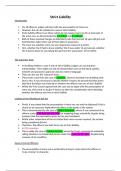
Strict Liability
Introduction
For all offences, judges will start with the presumption of mens rea.
However, this can be rebutted in cases of strict liability.
Strict liability offences are those which do not require mens rea for at least part of
the actus reus, as demonstrated by R v Prince and R v Hibbert.
Both of these involved charges to defendants who had married 16-year-old girls and
had therefore taken them out of their father’s possession.
The issue was whether mens rea was required in respect of 2 points.
First, whether the D had to know whether the D was under 16 and second, whether
the D had to know he was taking the girl from the ‘possession’ of her father.
The Gammon Tests
In deciding whether a case is one of strict liability, judges can use statutory
interpretation. They might use aids of interpretation such as the literal, golden,
mischief and purposive approach and also rules of language.
They can also use the ‘Gammon tests.’
These tests come from the case of Gammon, where D deviated from building work.
Due to this, it was necessary to decide whether it had to be proved that they knew
that their deviation was material or whether the offence was one of strict liability.
Whilst the Privy Council agreed that the case was to begin with the presumption of
mens rea, they went on to give 4 factors to take into consideration when deciding
whether the offence was one of strict liability.
Looking at the Wording of the Act
Firstly, it was stated that the presumption of mens rea can only be displaced if this is
clearly or by necessary implication the effect of the words of the statute.
This is demonstrated by the case of PSGB v Storkwain, where D was convicted of an
offence under s58 Medicines Act 1968 for supplying drugs unlawfully, despite being
unaware that the prescription given to him was fraudulent.
Whilst other subsections of the Act stated that mens rea was required, the section
being considered did not.
Therefore, the offence was held to be one of strict liability.
In (D)’s scenario…
This is unlike the case of Cundy v Le Cocq, where the D was convicted of unlawfully
selling alcohol to an intoxicated person under the Licensing Act 1872, despite being
unaware of his condition.
Quasi-Criminal Offences
The presumption of mens rea is particularly strong in cases where the offence is
‘truly criminal’ in character.
Introduction
For all offences, judges will start with the presumption of mens rea.
However, this can be rebutted in cases of strict liability.
Strict liability offences are those which do not require mens rea for at least part of
the actus reus, as demonstrated by R v Prince and R v Hibbert.
Both of these involved charges to defendants who had married 16-year-old girls and
had therefore taken them out of their father’s possession.
The issue was whether mens rea was required in respect of 2 points.
First, whether the D had to know whether the D was under 16 and second, whether
the D had to know he was taking the girl from the ‘possession’ of her father.
The Gammon Tests
In deciding whether a case is one of strict liability, judges can use statutory
interpretation. They might use aids of interpretation such as the literal, golden,
mischief and purposive approach and also rules of language.
They can also use the ‘Gammon tests.’
These tests come from the case of Gammon, where D deviated from building work.
Due to this, it was necessary to decide whether it had to be proved that they knew
that their deviation was material or whether the offence was one of strict liability.
Whilst the Privy Council agreed that the case was to begin with the presumption of
mens rea, they went on to give 4 factors to take into consideration when deciding
whether the offence was one of strict liability.
Looking at the Wording of the Act
Firstly, it was stated that the presumption of mens rea can only be displaced if this is
clearly or by necessary implication the effect of the words of the statute.
This is demonstrated by the case of PSGB v Storkwain, where D was convicted of an
offence under s58 Medicines Act 1968 for supplying drugs unlawfully, despite being
unaware that the prescription given to him was fraudulent.
Whilst other subsections of the Act stated that mens rea was required, the section
being considered did not.
Therefore, the offence was held to be one of strict liability.
In (D)’s scenario…
This is unlike the case of Cundy v Le Cocq, where the D was convicted of unlawfully
selling alcohol to an intoxicated person under the Licensing Act 1872, despite being
unaware of his condition.
Quasi-Criminal Offences
The presumption of mens rea is particularly strong in cases where the offence is
‘truly criminal’ in character.