Summary
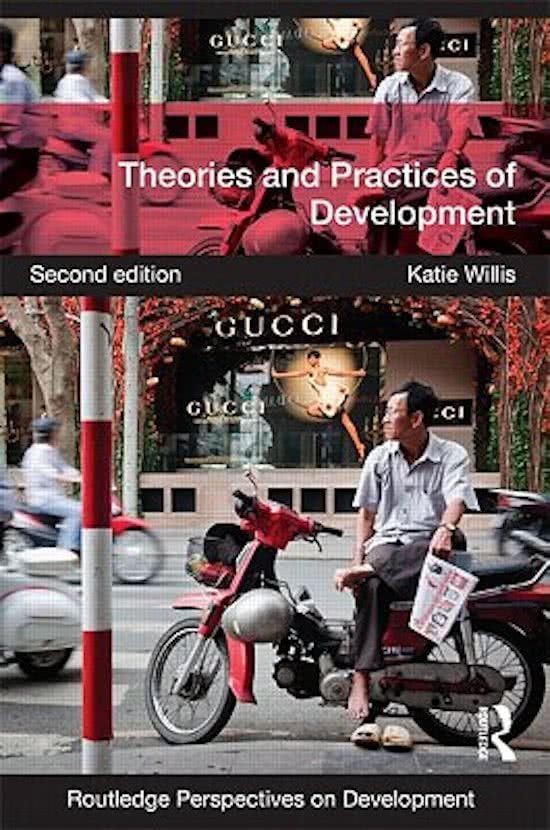
Theories and practices of Development second edition - by Katie Willis
1 Introduction: what do we mean by development?
Modernity
Modernity in its broadest sense means the condition of being modern, new or
up-to-date. Because of social, economic, political and cultural dynamism,
what is ‘modern’ will change over time and also spatially.
However, ‘modernity’ has been used as a term to describe particular forms of
economy and society based on the experiences of Western Europe and
more recently the USA ➝ ethnocentric approach.
In economic terms, ‘modernity’ encompasses industrialization, urbanization
and the increased use of technology within all sectors of the economy.
Modernity can be interpreted as ‘development’ and ‘progress’, but for others
it is associated with the elimination of cultural practices, the destruction of
natural environments and a decline in the quality of life.
Development as an economic process
People defining development as ‘modernity’, look at development largely in
economic terms.
BOX 1.2 Calculations of GDP, GNP and GNI
Gross Domestic Product (GDP) ➝ measures the value of all goods and
services produced within the geographical boundaries of a particular
country.
Gross National Product (GNP) ➝ measures the value of all goods and
services claimed by inhabitants of a particular country regardless of where
the production took place. (GNP = GDP + income from abroad – income
claimed by people overseas).
Gross National Income (GNI) ➝ alternative name for GNP
1
,The use of a wealth measure to represent development is regarded as
appropriate because it is assumed that with greater wealth come other
benefits such as improved health, education and quality of life.
Human development
The GNI is used in co-occurrence with other indicators of development which
highlight non-economic dimensions of the concept.
The Human Development Index (HDI) ➝ incorporates three dimensions of
development in relation to human well-being:
- A long and healthy life;
o Life expectancy at birth.
- Knowledge;
o Adult literacy index (% aged 15 and over);
o Gross Enrolment Ratio (GER) (% in primary, secondary and tertiary
education).
- A decent standard of living;
o GDP per capita
The higher the value (between 0 to 1), the higher the level of human
development.
GNI and HDI are related, but there is not complete overlap.
These measures do not consider inequalities in social terms within a country,
how people define development or how they would like their lives to change.
The important of scale
Development can be considered at different spatial scales: from the
individual to the local community, the regional, the national and the global.
Some forms of development lead to increased inequalities between places,
while others may attempt to reduce spatial inequalities.
The Gini coefficient (0 = equality – 1=inequality) and Gini index (0 = equality –
100 = inequality) are measures of inequality at a national level. They measure
either income inequality or inequalities in consumption between individuals,
households or groups.
2
, High levels of development do not necessarily mean great equality.
Experiences of marginalization, poverty and disadvantage are not restricted
to certain parts of the world.
There is a clear trend of rural-urban inequality with rural populations generally
being worse off than their urban counterparts. But we have to keep in mind
that poverty indicators are notoriously problematic because of differences in
cost of living or the availability of food from farms and the distinctions
between rural and urban areas are never as distinct as statistics may imply.
Beside spatial inequalities, social inequalities are also very important.
Particular ethnic groups may also be deprived of opportunities or may be
denied decision-making power. This can lead to destructions of cultural
practices and institutions, as well as decline in self-respect and self-esteem.
Measuring ‘development’
The way that development is measured is problematic, because of the
different conceptions of development and the range of scales at which it
can be considered. Choosing indicators for measuring health, education and
economic status is not straightforward. Also, comparability is a problem,
because not all data is comparable, representative for the whole society or
available for all countries. Finally, development measures are nearly always
quantitative. The subjective qualitative dimensions (feelings, experiences and
opinions) of development are excluded.
Most of the times the definition of poverty is an economic one. This is very
limited and assumes a clear relationship between income, poverty and other
measures of disadvantage.
The Multidimensional Poverty Index is a more recent attempt to measure
poverty and identifies health, education and living standards as key aspects.
But they still exclude any qualitative examination of experiences of poverty.
Terminology
There are many forms of classification and a range of terms to describe
groups of countries. The way that different parts of the world are described
3
Theories and practices of Development second edition - by Katie Willis
1 Introduction: what do we mean by development?
Modernity
Modernity in its broadest sense means the condition of being modern, new or
up-to-date. Because of social, economic, political and cultural dynamism,
what is ‘modern’ will change over time and also spatially.
However, ‘modernity’ has been used as a term to describe particular forms of
economy and society based on the experiences of Western Europe and
more recently the USA ➝ ethnocentric approach.
In economic terms, ‘modernity’ encompasses industrialization, urbanization
and the increased use of technology within all sectors of the economy.
Modernity can be interpreted as ‘development’ and ‘progress’, but for others
it is associated with the elimination of cultural practices, the destruction of
natural environments and a decline in the quality of life.
Development as an economic process
People defining development as ‘modernity’, look at development largely in
economic terms.
BOX 1.2 Calculations of GDP, GNP and GNI
Gross Domestic Product (GDP) ➝ measures the value of all goods and
services produced within the geographical boundaries of a particular
country.
Gross National Product (GNP) ➝ measures the value of all goods and
services claimed by inhabitants of a particular country regardless of where
the production took place. (GNP = GDP + income from abroad – income
claimed by people overseas).
Gross National Income (GNI) ➝ alternative name for GNP
1
,The use of a wealth measure to represent development is regarded as
appropriate because it is assumed that with greater wealth come other
benefits such as improved health, education and quality of life.
Human development
The GNI is used in co-occurrence with other indicators of development which
highlight non-economic dimensions of the concept.
The Human Development Index (HDI) ➝ incorporates three dimensions of
development in relation to human well-being:
- A long and healthy life;
o Life expectancy at birth.
- Knowledge;
o Adult literacy index (% aged 15 and over);
o Gross Enrolment Ratio (GER) (% in primary, secondary and tertiary
education).
- A decent standard of living;
o GDP per capita
The higher the value (between 0 to 1), the higher the level of human
development.
GNI and HDI are related, but there is not complete overlap.
These measures do not consider inequalities in social terms within a country,
how people define development or how they would like their lives to change.
The important of scale
Development can be considered at different spatial scales: from the
individual to the local community, the regional, the national and the global.
Some forms of development lead to increased inequalities between places,
while others may attempt to reduce spatial inequalities.
The Gini coefficient (0 = equality – 1=inequality) and Gini index (0 = equality –
100 = inequality) are measures of inequality at a national level. They measure
either income inequality or inequalities in consumption between individuals,
households or groups.
2
, High levels of development do not necessarily mean great equality.
Experiences of marginalization, poverty and disadvantage are not restricted
to certain parts of the world.
There is a clear trend of rural-urban inequality with rural populations generally
being worse off than their urban counterparts. But we have to keep in mind
that poverty indicators are notoriously problematic because of differences in
cost of living or the availability of food from farms and the distinctions
between rural and urban areas are never as distinct as statistics may imply.
Beside spatial inequalities, social inequalities are also very important.
Particular ethnic groups may also be deprived of opportunities or may be
denied decision-making power. This can lead to destructions of cultural
practices and institutions, as well as decline in self-respect and self-esteem.
Measuring ‘development’
The way that development is measured is problematic, because of the
different conceptions of development and the range of scales at which it
can be considered. Choosing indicators for measuring health, education and
economic status is not straightforward. Also, comparability is a problem,
because not all data is comparable, representative for the whole society or
available for all countries. Finally, development measures are nearly always
quantitative. The subjective qualitative dimensions (feelings, experiences and
opinions) of development are excluded.
Most of the times the definition of poverty is an economic one. This is very
limited and assumes a clear relationship between income, poverty and other
measures of disadvantage.
The Multidimensional Poverty Index is a more recent attempt to measure
poverty and identifies health, education and living standards as key aspects.
But they still exclude any qualitative examination of experiences of poverty.
Terminology
There are many forms of classification and a range of terms to describe
groups of countries. The way that different parts of the world are described
3