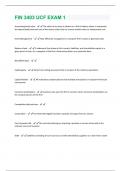
FIN 3403 UCF EXAM 1 Questions And Answers With Verified Solutions Graded A+
Accounting book value - The value of an asset as shown on a firm's balance sheet. It represents the depreciated historical cost of the assest rather than its current market value or replacement cost Asset Management - How efficienty management is using the firm's assets to generate sales Balance sheet - A statement that shows a firm's assets, liabilities, and shareholder equity at a given point in time. Its a snapshot of the firm's financial position on a particular date. Best Effort Basis - Capital gains - Gains from selling any assets that is not part of the ordinary operations Capital Market - All institutions andprocedures that facilitate transactions in long-term financial instruments Common stockholders - Investors who own the firm's common stock. Common stockholders are the residual owners of the firm Competitive bid purchase - Corporation - An entity that legally functions separate and apart from its owners Cost of goods sold - The cost of producing or acquiring a product or service to be sold in the ordinary course of business Debt - Liabilites consisting of such sources as credit extended by suppliers or a loan from a bankDefault-risk premium - The additional return required by investors to compensate them for the risk of default. It is calculated as the difference in rates between a U.S. Treasury bond and a corporate bound of the same maturity and marketability. Direct Sale - The sale of securities by a corporation to the investing public without the services of an investment-banking firm Dividends per share - The amount of dividends a firm pays for each share outstanding Dutch Auction - A method of issuing securities (common stock) by which investors place bids indicating how many shares they are willing to buy and at what price, The price the stock is then sold for becomes the lowest price at which the issuing company can sell all the available shares. Earnings before taxes - (taxable income) Operating income minus interest expense. Earnings per share - Net income on a per share basis Economic value added - Measures a company's economic profits, as compared to its accounting profits, by including not only interest expense as a cost buy also the shareholder's required rate of return on their investment Equity - Stockholders' investment in the firm and the cumulative profits retained in the business up to the date of the balance sheet Fixed costs - costs that do not vary in total dollar amount as sales volume or quantity of output changes. Also called indirect costs Flotation cost - The costs incurred by the firm when it issues securities to raise funds Form 10-K - An annual report required by the Securities and Exchange Commission (SEC) that provides such information as the firm's history, audited financial statements, management's analysis of the company's performance, and executive compensationFutures Market - Markets where you can buy or sell something at a future date General Partnership - A partnership in which all partners are fully liable for the indebtedness incurred by the partnership Goal of the Firm - Maximize Shareholder Wealth, (Maximizing firm value or Maximizing stock price) Gross Profit - Sales or revenue minus the cost of goods sold Income statement - A basic accounting statement that measures the results of a firm's operations over a specified period, commonly 1 year. The bottom line of the income statement, net profits (net income), shows the profit or loss for the period that is available for a company's owners(shareholders) Inflation Premium - A premium to compensate for anticipated inflation that is equal to the price change expected to occur over the life of the bond or investment instrument
Written for
- Institution
- FIN 3403 UCF
- Course
- FIN 3403 UCF
Document information
- Uploaded on
- July 26, 2024
- Number of pages
- 7
- Written in
- 2023/2024
- Type
- Exam (elaborations)
- Contains
- Questions & answers
Subjects

Also available in package deal