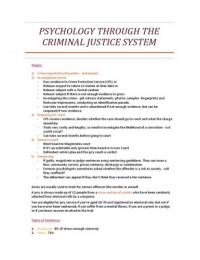
PSYCHOLOGY THROUGH THE
CRIMINAL JUSTICE SYSTEM
Stages:
1) Crime reported to the police - statements
2) Investigation/arrest
- Pass evidence to Crime Protection Service (CPS) or
- Release suspect to return to station at later date or
- Release subject with a formal caution
- Release subject if there is not enough evidence to press
- Investigating the crime - get witness statements, photos, samples- fingerprints and
footwear impressions, conducting an identification parade.
- Can take several months and is abandoned if not enough evidence. But can be
reopened if new evidence.
3) Preparing for court
- CPS reviews evidence, decides whether the case should go to court and what the charge
should be
- Trials very costly and lengthy, so need to investigate the likelihood of a conviction - is it
worth a trial?
- Can take several months before going to court
4) Going to court
- Most heard in Magistrates court
- If it’s an indictable only (prison) then heard in Crown Court
- Defendant enters plea and the jury reach a verdict
5) Sentencing
- If guilty, magistrate or judge sentences using sentencing guidelines. They can issue a
fine, community service, prison sentence, discharge or combination.
- Forensic psychologists sometimes asked whether the offender is a risk to society - will
they reoffend?
- The defendant can appeal if they don’t think they received a fair sentence
Juries are usually used in trials for serious offences like murder or assault.
A jury is always made up of 12 people from a cross-section of society who have been randomly
selected from electoral rolls by a computer.
You are eligible for jury service if you're aged 18-70 and registered on electoral role. But not if
you have ever been sentenced, if you suffer from a mental illness, if you are a priest or a judge,
or if you know anyone involved in the trial.
Types of Sentences
1. Discharge - 8% (if shows enough remorse)
2. Fines - 71%
, 3. Community Sentence - 13%, electronic tag Community sentencing is much more likely to
rehabilitate offenders and encourage reparation (two of the principles of sentencing)
because it combines punishment with changing offenders' behaviour and making amends.
Examples of community sentences include: community service, community rehabilitation,
curfews
4. Prison - 7%. Not unless necessary - breaks up families, can induce endless cycle of crime.
Jury/Magistrate makes decision based on:
- Protecting public
- Punishment - deterrent
- Reparation to victims
- Previous record
- Seriousness of offence
- Personal circumstances
- Remorse exhibited
- Time served
2005 Criminal Flow
British Crime Survey (BCS) - door to door survey, census, very large sample, ask who has
been victim of crime - but a lot of crimes go unreported
crime figure: 10, 912,000
Recorded Crime (crimes which aren’t reported - minor e.g. Drunken brawl, sexual
assault) -5,557,000
Of those, proceeded against - 1,895,000
Of these, 1,461,000 are tried at the magistrates court, where 1,426,000 are guilty and
1,407,000 are sentenced. 19,000 are referred to the crown court. Average length of
sentence is 3 months.
75,000 are tried at the Crown Court, where 58,000 are guilty and 76,000 are sentenced.
Average length of sentence is 25 ½ months.
In the Crown Court, the jury have to believe beyond reasonable doubt - so more of a
definitive decision, people don’t want to make it - so don’t convict as often.
PROFILING (USA)
Information from Crime Scene (CS) and elsewhere is used to infer information about the
offender
Origin as early as 1888 (Jack the Ripper)
Developed by FBI Behavioural Science Unit
Disputes regarding clinical skill
Problem as prevalence of profile-worthy crimes is small - so no statistical database - no power
Has been described as an art rather than science (Canter, 2004)
Experience and intuition used
Rare and unusual crimes
Profiler involved at multiple levels of investigation - so may be biased to see evidence which fits
their original profile
Innes (2002) - 90% of homicides are solved
70% are self-solvers - solve themselves easily - witnesses, forensic evidence.
30% are “Whodunnits”
CRIMINAL JUSTICE SYSTEM
Stages:
1) Crime reported to the police - statements
2) Investigation/arrest
- Pass evidence to Crime Protection Service (CPS) or
- Release suspect to return to station at later date or
- Release subject with a formal caution
- Release subject if there is not enough evidence to press
- Investigating the crime - get witness statements, photos, samples- fingerprints and
footwear impressions, conducting an identification parade.
- Can take several months and is abandoned if not enough evidence. But can be
reopened if new evidence.
3) Preparing for court
- CPS reviews evidence, decides whether the case should go to court and what the charge
should be
- Trials very costly and lengthy, so need to investigate the likelihood of a conviction - is it
worth a trial?
- Can take several months before going to court
4) Going to court
- Most heard in Magistrates court
- If it’s an indictable only (prison) then heard in Crown Court
- Defendant enters plea and the jury reach a verdict
5) Sentencing
- If guilty, magistrate or judge sentences using sentencing guidelines. They can issue a
fine, community service, prison sentence, discharge or combination.
- Forensic psychologists sometimes asked whether the offender is a risk to society - will
they reoffend?
- The defendant can appeal if they don’t think they received a fair sentence
Juries are usually used in trials for serious offences like murder or assault.
A jury is always made up of 12 people from a cross-section of society who have been randomly
selected from electoral rolls by a computer.
You are eligible for jury service if you're aged 18-70 and registered on electoral role. But not if
you have ever been sentenced, if you suffer from a mental illness, if you are a priest or a judge,
or if you know anyone involved in the trial.
Types of Sentences
1. Discharge - 8% (if shows enough remorse)
2. Fines - 71%
, 3. Community Sentence - 13%, electronic tag Community sentencing is much more likely to
rehabilitate offenders and encourage reparation (two of the principles of sentencing)
because it combines punishment with changing offenders' behaviour and making amends.
Examples of community sentences include: community service, community rehabilitation,
curfews
4. Prison - 7%. Not unless necessary - breaks up families, can induce endless cycle of crime.
Jury/Magistrate makes decision based on:
- Protecting public
- Punishment - deterrent
- Reparation to victims
- Previous record
- Seriousness of offence
- Personal circumstances
- Remorse exhibited
- Time served
2005 Criminal Flow
British Crime Survey (BCS) - door to door survey, census, very large sample, ask who has
been victim of crime - but a lot of crimes go unreported
crime figure: 10, 912,000
Recorded Crime (crimes which aren’t reported - minor e.g. Drunken brawl, sexual
assault) -5,557,000
Of those, proceeded against - 1,895,000
Of these, 1,461,000 are tried at the magistrates court, where 1,426,000 are guilty and
1,407,000 are sentenced. 19,000 are referred to the crown court. Average length of
sentence is 3 months.
75,000 are tried at the Crown Court, where 58,000 are guilty and 76,000 are sentenced.
Average length of sentence is 25 ½ months.
In the Crown Court, the jury have to believe beyond reasonable doubt - so more of a
definitive decision, people don’t want to make it - so don’t convict as often.
PROFILING (USA)
Information from Crime Scene (CS) and elsewhere is used to infer information about the
offender
Origin as early as 1888 (Jack the Ripper)
Developed by FBI Behavioural Science Unit
Disputes regarding clinical skill
Problem as prevalence of profile-worthy crimes is small - so no statistical database - no power
Has been described as an art rather than science (Canter, 2004)
Experience and intuition used
Rare and unusual crimes
Profiler involved at multiple levels of investigation - so may be biased to see evidence which fits
their original profile
Innes (2002) - 90% of homicides are solved
70% are self-solvers - solve themselves easily - witnesses, forensic evidence.
30% are “Whodunnits”