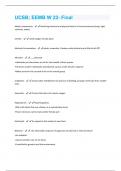
UCSB; EEMB W 22 - Final abiotic components - Nonliving chemical and physical factors in the environment (temp, light, nutrients, water) aerobis - needs oxygen to take place Alcoholic Fermentation - plants, anaerobic, Produces ethyl alcohol and a little bit of ATP Altruistic - ___ behavior -individuals put themselves at risk for the benefit of their species -Enhances another individuals reproductive success at the altruist's expense -Makes sense for the survival of kin or the overall group anabolism - Constructive metabolism; the process of building up larger molecules from smaller ones. Anaerobic - Process that does not require oxygen Angiosperms - flowering plants -90% of all plants that use a flower as a reproductive shoot -Flower structure can be male and/or female part Autotroph - An organism that makes its own food Behavior - -the observable response of organisms to external or internal stimuli -Are adaptive -natural selection can act on these -Controlled by genetics and the environment Behavioral plasticity - expression of behaviors will be expressed differently depending on the environment better - Acoustic sounds (alarm, sexual, social) travel ______ through water than air biotic components - living organisms of ecosystem (organisms, competition, predation, herbivory) carrying capacity - maximum population size that an environment can support Catabolism - destructive metabolism; the breaking down in living organisms of more complex substances into simpler ones, with the release of energy Cellular Respiration - -process of converting potential chemical energy (stored in carbohydrates) into usable biochemical energy (ATP) -produces; CO2 + H2O + ATP + heat E chlorophyll a - -green pigments that absorb red, violet and orange light to reflect green light -cause green plant color Chloroplast - Site of photosynthesis, green body, 2 outer membranes Citric Acid Cycle - (aka Krebs Cycle) -Occurs in mitochondria -Produces; 8 NADH, 2 FADH2, 2 ATP Coevolution - joint evolution of two closely interactive species, each species selects for traits in the other, shifting the range of adaptations
Exam (elaborations)
UCSB; EEMB W 22- Final Updated 2024/2025 with complete solutions
Rating
Sold
-
Pages
11
Grade
A+
Uploaded on
24-07-2024
Written in
2023/2024
abiotic components - Nonliving chemical and physical factors in the environment (temp, light, nutrients, water) aerobis - needs oxygen to take place Alcoholic Fermentation - plants, anaerobic, Produces ethyl alcohol and a little bit of ATP Altruistic - ___ behavior -individuals put themselves at risk for the benefit of their species -Enhances another individuals reproductive success at the altruist's expense -Makes sense for the survival of kin or the overall group anabolism - Constructive metabolism; the process of building up larger molecules from smaller ones. Anaerobic - Process that does not require oxygen Angiosperms - flowering plants -90% of all plants that use a flower as a reproductive shoot -Flower structure can be male and/or female part Autotroph - An organism that makes its own food Behavior - -the observable response of organisms to external or internal stimuli -Are adaptive -natural selection can act on these -Controlled by genetics and the environmentBehavioral plasticity - expression of behaviors will be expressed differently depending on the environment better - Acoustic sounds (alarm, sexual, social) travel ______ through water than air biotic components - living organisms of ecosystem (organisms, competition, predation, herbivory) carrying capacity - maximum population size that an environment can support Catabolism - destructive metabolism; the breaking down in living organisms of more complex substances into simpler ones, with the release of energy Cellular Respiration - -process of converting potential chemical energy (stored in carbohydrates) into usable biochemical energy (ATP) -produces; CO2 + H2O + ATP + heat E chlorophyll a - -green pigments that absorb red, violet and orange light to reflect green light -cause green plant color Chloroplast - Site of photosynthesis, green body, 2 outer membranes Citric Acid Cycle - (aka Krebs Cycle) -Occurs in mitochondria -Produces; 8 NADH, 2 FADH2, 2 ATP Coevolution - joint evolution of two closely interactive species, each species selects for traits in the other, shifting the range of adaptationsCommunication - -The use of specialized signals to modify behaviors of other organisms -Integration of chemical, visual and acoustic adaptations -For social, sexual, and defensive interaction community - 2+ populations living in the same geographical area
Show more
Read less
Institution
UCSB; EEMB W 22
Course
UCSB; EEMB W 22
Whoops! We can’t load your doc right now. Try again or contact support.
Written for
- Institution
- UCSB; EEMB W 22
- Course
- UCSB; EEMB W 22
Document information
- Uploaded on
- July 24, 2024
- Number of pages
- 11
- Written in
- 2023/2024
- Type
- Exam (elaborations)
- Contains
- Questions & answers
Subjects
Content preview
$7.99
Get access to the full document:
100% satisfaction guarantee
Immediately available after payment
Both online and in PDF
No strings attached

Also available in package deal
Package deal
EEMB EXAM PACKAGE DEAL 2024
7
2024
$ 55.93
More info