NUR3128 Final Exam Questions With Verified Answers.
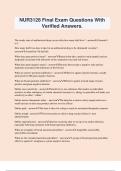
NUR3128 Final Exam Questions With Verified Answers. The steady state of antibacterial drugs occurs after how many half-lives? - answerAround 4 to 5 How many half lives does it take for an antibacterial drug to be eliminated via urine? - answerAround the 7th half life What does gram positive mean? - answerBacteria that take a positive stain (purple) and are frequently associated with infections of the respiratory tract and soft tissues What does gram negative mean? - answerBacteria that excepts a negative stain and are fequently associated with infections of the GI tract What are narrow spectrum antibiotics? - answerEffective against specific bacteria, usually gram positive OR gram negative bacteria What are broad spectrum antibiotics? - answerEffective against a broad range of gram- positive and gram-negative bacteria Define cross sensitivity - answerSensitivity to one substance that renders an individual sensitive to other substances of similar chemical structure (i.e. allergy to penicillin will make you sensitivity to other "-cillins". Define narrow therapeutic index. - answerThe drug has a narrow safety margin and even a small increase in dose may produce adverse or toxic effects Define peak - answerThe time it takes for a drug to reach its maximum therapeutic response Define trough - answerThe lowest point at which a drug reaches before it's next administration Define superinfection - answerinfection occurring after or on top of an earlier infection, especially following treatment with broad-spectrum antibiotics. What are examples of broad spectrum penicillins? - answerAmpicillin, amoxicillin, amoxicillin-clavulanate What are the extended spectrum penicillins? - answerA group of broad spectrum penicillins effective against P. aeruginosa, a gram negative bacteria. What are examples of extended spectrum penicillins? - answerPiperacillin tazobactam What are the beta-lactam antibiotics? - answerA broad spectrum antibiotic is combined with a beta-lactamase enzyme inhibitor, which helps make the antibiotic more effective and extends its effect. What are examples of beta-lactam antibiotics? - answerAztreonam, meropenem What are cephalosporins? - answerA type of antibiotic that is effective against gram negative and gram positive bacteria, as well as resistant to beta-lactamase, so it can easily penetrate bacteria cell walls. What are examples of cephalosporins? - answerCefazolin, Ceftriaxon, Cefuroxime, Cefdinir, Cefepime What is penicillin G used for? - answerStreptococcal infections, such as syphilis, meningitis, endocarditis, pneumonia, serious respiratory infections What is amoxicillin used for? - answerUTI's, sinusitis, otitis, and lower respiratory tract infections What is ampicillin used for? - answerUsed to treat skin infections, soft tissue infections, otitis media (inflammation of middle ear), sinusitis, respiratory infections, meningitis, septicemia What are the adverse reactions to ampicillin? - answerCDAD Diarrhea Rash Seizures (with high doses) Anaphylaxis and serum sickness (allergy) What is amoxicillin-clavulanate used for? - answerTreatment of sinusitis, RTIs, genitourinary tract infections. What are the adverse reactions to amoxicillin-clavulanate? - answerCDAD Diarrhea Rash Seizures (with high doses) Anaphylaxis and serum sickness (allergy) What is the overall desired effect of using anti-infective medications? - answerElimination of infection What is ciprofloxacin used for? - answerAnthrax and some variations of the plague; but also UTIs, lower respiratory tract infections, some forms of gonorrhea. What is vancomycin used for? - answerGram positive severe infections, such as MRSA, enterococci and Clostridium difficile (C-Diff) What adverse reactions are associated with vancomycin? - answerAnaphylaxis and red-man syndrome (occurs with rapid transfusion) What are the Fluroquinolones? - answerA group of broad spectrum antibiotics used for their treatment of UTIs, bone and joint infections, bronchitis, pneumonia, and gastroenteritis. Should be used as last resort antibiotics due to strong adverse reactions. What items should be avoided before or after taking antibiotics? - answerAntacids, milk, iron, alcohol, grapefruit What adverse reactions are associated with fluroquinolones? - answerTendinitis, tendon rupture What tests are done to identify TB infection? - answerTB skin test (PPD), and TB blood test (QuantiFERON) What are antituberculars? - answerDrugs that treat tuberculosis What is latent infection of TB? - answerPeople who harbor TB microorganisms, and may become active later in life. What is active infection of TB? - answerWhen a person is actively infected with TB What are symptoms of TB? - answerAnorexia, productive cough with blood, chest pain, fever, night sweats, weight loss What are prophylactic TB antibiotics? - answerAntitubercular drugs designed to prevent active TB infection in latently infected TB holders. Who is prophylactic treatment recommend for when it comes to TB? - answer· Latent TB infection · Immunocompromised · Positive tuberculin skin test · Positive iGRA results · Converted from negative to positive TB Who should not receive prophylactic TB treatment? - answerThose with liver disease because INH (the primary anti-TB drug used) can damage the liver.
Written for
- Institution
- NUR 3128
- Course
- NUR 3128
Document information
- Uploaded on
- July 21, 2024
- Number of pages
- 23
- Written in
- 2023/2024
- Type
- Exam (elaborations)
- Contains
- Questions & answers
Subjects
-
nur3128 final exam questions with verified answers

Also available in package deal