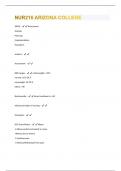
NUR216 ARIZONA COLLEGE QUESTIONS WITH 100% CORRECT ANSWERS!!
AAPIE - Assessment Analysis Planning Implementation Evaluation analysis - Assessment - BMI ranges - underweight: <18.5 normal: 18.5-24.9 overweight: 25-29.9 obese: >30 Brachycardia - when heartbeat is < 60 ethical principles of nursing - Evlauation - GCS Score Motor - Motor -6 Obeys verbal commands to move +Moves due to stimuli -5 Localizes pain -4 Flexion/Withdrawal from pain-3 Decorticate posture -2 Decerebrate posture -1 Unresponsive GCS scoring eyes - Eyes -4 Open spontaneously -3 Opens on verbal -2 Opens on pain -1 Unresponsive GCS Scoring: Verbal - Speech -5 Speaks spontaneously, makes sense -4 Speaks spontaneously, but is confused -3 Speaks spontaneously, does NOT make sense -2 Makes only sounds -1 Unresponsive General Survey: Behavior - facial expression, mood and affect, speech, speech pattern, dress (appropriate to weather), personal hygiene General Survey: Body Structure - stature, nutrition, symmetry, posture, position, body build, contour General Survey: Mobility - -Gait -Range of Motion (ROM) General Survey: Physical Appearance - age, sex, level of consciousness, skin color, facial features Glascow Coma Scale (GCS) - Neurologic assessment of* verbal response *eye opening *motor function. health assessment tools - Highest GCS score - 15 fully awake implementation - lowest GCS score - 3 -coma or death Normal heart rate - 60-100 beats per minute Normal oral temperature - 97.6F - 99.6F objective data - information that is seen, heard, felt, or smelled by an observer; signs Pain Assessment PQRST - Provocative or Palliative (what makes it worse/better) Quality or Quantity (For example, is the pain sharp or dull, throbbing?) region or Radiation(Location) Severity Scale (Numeric pain intensity scale) Timing (Onset) Understand Patient's Perception (Activities of Daily Living assessment) pain response - - Sensation produced by tissue-damaging stimulus or stimulus that can potentially cause tissue damage - Pain elicits sensation, autonomic responses, and emotional responses- Pain perception depends on past experiences Physical Assessment Techniques - Inspection Palpation Percussion Auscultation Planning - PQRST - provocative/palliative, quality, region/radiation, severity, timing review of systems - physical examination of all body systems in a systematic manner as part of the nursing assessment subjective data - things a person tells you about that you cannot observe through your senses; symptoms Tachycardia - rapid heart rate over 100 beats per minute What is a 'General Survey'? - Begins the moment you first encounter a patient. *Physical Appearance *Behavior *Body Structure *Mobility.
Written for
- Institution
- NUR216 ARIZONA COLLEGE
- Course
- NUR216 ARIZONA COLLEGE
Document information
- Uploaded on
- July 19, 2024
- Number of pages
- 4
- Written in
- 2023/2024
- Type
- Exam (elaborations)
- Contains
- Questions & answers
Subjects

Also available in package deal