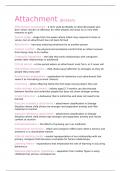
Attachment glossary
Affectionless psychopath – a term used by Bowlby to describe people who
don’t show concern or affection for other people and show no or very little
remorse or guilt
Asocial stage – stage from 0-6 weeks where infant may respond to faces or
voices, but an attachment has not been formed
Attachment – two-way enduring emotional tie to another person
Contact comfort – the physical and emotional comfort that an infant receives
from being close to its mother
Continuity Hypothesis – the idea that early relationships with caregivers
predict later relationships in adulthood
Critical period – a time period where an attachment must form, or it never will
Disinhibited attachment – child shows equal affection to strangers as they do
people they know well
Evolutionary explanation – explanation for behaviour such attachment that
views it as increasing survival chances
Imprinting – where offspring follow the first large-moving object they see
Indiscriminate attachment – infants aged 2-7 months can discriminate
between familiar and unfamiliar people but does not show stranger anxiety
Innate behaviour – a behaviour that is instinctive and does not need to be
learned
Insecure avoidance attachment – attachment classification in Strange
Situation where child shows low stranger and separation anxiety and little
response to reunion
Insecure resistance attachment – attachment classification in Strange
Situation where child shows high stranger and separation anxiety and resists
comfort at reunion
Institutionalisation – the effects of growing up in an institution
Interactional synchrony – infant and caregiver reflect each other’s actions and
emotions in a coordinated manner
Internal working model – mental representation of our relationship with our
primary caregiver that becomes a template for future relationships
Learning theory – explanations that emphasise the role of learning in ac1uiring
behaviours
Maternal deprivation hypothesis – separation from mother figure in early
childhood has serious consequences
Affectionless psychopath – a term used by Bowlby to describe people who
don’t show concern or affection for other people and show no or very little
remorse or guilt
Asocial stage – stage from 0-6 weeks where infant may respond to faces or
voices, but an attachment has not been formed
Attachment – two-way enduring emotional tie to another person
Contact comfort – the physical and emotional comfort that an infant receives
from being close to its mother
Continuity Hypothesis – the idea that early relationships with caregivers
predict later relationships in adulthood
Critical period – a time period where an attachment must form, or it never will
Disinhibited attachment – child shows equal affection to strangers as they do
people they know well
Evolutionary explanation – explanation for behaviour such attachment that
views it as increasing survival chances
Imprinting – where offspring follow the first large-moving object they see
Indiscriminate attachment – infants aged 2-7 months can discriminate
between familiar and unfamiliar people but does not show stranger anxiety
Innate behaviour – a behaviour that is instinctive and does not need to be
learned
Insecure avoidance attachment – attachment classification in Strange
Situation where child shows low stranger and separation anxiety and little
response to reunion
Insecure resistance attachment – attachment classification in Strange
Situation where child shows high stranger and separation anxiety and resists
comfort at reunion
Institutionalisation – the effects of growing up in an institution
Interactional synchrony – infant and caregiver reflect each other’s actions and
emotions in a coordinated manner
Internal working model – mental representation of our relationship with our
primary caregiver that becomes a template for future relationships
Learning theory – explanations that emphasise the role of learning in ac1uiring
behaviours
Maternal deprivation hypothesis – separation from mother figure in early
childhood has serious consequences