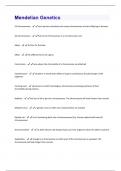
Mendelian Genetics Exam Questions And Answers Rated A+ New Update Assured Satisfaction
23 chromosomes - each parent contributes this many chromosomes to their offspring in humans. 46 chromosomes - Full set of chromosomes in a normal human cell. Adele - Set Fire To The Rain Allele - the different forms of a gene. Centromere - area where the chromatids of a chromosome are attached Codominance - situation in which both alleles of a gene contribute to the phenotype of the organism Crossing over - process in which homologous chromosomes exchange portions of their chromatids during meiosis deletion - the loss of all or part of a chromosome. The chromosome will look shorter than normal. Dihybrid cross - a genetic cross in which two characteristics are tracked Diploid cell - A cell containing both sets of chromosomes (2n). Human diploid cells have 46 chromosomes. Dominant allele - an allele whose trait always shows up in the organism when the allele is present duplication - change to a chromosome in which part of the chromosome is repeated. The chromosome will look longer than normal.Genotype - An organism's genetic makeup, or allele combinations. Genotypic ratio - the ratio of genotypes that could appear in offspring Goat trait that showed complete dominance - Coat color Goat trait that showed incomplete dominance - Ear size Gregor Mendel - Father of genetics. Experimented with pea plants and discovered law of dominance, ind. assortment, and segregation. Haploid cell - a cell containing only one set of chromosomes (n). Human haploid cells have 23 chromosomes. Only in sperm and egg cells. Heterozygous - Having two different alleles for a trait
Written for
- Institution
- Mendelian Genetics
- Course
- Mendelian Genetics
Document information
- Uploaded on
- July 18, 2024
- Number of pages
- 4
- Written in
- 2023/2024
- Type
- Exam (elaborations)
- Contains
- Questions & answers
Subjects

Also available in package deal