Mendelian & Non-Mendelian Genetics Questions With 100 % Correct Answers | latest
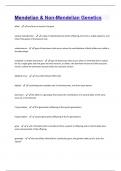
allele - one form or version of a gene asexual reproduction - a type of reproduction by which offspring arise from a single organism, and inherit the genes of that parent only codominance - type of dominance that occurs when the contributions of both alleles are visible in the phenotype complete or simple dominance - type of dominance that occurs when an inherited trait is coded for by a single gene and that gene has two versions, or alleles: the dominant version and the recessive version, where the dominant version masks the recessive version dihybrid cross - cross that follows TWO traits diploid - containing two complete sets of chromosomes, one from each parent dominant - the allele in a genotype that masks the contribution of a second allele at the same locus on a chromosome F1 generation - first generation (offspring of the parent generation) F2 generation - second generation (offspring of the F1 generation) gene - a unit of heredity that is transferred from a parent to offspring and is held to determine some characteristic of the offspring genotype - the two alleles inherited for a particular gene; the genetic make up of a trait; the "genes"Gregor Mendel - an Austrian monk who discovered the basic principles of heredity through experiments in his garden haploid - having a single set of unpaired chromosomes hemophilia - a genetic disorder caused by missing or defective factor VIII, a clotting protein. heredity - passing of traits from parents to their offspring, either through reproduction heterozygous - description of a genotype of an individual who has two different alleles, one dominant and the other recessive homozygous - description of a genotype of an individual who has two of the same allele, whether dominant or recessive hybrid - an individual with a heterozygous genotype incomplete dominance - type of dominance that occurs when the phenotype of the heterozygous phenotype is distinct from and often intermediate to the phenotypes of the homozygous phenotypes Law of Independent Assortment - the principle, originated by Gregor Mendel, stating that when two or more characteristics are inherited, individual hereditary factors line up independently during gamete production, giving different traits an equal opportunity of occurring together Law of Segregation - the principle, originated by Gregor Mendel, stating that during the production of gametes the two copies of each hereditary factor separate so that offspring acquire one factor from each parent meiosis - a type of cell division that results in four daughter cells each with half the number of chromosomes of the parent cellmonohybrid cross - cross that follows just ONE trait multiple alleles - three or more alternative forms or versions of a gene P generation - parent generation
Written for
- Institution
- Mendelian & Non-Mendelian Genetics
- Course
- Mendelian & Non-Mendelian Genetics
Document information
- Uploaded on
- July 18, 2024
- Number of pages
- 4
- Written in
- 2023/2024
- Type
- Exam (elaborations)
- Contains
- Questions & answers
Subjects
-
mendelian non mendelian genetics

Also available in package deal