Biopsychology – Paper 2
The Nervous System
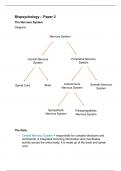
Diagram:
Nervous System
Central Nervous Peripheral Nervous
System System
Spinal Cord Brain Autonomous Somatic Nervous
Nervous System System
Sympathetic Parasympathetic
Nervous System Nervous System
The Role:
- Central Nervous System = responsible for complex decisions and
commands. It integrates incoming information and coordinates
activity across the entire body. It is made up of the brain and spinal
cord.
, - Brain = is an organ made up of a mass of nerve tissue. It’s the
centre of conscious awareness and allows us to have higher
mental processes.
- Spinal Cord = extension of the brain, it passes messages to and
from the brain. It connects to the peripheral nervous system.
- Peripheral Nervous System = sends messages to and from the
central nervous system and controls muscles and glands.
- Somatic Nervous System = is a voluntary part of the peripheral
nervous system, controls muscle movement ad receives
information from sensory receptors on the body. Works with the
central nervous system to direct muscles to act.
- Sympathetic Nervous System = the flight or fright response
prepares the body to respond to threats by releasing adrenaline
and stimulating a heartbeat.
- Parasympathetic Nervous System = the rest and digest response
which restores the body back to its usual state or relaxation.
The Nervous and Endocrine System
Organ Sympathetic Nervous System
Gut Slows digestion Increases digestion
Salivary Inhibits saliva production Increases saliva production
Gland
Heart Increase heart rate Decreases heart rate
Liver Stimulates glucose production Stimulates bile production
Lungs Dilates bronchi Constricts bronchi
Bladder Inhibits urination Decreases urination
Eyes Dilates pupils Constricts dilation
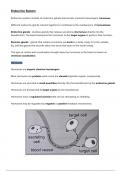
The Endocrine System:
- Is composed of glands that secrete hormones directly into the
bloodstream.
- Blood carries hormones around the body and when it reaches a
target cell or organ, it produces an effect compared to the
The Nervous System
Diagram:
Nervous System
Central Nervous Peripheral Nervous
System System
Spinal Cord Brain Autonomous Somatic Nervous
Nervous System System
Sympathetic Parasympathetic
Nervous System Nervous System
The Role:
- Central Nervous System = responsible for complex decisions and
commands. It integrates incoming information and coordinates
activity across the entire body. It is made up of the brain and spinal
cord.
, - Brain = is an organ made up of a mass of nerve tissue. It’s the
centre of conscious awareness and allows us to have higher
mental processes.
- Spinal Cord = extension of the brain, it passes messages to and
from the brain. It connects to the peripheral nervous system.
- Peripheral Nervous System = sends messages to and from the
central nervous system and controls muscles and glands.
- Somatic Nervous System = is a voluntary part of the peripheral
nervous system, controls muscle movement ad receives
information from sensory receptors on the body. Works with the
central nervous system to direct muscles to act.
- Sympathetic Nervous System = the flight or fright response
prepares the body to respond to threats by releasing adrenaline
and stimulating a heartbeat.
- Parasympathetic Nervous System = the rest and digest response
which restores the body back to its usual state or relaxation.
The Nervous and Endocrine System
Organ Sympathetic Nervous System
Gut Slows digestion Increases digestion
Salivary Inhibits saliva production Increases saliva production
Gland
Heart Increase heart rate Decreases heart rate
Liver Stimulates glucose production Stimulates bile production
Lungs Dilates bronchi Constricts bronchi
Bladder Inhibits urination Decreases urination
Eyes Dilates pupils Constricts dilation
The Endocrine System:
- Is composed of glands that secrete hormones directly into the
bloodstream.
- Blood carries hormones around the body and when it reaches a
target cell or organ, it produces an effect compared to the