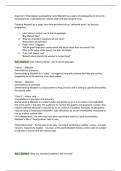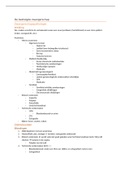
Argument: Shakespeare purposefully wrote Macbeth as a piece of propaganda to show the
consequences of disrupting the natural order and betraying the king.
Tracking Macbeth as a tragic hero who devolves into an “abhorred tyrant” as the play
progresses.
1. “Like Valour’s minion carv’d out his passage”
“Brandished steel”
2. “Stay you imperfect speakers tell me more”
“Instruments of darkness”
3. “Fatal vision” (Dagger)
“Will all great Neptune’s ocean wash this blood clean from my hands? No”
“Give to the edge of the sword, his wife, his babes”
4. “Turn, hell-hound, turn”
“Behold where stands the usurper’s cursed head”
Act1, Scene 2 “Like Valour’s minion, carv’d out his passage”
“Valour” - adjective
Connotations of bravery
Demonstrating Macbeth is a “noble”, courageous hero who protects his King and country,
suggesting he is the epitome of an ideal soldier.
“Minion” - adjective
Connotations of servitude
Demonstrating Macbeth is a loyal soldier to King Duncan and is willing to uphold and protect
the natural order.
“Carv’d” - violent verb
Connotations of precision and accuracy
Demonstrating Macbeth is a skilful soldier and almost as if he is an artist on the battlefield.
Yet at this point in the play, the audience do not fear the graphic and gruesome scenes, they
instead celebrate Macbeth’s masculinity as his violence is justified. Ironically, Shakespeare
may be trying to foreshadow Macbeth’s later devolution as we are immediately introduced to
him as a blood-soaked killer.
On a deeper level, this verb may have been specifically used as it also foreshadows
Macbeth’s title of “dead butcher” later in play.
“Brandished steel” - At this point in the play, the sword symbolises (nobility, honour, courage,
heroism, masculinity, loyalty) - it is clear at this point Macbeth follows a strict code of conduct
to uphold his honour and the natural order.
Act 1, Scene 3 “Stay you imperfect speakers, tell me more”
consequences of disrupting the natural order and betraying the king.
Tracking Macbeth as a tragic hero who devolves into an “abhorred tyrant” as the play
progresses.
1. “Like Valour’s minion carv’d out his passage”
“Brandished steel”
2. “Stay you imperfect speakers tell me more”
“Instruments of darkness”
3. “Fatal vision” (Dagger)
“Will all great Neptune’s ocean wash this blood clean from my hands? No”
“Give to the edge of the sword, his wife, his babes”
4. “Turn, hell-hound, turn”
“Behold where stands the usurper’s cursed head”
Act1, Scene 2 “Like Valour’s minion, carv’d out his passage”
“Valour” - adjective
Connotations of bravery
Demonstrating Macbeth is a “noble”, courageous hero who protects his King and country,
suggesting he is the epitome of an ideal soldier.
“Minion” - adjective
Connotations of servitude
Demonstrating Macbeth is a loyal soldier to King Duncan and is willing to uphold and protect
the natural order.
“Carv’d” - violent verb
Connotations of precision and accuracy
Demonstrating Macbeth is a skilful soldier and almost as if he is an artist on the battlefield.
Yet at this point in the play, the audience do not fear the graphic and gruesome scenes, they
instead celebrate Macbeth’s masculinity as his violence is justified. Ironically, Shakespeare
may be trying to foreshadow Macbeth’s later devolution as we are immediately introduced to
him as a blood-soaked killer.
On a deeper level, this verb may have been specifically used as it also foreshadows
Macbeth’s title of “dead butcher” later in play.
“Brandished steel” - At this point in the play, the sword symbolises (nobility, honour, courage,
heroism, masculinity, loyalty) - it is clear at this point Macbeth follows a strict code of conduct
to uphold his honour and the natural order.
Act 1, Scene 3 “Stay you imperfect speakers, tell me more”