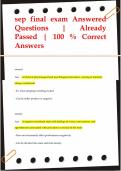
sep final exam Answered
Questions | Already
Passed | 100 % Correct
Answers
arousal
Ans: A blend of physiological and psychological activation, varying in intensity
along a continuum
- Ex. from sleeping to feeling excited
- Can be either positive or negative
anxiety
Ans: A negative emotional state with feelings of worry, nervousness, and
apprehension associated with activation or arousal of the body
- Does not necessarily affect performance negatively
- Can be divided into state and trait anxiety
,state anxiety
Ans: - Refers to the ever-changing mood component
- Cognitive state anxiety: worries
- Somatic state anxiety: physiological activation, heart racing
- It is a right-now feeling of nervousness and apprehension that can change from
moment to moment
trait anxiety
Ans: - A personality disposition that is stable over time
- People with high trait anxiety usually have more state anxiety in highly evaluative
situations
measuring arousal and anxiety
Ans: - Global and multidimensional self-report scales
-- Competitive state anxiety inventory
-- Sport competition anxiety test
-- Sport anxiety scale
- Psychological signs
-- Heart rate
,-- Biochemistry
symptoms of arousal and state anxiety
Ans: - Cold, clammy hands
- Constant need to urinate
- Profuse sweating
- Negative self-talk
- Dazed look in eyes
- Feeling ill
- Headache
- Dry mouth
- Constant sickness
- Difficulty sleeping
- Increased muscle tension
- Butterflies in stomach
- Inability to concentrate
- Consistently better performance in non-evaluative situations
stress
, Ans: - Imbalance between demand (physical and/or psychological) and response
capability under conditions where failure has important consequences
- Stress is a sequence of events that will lead to a particular end
-- Environmental demand
-- Perception of demand
-- Stress response
-- Behavioral consequences
the stress process
Ans: - Environmental demand
-- Some type of demand is placed on an individual
-- Demand might be physical (ex. skill demonstration) or psychological (ex. pressure)
- Perception of demand
-- People do not perceive demands in the same way
-- Level of trait anxiety greatly influences it
- Stress response
-- Physical and psychological response to a perception of the situation (ex. imbalance
between demands and response capability -> high stress
- Behavioral consequences
Questions | Already
Passed | 100 % Correct
Answers
arousal
Ans: A blend of physiological and psychological activation, varying in intensity
along a continuum
- Ex. from sleeping to feeling excited
- Can be either positive or negative
anxiety
Ans: A negative emotional state with feelings of worry, nervousness, and
apprehension associated with activation or arousal of the body
- Does not necessarily affect performance negatively
- Can be divided into state and trait anxiety
,state anxiety
Ans: - Refers to the ever-changing mood component
- Cognitive state anxiety: worries
- Somatic state anxiety: physiological activation, heart racing
- It is a right-now feeling of nervousness and apprehension that can change from
moment to moment
trait anxiety
Ans: - A personality disposition that is stable over time
- People with high trait anxiety usually have more state anxiety in highly evaluative
situations
measuring arousal and anxiety
Ans: - Global and multidimensional self-report scales
-- Competitive state anxiety inventory
-- Sport competition anxiety test
-- Sport anxiety scale
- Psychological signs
-- Heart rate
,-- Biochemistry
symptoms of arousal and state anxiety
Ans: - Cold, clammy hands
- Constant need to urinate
- Profuse sweating
- Negative self-talk
- Dazed look in eyes
- Feeling ill
- Headache
- Dry mouth
- Constant sickness
- Difficulty sleeping
- Increased muscle tension
- Butterflies in stomach
- Inability to concentrate
- Consistently better performance in non-evaluative situations
stress
, Ans: - Imbalance between demand (physical and/or psychological) and response
capability under conditions where failure has important consequences
- Stress is a sequence of events that will lead to a particular end
-- Environmental demand
-- Perception of demand
-- Stress response
-- Behavioral consequences
the stress process
Ans: - Environmental demand
-- Some type of demand is placed on an individual
-- Demand might be physical (ex. skill demonstration) or psychological (ex. pressure)
- Perception of demand
-- People do not perceive demands in the same way
-- Level of trait anxiety greatly influences it
- Stress response
-- Physical and psychological response to a perception of the situation (ex. imbalance
between demands and response capability -> high stress
- Behavioral consequences