BSNC 1000 Module 2: Growth & Development Questions & Answers(RATED A+)
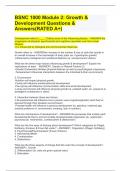
Development refers to ____. Outline some of the influencing factors. - ANSWER-the progression of physical, psychosocial and cognitive capacities over the human lifespan. -It is influenced by biological and environmental influences Growth refers to - ANSWERan increase in the number & size of cells that results in an overall increase in the size/weight of body parts (ex. hypertrophic growth) -Influenced by biological and contextual features (ie. socioeconomic status) What are the three major factors influencing growth & development? Explain the implications of each. - ANSWER1. Genetic or Natural Factors (2) -Genetic Endowment dictates physical features as well as psychological uniqueness. -Temperament influences interactions between the individual & their environment) 2. Environment -Nutrition will impact physical growth -Family will influence emotional/social development -Peer group will influence communication skills and social development -Living environment will influence physical growth (ie. polluted water, air, exposure to teratogenic substances in utero) 3. Interaction between these two factors -Life experiences will influence how a person uses (cognitive/genetic) what they've learned through their situation (environment) -Prenatal health will influence a persons development (ie. genetics; maternal age, medical problems vs. environment; smoking, lack of nutrition) What are mechanisms of development? - ANSWER-the processes that underly each developmental theory and and enable developmental progression (ie. organicism, psychosocial, mechanistic, contextualism & dialecticism) What are the five ways of thinking about development? Which categories do Piaget, Kolhberg, Erickson & Freud fall under? - ANSWER1. Organicism (Piaget, Kohlberg) 2. Psychosocial/Psychoanalytic (Freud, Erikson) 3. Mechanistic/Motor 4. Contextualism 5. Dialecticism What are the three aspects of change that fall under the concept of development? - ANSWER1. Growth 2. Differentiation (ie. cells are given special roles) 3. Maturation List the age groups (in order) in which growth & development are usually tracked (10). - ANSWER1. Embryologic 2. Infant 3. Toddler 4. Preschool 5. School age 6. Adolescent 7. Young adult 8. Adult 9. Middle Age 10. Older adult ex. Deciduous Teeth normally begin to come in around 6mo after birth. However, mine came in around 1yr of age, therefore I was delayed in my infant stage. List 6 risk factors for growth & development. - ANSWER1. Prenatal factors (ie. folic acid, smoking) 2. Birth Factors (ie. umbilical cord around neck, premature) 3. Family factors (ie. abusive family dynamics may delay a child's psychosocial development) 4. Situational factors (ie. living in a poor country may mean lack of access to adequate nutrition; delayed in physical development) 5. Individual factors (ie. ADHD may delay a child's cognitive development) 6. DoH (ie. Access to quality education may advance/delay a child's cognitive development) What stages of the lifespan are most effected by the presence of risk factors in terms of growth & development? - ANSWERStages of rapid growth : -Embryologic -Infant -Toddler
Written for
- Institution
- BSNC 1000 Module 2:
- Course
- BSNC 1000 Module 2:
Document information
- Uploaded on
- July 16, 2024
- Number of pages
- 16
- Written in
- 2023/2024
- Type
- Exam (elaborations)
- Contains
- Questions & answers
Subjects
-
bsnc 1000 module 2 growth development questions
-
bsnc 1000 module 2 stuvia 2024
-
development refers to outline some of the i
-
growth refers to answeran increase in the number

Also available in package deal