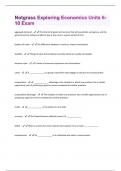
Notgrass Economics - Exam #2 Questions And Answers Graded A+
absolute advantage - when one person or country can produce goods with a smaller input of resources than another business cycle - expansion, peak, recession, trough capital gains - the increase in value of capital assets cause market failures - monopolies, taxes, regulations closed shop laws - require that in certain industries, workers have to be members of a labor union comparative advantage - when one producer has a smaller opportunity cost of producing a good or service compared to another producer complementary goods - goods that are commonly bought together, so much so that a change in price for one product leads to a change in demand for the other corporation - a separate entity from the owners and directors, is chartered, has a board of directors currency exchange rate - the price of one country's currency expressed in terms of another country's currency dead weight loss - a reduction in efficiency that leads to a loss in profit or a loss to society derived demand - demand by a producer for a factor of production that occurs as a result of the production of another product or servicedeterminants of supply - price of the good, disposable income, price of resources discount rate - the interest that the Fed charges banks for loans of its funds economic profit - determined by subtracting the opportunity cost as well as the ledger costs from the revenue factors that increase trade - better communication, better transportation, lower transaction costs fiat currency - money that has value by the declaration of a nation's government that the money is legal tender fractional reserve banking - the practice of loaning out the majority of the money that a bank has on deposit functional distribution of income - a measure of income among different businesses and occupations in the economy inflation - a general increase in prices for goods and services interest - the price of money law of demand - when the price of a good or service reuses, demand falls law of diminishing marginal returns - the productivity of an input decreases as the quantity of the input increases law of supply - as the price for a product or service increases, production will increaselaw of supply and demand - the price of a product or service adjusts to bring supply and demand into balance liquidity - the ease with which an asset can be turned into money marginal analysis - study of factors that lead to a change in business behavior markets - accomplish the allocation of resources, determine prices minimum wage - price floor on wages money - a medium of exchange
Written for
- Institution
- Notgrass Economics
- Course
- Notgrass Economics
Document information
- Uploaded on
- July 16, 2024
- Number of pages
- 4
- Written in
- 2023/2024
- Type
- Exam (elaborations)
- Contains
- Questions & answers
Subjects

Also available in package deal