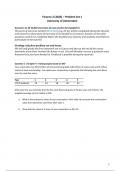
Finance 2 (2023) – Problem Set 1
University of Amsterdam
Answers to IN CLASS exercises do not need to be handed in
The parts of exercises marked [IN CLASS] (e.g. 2h-2j.) will be completed during the tutorial
and answers to these parts do not need to be handed in via Canvas. Answers to the other
questions need to be completed before the deadline (see Canvas) and students need them to
participate in the tutorial.
Grading: only first problem set and bonus
We will only grade the first homework set in Canvas and then at the end of the course
determine if you have received the bonus or not. You will therefore not see a grade for each
homework set you have handed in. Feedback is possible during the tutorials.
Question 1 | Chapter 9 - Valuing equity based on DCF
Your corporation has $150 million of interest-bearing debt, $40 million of excess cash and 9 million
shares of stock outstanding. You expect your corporation to generate the following free cash flows
over the next five years:
Year 1 2 3 4 5
FCF ($ millions) 15 20 18 20 25
After year five, you estimate that the free cash flows will grow at 3% per year until infinity. The
weighted average cost of capital is 10%.
a. What is the enterprise value of your corporation? Hint: take into account the continuation
value that represents cash flows after year 5.
b. Show that the value of a share of your corporation is $21.25.
1
,Question 2 | Chapter 12 - Debt & asset beta's and costs of capital
Consider the following information regarding corporate bonds.
Rating AAA AA A BBB BB B CCC
Average Default Rate 0.0% 0.1% 0.2% 0.45% 2.2% 5.5% 12.2%
Recession Default Rate 0.0% 1.0% 3.0% 3.0% 8.0% 16.0% 48.0%
Average Beta 0.05 0.05 0.05 0.10 0.17 0.26 0.31
Total
Market Enterprise
Capitalization Value Equity Debt
Company ($million) ($million) Beta Rating
Taggart Transcontinental $4500 $8000 1.1 BBB
Rearden Metal $3800 $7200 1.3 AAA
Wyatt Oil $2400 $3800 0.9 A
Nielson Motors $1500 $4400 1.75 BB
Assume the current risk-free rate is 2% and the market’s return is 7%.
a. What is the debt beta for Taggart Transcontinental?
b. What is the asset beta for Taggart Transcontinental?
c. What is the asset beta for Nielson Motors?
d. What is the debt cost of capital for Taggart Transcontinental?
e. Explain why the debt cost of capital is often lower than the yield on the debt.
f. What is the equity cost of capital for Taggart Transcontinental?
g. What is the unlevered (or asset) cost of capital for Taggart Transcontinental?
h. Explain in words what the debt and asset beta’s indicate. Is it logical that the beta of debt is
lower than the beta of assets? What about the beta of equity? [IN CLASS]
i. Explain in words what the debt, equity and asset cost of capital indicate. [IN CLASS]
j. If Taggart Transcontinental were to change its capital structure (i.e. change its D/V and E/V
ratio), would you expect that the unlevered (or asset) cost of capital of Taggart would also
change? Explain why or why not. [IN CLASS]
2
, Problem set 1
Question 1
Your corporation has $150 million of interest-bearing debt, $40 million of excess cash
and 9 million shares of stock outstanding. You expect your corporation to generate the
following free cash flows over the next five years:
Year 1 2 3 4 5
FCF ($ millions) 15 20 18 20 25
A er year five, you estimate that the free cash flows will grow at 3% per year until
infinity. The weighted average cost of capital is 10%.
a.
Enterprise value: V₀ = (.1) + (.1 ²) + (.1 ³) + (.1 ⁴) + (.1 ⁵) +
((25 * 1.03 / (0.1 - 0.03) / 1.1 ⁵) = $301.28 million
b.
Share price: P₀ = (V₀ + cash - debt) / shares outstanding = (301.28 + 40 - 150) / 9 =
$21.25
University of Amsterdam
Answers to IN CLASS exercises do not need to be handed in
The parts of exercises marked [IN CLASS] (e.g. 2h-2j.) will be completed during the tutorial
and answers to these parts do not need to be handed in via Canvas. Answers to the other
questions need to be completed before the deadline (see Canvas) and students need them to
participate in the tutorial.
Grading: only first problem set and bonus
We will only grade the first homework set in Canvas and then at the end of the course
determine if you have received the bonus or not. You will therefore not see a grade for each
homework set you have handed in. Feedback is possible during the tutorials.
Question 1 | Chapter 9 - Valuing equity based on DCF
Your corporation has $150 million of interest-bearing debt, $40 million of excess cash and 9 million
shares of stock outstanding. You expect your corporation to generate the following free cash flows
over the next five years:
Year 1 2 3 4 5
FCF ($ millions) 15 20 18 20 25
After year five, you estimate that the free cash flows will grow at 3% per year until infinity. The
weighted average cost of capital is 10%.
a. What is the enterprise value of your corporation? Hint: take into account the continuation
value that represents cash flows after year 5.
b. Show that the value of a share of your corporation is $21.25.
1
,Question 2 | Chapter 12 - Debt & asset beta's and costs of capital
Consider the following information regarding corporate bonds.
Rating AAA AA A BBB BB B CCC
Average Default Rate 0.0% 0.1% 0.2% 0.45% 2.2% 5.5% 12.2%
Recession Default Rate 0.0% 1.0% 3.0% 3.0% 8.0% 16.0% 48.0%
Average Beta 0.05 0.05 0.05 0.10 0.17 0.26 0.31
Total
Market Enterprise
Capitalization Value Equity Debt
Company ($million) ($million) Beta Rating
Taggart Transcontinental $4500 $8000 1.1 BBB
Rearden Metal $3800 $7200 1.3 AAA
Wyatt Oil $2400 $3800 0.9 A
Nielson Motors $1500 $4400 1.75 BB
Assume the current risk-free rate is 2% and the market’s return is 7%.
a. What is the debt beta for Taggart Transcontinental?
b. What is the asset beta for Taggart Transcontinental?
c. What is the asset beta for Nielson Motors?
d. What is the debt cost of capital for Taggart Transcontinental?
e. Explain why the debt cost of capital is often lower than the yield on the debt.
f. What is the equity cost of capital for Taggart Transcontinental?
g. What is the unlevered (or asset) cost of capital for Taggart Transcontinental?
h. Explain in words what the debt and asset beta’s indicate. Is it logical that the beta of debt is
lower than the beta of assets? What about the beta of equity? [IN CLASS]
i. Explain in words what the debt, equity and asset cost of capital indicate. [IN CLASS]
j. If Taggart Transcontinental were to change its capital structure (i.e. change its D/V and E/V
ratio), would you expect that the unlevered (or asset) cost of capital of Taggart would also
change? Explain why or why not. [IN CLASS]
2
, Problem set 1
Question 1
Your corporation has $150 million of interest-bearing debt, $40 million of excess cash
and 9 million shares of stock outstanding. You expect your corporation to generate the
following free cash flows over the next five years:
Year 1 2 3 4 5
FCF ($ millions) 15 20 18 20 25
A er year five, you estimate that the free cash flows will grow at 3% per year until
infinity. The weighted average cost of capital is 10%.
a.
Enterprise value: V₀ = (.1) + (.1 ²) + (.1 ³) + (.1 ⁴) + (.1 ⁵) +
((25 * 1.03 / (0.1 - 0.03) / 1.1 ⁵) = $301.28 million
b.
Share price: P₀ = (V₀ + cash - debt) / shares outstanding = (301.28 + 40 - 150) / 9 =
$21.25