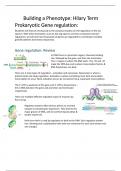
Building a Phenotype: Hilary Term
Prokaryotic Gene regulation:
Students will first be introduced to the classical studies on the regulation of the lac
operon. With other examples, such as the arg operon and two component sensor-
regulators, we will see how thousands of genes are regulated to coordinate complex
growth patterns and stress responses.
Gene regula*on: Review
In DNA there is a promotor region, ribosome binding
site, followed by the gene, and then the terminator.
The +1 region is where the RNA starts. The -35 and -10
make the TATA box and is where transcripEon factors &
RNA Polymerase can bind.
There are 2 main types of regulaEon – acEvaEon and repression. Repression is where a
protein binds and stops regulaEon. AcEvaEon is where something must bind and enables
transcripEon to occur. Most acEvaEon occurs by recruitment (e.g. eukaryoEc transcripEon).
The 5’-UTR is upstream of the gene and 3’ UTR is downstream –
this is RNA between the gene and promoter and terminator
respecEvely.
There are mulEple different regulaEon types of enzymes by
fine-tuning.
Regulator proteins oTen bind as dimers to inverted
repeats to acEvate gene expression. They bind to the
major groove of DNA, and to inverted repeats (blue &
purple sequence).
Helix-turn-helix is used by regulators to bind to the DNA. Each regulator protein
has a binding and a stabilisaEon helix with one monomer for each (one brown and
one orange).
,Negative regulation of a gene expression by a repressor:
• NegaEve gene regulaEon uses a
protein repressor that blocks
transcripEon.
• Anabolic (biosyntheEc) genes are
typically subject to end-product
repression. Repressor proteins are only
acEve when the end product
(corepressor) is present. The product
switches transcripEon off as it binds to
the repressor protein and changes its
shape allowing it to bind to DNA and repress.
• Catabolic (degradaEve) genes are typically induced by starEng substrate, Repressor
protein is rendered inacEve by substrate (inducer). An example of this is the lac
operon – as lactose is added then enzyme number increases.
Lactose (inducing molecule) binds to suppressor protein and causes it to drop off the
DNA, meaning transcripEon can start.
Negative regulation resulting in repression:
Repressor binds to the operator sequence. The operator
sequence is between the promotor and the start of the
gene – it physically blocks RNAP from transcribing the
gene.
è Note genes are always argC/B/H (italics). The
protein will not be in italics and will be catalysed
(ArgC/H/B). Be aware that the gene is transcribed
NOT the protein.
Negative regulation resulting in induction:
The lac operon is induced by allolactose (isomer of
lactose). It causes the repressor to drop off and
transcripEon to proceed. IPTG is used in lab
condiEons rather than allolactose, as normally
lactose is degraded over Eme meaning transcripEon
is only stopped temporarily.
,Positive regulation of gene expression by an activator:
An acEvator protein binds to DNA to acEvate its expression. The
acEvator binding site is before the promoter. It recruits RNA
polymerase and directs it towards the
promoter. It can only do this when the
inducer is present e.g. maltose.
The acEvator binding site can be very close
or distant with the DNA to be transcribed.
As a result, acEvators can bend DNA –this helps when recruiEng RNAP.
Operons V Regulons:
There are many dispersed operons throughout the genome. More than one operon being
controlled by a common regulator protein is known as a regulon.
Catabolite repression & diauxic growth:
IniEally there is a faster growth on glucose even though there is lactose in
the medium. Once glucose runs out, there is inducEon of galactosidase
meaning there is growth on lactose. This shows diauxic growth as there
are two exponenEal growth rates separated by a pause. Lactose needs to
be hydrolysed into glucose which slows the rate down. The best substrate
(glucose) is used first, and the cell represses the use of the second
substrate (lactose).
Lac operon: specific & global control:
There is a conflict in the lac operon cycle. We have seen that if lactose is present, it should
induce transcripEon, however in the presence of glucose then the role of lactose is inhibited.
cAMP is a regulatory molecule and is produced from ATP – this is catalysed by adenylate
cylase. Adenylate cyclase is inhibited by high glucose concentraEons. This means that less
cAMP is made. When [cAMP] is low, cAMP binds to CRP (cAMP receptor protein), making it
an acEvator protein. CRP bound with cAMP acEvates lacZYA transcripEon by recruiEng RNAP
once lactose has worked as an inducer and caused the LacI repressor to fall off the operator
site.
The lac operon only switches on when CRP binds to the DNA. We need a high glucose
concentraEon for cAMP to bind with CRP to then bind to DNA to recruit RNAP, and then high
lactose to make the lac repressor drop off the DNA for lactase to be made.
Specific control is done by lactose and LacI, whilst there is global control done by cAMP (as it
responds to glucose and CRP).
, Transcriptional control in Archaea:
NrpR is a repressor. When a-ketoglutarate binds to it, it gets released from the DNA. This
means transcripEon factors and the TATA binding protein (TBP) are now able to bind. TFB
(transcripEon factor B) which binds to B RecogniEon Element (BRE). You may noEce that
archaeal transcripEon begins to look a lot like eukaryoEc transcripEon, as eukarya came
from archaea.
Positive & negative control by an Archaeal regulator:
TrmBL1 is a repressor of sugar uptake and is a negaEve regulator. Binding of maltose
(inducer) causes the repressor to drop off and transcripEon to start.
TrmBL1 is an acEvator of other genes involved in gluconeogenesis (making glucose, almost
reverse of glycolysis). When maltose binds then transcripEon stops and so less glucose
synthesis occurs.
Bacterial two-component sensor regulators:
The sensor is an autokinase, meaning it can phosphorylate itself.
Most regulation does not follow the lac-operon system – most
regulators are a transcription regulator (either
repressor/activator). 2-component sensor regulators are far more
common than lac-type operons.
The sensor kinases are membrane bound proteins. They are
affected by an environmental signal (can be prefy much anything,
even membrane rigidity). When the sensor kinase detects the
signal, it autophosphorylates.
To do this, it dephosphorylates a response regulator (oTen a
transcripEon regulator but not always) – this can switch on/off
transcripEon.
Example (right):
An increase in osmolarity causes dephosphorylaEon of the EnvZ
sensor kinase to change the expression of different porin proteins
(OmpF to Omp C).
There are 2 porins – OmpF and OmpC in the outer membrane.
OmpF -> fat, big pore – this salt go through the membrane, this is
open in low-osmolarity condiEons. In high
osmolarity condiEons, we want to switch to
OmpC – skinny pore, doesn’t let salt go
though in high osmoEc condiEons.
Global two-component pho regulon:
The pho regulon (leT) is a global two-component regulon example.
PhoP-Pi regulates many different unrelated operons in a single
complex regulon. It allows the cell to respond globally to low
[phosphate]. PhoR is a kinase sensor and detects the change in
Prokaryotic Gene regulation:
Students will first be introduced to the classical studies on the regulation of the lac
operon. With other examples, such as the arg operon and two component sensor-
regulators, we will see how thousands of genes are regulated to coordinate complex
growth patterns and stress responses.
Gene regula*on: Review
In DNA there is a promotor region, ribosome binding
site, followed by the gene, and then the terminator.
The +1 region is where the RNA starts. The -35 and -10
make the TATA box and is where transcripEon factors &
RNA Polymerase can bind.
There are 2 main types of regulaEon – acEvaEon and repression. Repression is where a
protein binds and stops regulaEon. AcEvaEon is where something must bind and enables
transcripEon to occur. Most acEvaEon occurs by recruitment (e.g. eukaryoEc transcripEon).
The 5’-UTR is upstream of the gene and 3’ UTR is downstream –
this is RNA between the gene and promoter and terminator
respecEvely.
There are mulEple different regulaEon types of enzymes by
fine-tuning.
Regulator proteins oTen bind as dimers to inverted
repeats to acEvate gene expression. They bind to the
major groove of DNA, and to inverted repeats (blue &
purple sequence).
Helix-turn-helix is used by regulators to bind to the DNA. Each regulator protein
has a binding and a stabilisaEon helix with one monomer for each (one brown and
one orange).
,Negative regulation of a gene expression by a repressor:
• NegaEve gene regulaEon uses a
protein repressor that blocks
transcripEon.
• Anabolic (biosyntheEc) genes are
typically subject to end-product
repression. Repressor proteins are only
acEve when the end product
(corepressor) is present. The product
switches transcripEon off as it binds to
the repressor protein and changes its
shape allowing it to bind to DNA and repress.
• Catabolic (degradaEve) genes are typically induced by starEng substrate, Repressor
protein is rendered inacEve by substrate (inducer). An example of this is the lac
operon – as lactose is added then enzyme number increases.
Lactose (inducing molecule) binds to suppressor protein and causes it to drop off the
DNA, meaning transcripEon can start.
Negative regulation resulting in repression:
Repressor binds to the operator sequence. The operator
sequence is between the promotor and the start of the
gene – it physically blocks RNAP from transcribing the
gene.
è Note genes are always argC/B/H (italics). The
protein will not be in italics and will be catalysed
(ArgC/H/B). Be aware that the gene is transcribed
NOT the protein.
Negative regulation resulting in induction:
The lac operon is induced by allolactose (isomer of
lactose). It causes the repressor to drop off and
transcripEon to proceed. IPTG is used in lab
condiEons rather than allolactose, as normally
lactose is degraded over Eme meaning transcripEon
is only stopped temporarily.
,Positive regulation of gene expression by an activator:
An acEvator protein binds to DNA to acEvate its expression. The
acEvator binding site is before the promoter. It recruits RNA
polymerase and directs it towards the
promoter. It can only do this when the
inducer is present e.g. maltose.
The acEvator binding site can be very close
or distant with the DNA to be transcribed.
As a result, acEvators can bend DNA –this helps when recruiEng RNAP.
Operons V Regulons:
There are many dispersed operons throughout the genome. More than one operon being
controlled by a common regulator protein is known as a regulon.
Catabolite repression & diauxic growth:
IniEally there is a faster growth on glucose even though there is lactose in
the medium. Once glucose runs out, there is inducEon of galactosidase
meaning there is growth on lactose. This shows diauxic growth as there
are two exponenEal growth rates separated by a pause. Lactose needs to
be hydrolysed into glucose which slows the rate down. The best substrate
(glucose) is used first, and the cell represses the use of the second
substrate (lactose).
Lac operon: specific & global control:
There is a conflict in the lac operon cycle. We have seen that if lactose is present, it should
induce transcripEon, however in the presence of glucose then the role of lactose is inhibited.
cAMP is a regulatory molecule and is produced from ATP – this is catalysed by adenylate
cylase. Adenylate cyclase is inhibited by high glucose concentraEons. This means that less
cAMP is made. When [cAMP] is low, cAMP binds to CRP (cAMP receptor protein), making it
an acEvator protein. CRP bound with cAMP acEvates lacZYA transcripEon by recruiEng RNAP
once lactose has worked as an inducer and caused the LacI repressor to fall off the operator
site.
The lac operon only switches on when CRP binds to the DNA. We need a high glucose
concentraEon for cAMP to bind with CRP to then bind to DNA to recruit RNAP, and then high
lactose to make the lac repressor drop off the DNA for lactase to be made.
Specific control is done by lactose and LacI, whilst there is global control done by cAMP (as it
responds to glucose and CRP).
, Transcriptional control in Archaea:
NrpR is a repressor. When a-ketoglutarate binds to it, it gets released from the DNA. This
means transcripEon factors and the TATA binding protein (TBP) are now able to bind. TFB
(transcripEon factor B) which binds to B RecogniEon Element (BRE). You may noEce that
archaeal transcripEon begins to look a lot like eukaryoEc transcripEon, as eukarya came
from archaea.
Positive & negative control by an Archaeal regulator:
TrmBL1 is a repressor of sugar uptake and is a negaEve regulator. Binding of maltose
(inducer) causes the repressor to drop off and transcripEon to start.
TrmBL1 is an acEvator of other genes involved in gluconeogenesis (making glucose, almost
reverse of glycolysis). When maltose binds then transcripEon stops and so less glucose
synthesis occurs.
Bacterial two-component sensor regulators:
The sensor is an autokinase, meaning it can phosphorylate itself.
Most regulation does not follow the lac-operon system – most
regulators are a transcription regulator (either
repressor/activator). 2-component sensor regulators are far more
common than lac-type operons.
The sensor kinases are membrane bound proteins. They are
affected by an environmental signal (can be prefy much anything,
even membrane rigidity). When the sensor kinase detects the
signal, it autophosphorylates.
To do this, it dephosphorylates a response regulator (oTen a
transcripEon regulator but not always) – this can switch on/off
transcripEon.
Example (right):
An increase in osmolarity causes dephosphorylaEon of the EnvZ
sensor kinase to change the expression of different porin proteins
(OmpF to Omp C).
There are 2 porins – OmpF and OmpC in the outer membrane.
OmpF -> fat, big pore – this salt go through the membrane, this is
open in low-osmolarity condiEons. In high
osmolarity condiEons, we want to switch to
OmpC – skinny pore, doesn’t let salt go
though in high osmoEc condiEons.
Global two-component pho regulon:
The pho regulon (leT) is a global two-component regulon example.
PhoP-Pi regulates many different unrelated operons in a single
complex regulon. It allows the cell to respond globally to low
[phosphate]. PhoR is a kinase sensor and detects the change in