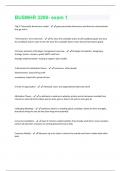
BUSMHR 3200- exam 1 Questions + Answers Graded A+
"Big 5" Personality dimensions model - gives personality dimensions and then the characteristics that go with it "Three Stories" of an interview - the story the candidate wants to tell (cadidates goal), the story the candidate doesn't want to tell, the story the candidate doesn't even know (interviewers goals) 2 Primary elements of Strategic management overview - Strategic Formulation- designing a strategy. (vision, missions, goals) SWOT used here Strategic Implementation- making it happen! (star model) 3 dimensions for attribution theory - consensus- other people distinctiveness- based off yourself consistency- based off a period of time 3 levels of organization - individual, team, and organizational (describe each) Attribution Theory - an attribute is made as to whether actions and or behaviors resulted from internal or external factors (does well on tests, gets A, doesn't do well on test, gets A) Calibrating Meetings - questions asked in a meeting about candidate. (what are their strengths, worst/best thing we saw, do they have long-term potential) concurrent validation - type of criterion-related validity. They already work there. Scores workers, collects all data then compares to existing job performance skills Construct Validity - Measures up to its claims. Looks at the outside and how it relates with other testsContent Validity - consistency between the test items or problems and the kinds of situations or problems that occur on the job Content Validity - experts look inside the test of the content context of strategy - organizational behavior and human capital management decisions should always be made with overall company in mid. Contingency Approach - calls for using the OB concepts and tools that best suit the situation, instead of trying to rely on "one best way" Criterion-Related Validity - measure of validity based on showing a substantial correlation between test scores and job performance scores Cultural differences - differences in social customs, norms, use of space, religion. can have high context or low context Culture - Values shared by associates in an organization Derailers - insensitive to others, poor working relations, inability to build or lead a team, unable to change or adapt (just not good workers, they suck) Diversity - the multitude of individual differences and similarities that exist among people. -Tends to focus on differences Emotional Intelligence Model - first used by John mayer and Peter Salovey. provided alternative idea that "IQ" was greatest correlate of success. Tied this into leadership and business. Enacted Values - Values that the organization members perceive to be values by the org- the "reality"Ethnocentrism - belief that one's culture is superior to others Expatriates - employees assigned to work in a country that is not their native country. Exposed Value - values that the organization states that it believes in (missions statements, values, etc) Four Parts in Emotional Intelligence model - Self-Awareness- emotional self awareness, self confident Self-Management- emotional self control, adaptability Social Awareness- empathy, service, etc Relationship Management- inspiring, influencial, etc
Written for
- Institution
- BUSMHR 3200
- Course
- BUSMHR 3200
Document information
- Uploaded on
- July 15, 2024
- Number of pages
- 7
- Written in
- 2023/2024
- Type
- Exam (elaborations)
- Contains
- Questions & answers
Subjects

Also available in package deal