CP - Final Exam Review with Verified and Updated Questions and Answers 100% Already Graded A+ Excel
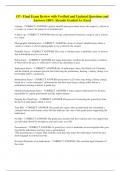
CP - Final Exam Review with Verified and Updated Questions and Answers 100% Already Graded A+ Excel Lineups - CORRECT ANSWER-a police identification procedure where the suspect is shown to a victims or witness for purposes of identification A Show up - CORRECT ANSWER-One-on-one confrontation between a suspect and a witness to a crime Photographic Identification - CORRECT ANSWER-a form of suspect identification where a victim or witness is shown photographs to try to identify the suspect Probable Cause - CORRECT ANSWER-The issue is whether there is probable cause to believe that a defendant may be convicted Prima Facie: - CORRECT ANSWER-the judge determines whether the prosecution's evidence, if believed by the jury, is sufficient to convict the defendant at trial. Indictment States: - CORRECT ANSWER-the 18 indictment states, the District of Columbia, and the federal government provide that following the preliminary hearing, a felony charge is to be brought before a grand jury. Information States - CORRECT ANSWER-prosecutors in 28 states may bring a felony charge based on a "sworn statement" (information) and then may bring a charge either before a preliminary hearing or before a grand jury Modified Indictment States: - CORRECT ANSWER-4 states require indictments for felonies punishable by capital punishment and life imprisonment Purging the Grand Jury: - CORRECT ANSWER-The process of selecting the grand jury from the pool of individuals called to serve True Bill: - CORRECT ANSWER-The grand jury agrees that an individual has committed a criminal offense and returns a true bill that indicates the vote of the grand jurors supporting the indictment No Bill: - CORRECT ANSWER-The grand jury decides that the evidence does not support that an individual should be brought to trial and issues a no bill. Presentment - CORRECT ANSWER-•A grand jury votes to undertake an investigation that goes beyond the indictment and may issue a presentment •The presentment is a report filed with the court that may name the individuals whom the jury finds engaged in criminal activity Essential Elements of an Indictment: - CORRECT ANSWER-•The essential legal elements of the crime •This includes the required criminal intent and criminal act Factual Specificity in regard to an Indictment: - CORRECT ANSWER-The defendant's intent and acts that constitute the crime Arraignment: - CORRECT ANSWER-a defendant is brought before a judge, is informed of the charges filed against him or her, and required to enter one of four possible pleas Venire - CORRECT ANSWER-refers to the jury pool where a petit panel is selected typically based on names drawn from voter registration lists or lists of taxpayers or lists of licensed drivers over 18 years of age Voir Dire - CORRECT ANSWER-refers to the questioning of individuals to determine who is to serve on the jury Peremptory Challenge: - CORRECT ANSWER-Striking a jury without offering a reason Challenge for Cause: - CORRECT ANSWER-Striking a juror based on bias or prejudice Opening Statement: - CORRECT ANSWER-the prosecution and the defense each outline their case Evidence: - CORRECT ANSWER-the prosecution and the defense present their cases, and the witnesses are subject to cross-examination. Closing Arguments: - CORRECT ANSWER-the prosecution and the defense summarize their cases Jury Instructions - CORRECT ANSWER-the judge instructs the jury in regard to the law that is to be followed Jury Deliberations - CORRECT ANSWER-the jury evaluates the facts and returns a verdict Confrontation Clause - CORRECT ANSWER-It guarantees a defendant the right to be present in the courtroom and to confront the witness and evidence against him or her Hearsay: - CORRECT ANSWER-" ◦In other words, hearsay involves a witness testifying as to what someone else said outside the courtroom List the four Constitutional rights that are often invoked by suspects during pretrial identification stages. - CORRECT ANSWER-◦The right to counsel ◦The right to due process ◦The right against unreasonable searches and seizures ◦The right against self-incrimination Know the holding in Kirby v. Illinois - CORRECT ANSWER-FACTS: A robbery suspect was identified by the victim in an identification procedure at the police station. No lawyer was present in the room during the identification, nor was Kirby advised by the police of any right to the presence of counsel. Kirby later was convicted of robbery and appealed his conviction. HOLDING: The Court held that Kirby was not entitled to the presence and advice of a lawyer during a lineup or other face-to-face confrontation, because he had not been formally charged with an offense. REASONING: The identification process in which he participated was a matter of routine police investigation and thus was not considered a "critical stage of the prosecution." Only when the proceeding is considered a "CRITICAL STAGE OF THE PROSECUTION" is a suspect entitled to the presence and advice of counsel. Don't need to give the miranda warnings at this time Define the Wade-Gilbert Rule - CORRECT ANSWER-◦After being formally charged with a crime, a suspect in a lineup or other confrontation is entitled to have a lawyer present. ◦Failure to provide a lawyer at a lineup after a formal charge has been filed against the suspect makes the evidence inadmissible. What do Miranda warnings have to do with the right of counsel when talking about these identifications? - CORRECT ANSWER-◦The answer is that the Miranda warnings must be given any time a police officer interrogates a suspect who is in custody. What is the main role and function of an attorney during lineups? - CORRECT ANSWER-make sure the procedure is fair. Cannot interfere What are some examples that involve only the giving of physical evidence? - CORRECT ANSWER-Nontestimonial evidence Appear in a police lineup before or after a formal charge Give a blood sample Submit to a photograph Give handwriting samples Submit to fingerprinting Repeat certain words or gestures of give a voice List when showups generally take place - CORRECT ANSWER-◦Shortly after the crime has occurred or ◦In circumstances where a lineup is not feasible List the three stages of eyewitness identifications - CORRECT ANSWER-◦Perception - you view the crime ◦Memory - you remember what happened ◦Identification -you recall what happened and identify the perpetrator List the principles associated with wrongful convictions and eyewitness identifications - CORRECT ANSWER-#Misidentifications◦Identification is an inexact process◦This means it is not always a perfect system◦Primary cause of false convictions◦This means that even under the
Written for
- Institution
- CP - Certified Photogrammetrist
- Course
- CP - Certified Photogrammetrist
Document information
- Uploaded on
- July 15, 2024
- Number of pages
- 24
- Written in
- 2023/2024
- Type
- Exam (elaborations)
- Contains
- Questions & answers
Subjects
-
cp final exam review with verified and updated q

Also available in package deal