Rosh Rapid Review Questions With 100% Correct Answers.
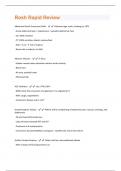
Abdominal Aortic Aneurysm (AAA) - -Advanced age, male, smoking hx, HTN -Acute abdominal pain + hypotension + pulsatile abdominal mass -US: 100% sensitive -CT: 100% sensitive, detects rupture/leak -AAA > 5 cm: ↑ risk of rupture -Renal colic in elderly: r/o AAA Absence Seizures - -5-10 yo -Sudden mental status alteration without motor activity -Blank stare -No aura, postictal state -Ethosuxamide ACE Inhibitors - -Use: HTN, DM II -MOA: block the conversion of angiotensin I to angiotensin II -ADR: cough, angioedema -Comments: Names end in "pril" Acetaminophen Toxicity - -Patient will be complaining of abdominal pain, nausea, vomiting, and diaphoresis -PE will show RUQ tenderness -Labs will show elevated AST and ALT -Treatment is N-acetylcysteine -Comments: Rumack-Matthew nomogram - stratifies the risk of liver failure Achilles Tendon Rupture - -Patient will be a deconditioned athlete -With a history of fluoroquinolone use-Complaining of "pop" or "snap" and sudden pain in the calf area -PE will show absent plantarflexion upon calf squeeze (Thompson test) -Treatment is posterior splint in plantarflexion, orthopedic consult Achilles Tendon Rupture - -RFs: Deconditioned athletes, fluoroquinolone use -"Pop" or "snap" -Thompson test: absent plantarflexion upon calf squeeze -Rx: posterior splint in plantarflexion, orthopedic consult Acoustic Neuroma - -CN VIII tumor -Hearing loss + tinnitus + vertigo -MRI with gadolinium Acquired Cholesteatoma - -Patient will have a history of chronic ear infections or tympanostomy tubes -Complaining of painless otorrhea -PE will show yellow or white mass behind the tympanic membrane -Treatment is tympanomastoid surgery Acromegaly - -Excessive growth hormone -Pituitary adenoma (>99% of cases) -Enlargement of hands and feet -IGF-1 -Transphenoid resection Acute Angle-Closure Glaucoma - -Precipitated by pupillary dilation -Acute unilateral painful vision loss -Cloudy cornea, perilimbic flush, fixed mid-dilated pupil -Nausea/vomiting-↑ IOP (>21 mm Hg) -Topical ßBs, carbonic anhydrase inhibitors, steroids, miotics Acute Bronchitis - -Viruses > bacteria -Most common cause of minor hemoptysis -Hallmark: cough (usually productive), <1week -Symptomatic treatment, bronchodilators -Routine ABX therapy not indicated Acute Cholangitis - -Patient will be complaining of right upper quadrant pain, jaundice, fever (Charcot's triad) -Diagnosis is made by: Gold standard: ERCP -Most commonly caused by choledocholithiasis leading to bacterial infection, E.coli -Treatment is antibiotics -Comments: Charcot's triad + hypotenstion and AMS = Reynold's pentad, acute obstruction Acute Coronary Syndrome: Management - -Aspirin: ↓ mortality, ↓ infarct size, ↓ reinfarction rate -Clopridogrel: patients with aspirin allergy -Heparin: ↓ DVT, ↓ reinfarction, ↓ stroke, ↓ LV thrombus, ↓ reocclusion -Nitroglycerin: --Coronary artery dilation/vascular smooth muscle relaxation → ↓preload/afterload → ↓ myocardial O2 demand --Contraindications: sildenafil use within 24 hrs, RV infarction -ß-blockers: --↓ Myocardial O2 demand, ↓ ventricular fibrillation --IV indications: tachydysrhythmias, intractable HTN - Morphine: --↓ Preload/afterload, ↓ sympathetic activity --No mortality benefit-Glycoprotein IIb/IIIa inhibitors: benefit in patients undergoing PCI -PCI: --Preferred over thrombolytics in all STEMI patients --PCI center: <90 minutes contact to device time --Non-PCI center: transfer to PCI center if contact to device time can be <120 minutes --Non-PCI center: thrombolytics if contact to device time to be >120 minutes -Thrombolytics: begin within 30 minutes of ED arrival if selected Acute Decompensated Heart Failure - -Exertional dyspnea, orthopnea, paroxysmal nocturnal dyspnea, pitting edema -S3 -↑ BNP -CXR: cardiomegaly, cephalization, Kerley B lines, effusions -Most useful study: echo -Treatment: -BiPAP: ↑ oxygenation, ↓ work of breathing, ↓ preload/afterload -Nitroglycerin: ↓ preload/afterload -Furosemide: diuresis -Hypotension without signs of shock: dobutamine (may worsen hypotension) -Severe hypotension with signs of shock: norepinephrine (↑ systemic vascular resistance, ↑ HR, ↑ BP, ↑ myocardial O2 demand) Acute Hepatitis - -HAV: fecal-oral, shellfish, alone (no carrier), asymptomatic, acute -HBV: --HBsAg: active infection --Anti-HBs: recovered or immunized --Anti-HBc IgM: early marker of infection, positive in window period --Anti-HBc IgG: best marker for prior HBV --HBeAg: high infectivity--Anti-HBeAb: low infectivity -HCV: IVDA, chronic, cirrhosis, carcinoma, carrier -HDV: dependent on HBV coinfection -HEV: fecal-oral (enteric) high mortality rate among pregnant (expectant) patients, epidemics, -HAV and HEV are fecal-oral: "The vowels hit your bowels" -Autoimmune hepatitis: young females -Alcoholic hepatitis: moderate transaminase elevation, AST>ALT -Supportive rx Acute Mountain Sickness - -Patient will be climbing a mountain -Complaining of "Hangover" like symptoms, headache, nausea, vomiting, insomnia -Treatment is halt ascent, acetazolamide -Comments: Sulfa allergy - avoid acetazolamide Acute Otitis Media - -Viral > bacterial (S. pneumoniae most common) -Middle ear effusion -↓ TM mobility with pneumatic otoscopy -Bulging, cloudy TM -Amoxicillin Acute Pancreatitis - -Gallstones (most common), alcohol -Epigastric pain radiating to back -Grey-Turner sign: ecchymosis of left flank -Cullen sign: umbilical ecchymosis -Lipase: best laboratory marker -Ranson's criteria (prognosis, measured at admission and within 48 hours)
Written for
- Institution
- Rosh
- Course
- Rosh
Document information
- Uploaded on
- July 15, 2024
- Number of pages
- 95
- Written in
- 2023/2024
- Type
- Exam (elaborations)
- Contains
- Questions & answers
Subjects

Also available in package deal