Exam (elaborations) ECON
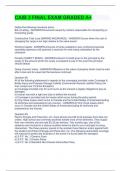
S = Situation -what is going on with the client/ patient (Chest pain, nausea, etc...) B = Background- client’s/ patient's presenting complaint, relevant past medical history and brief summary of background A = Assessment - Vital signs, any outside normal parameters, your clinical impression, severity of client/ patient and clinical concerns R = Recommendation- suggestions of what action is to be take, how urgent and when action needs to be taken. R= Review - what has been the effect of the action/ intervention. (Institute for Healthcare Improvement, 2016) Focus Charting Focus charting identifies specific concerns determined during the assessment e.g. a focus may reflect: > A client/ patient concern, such as decreased urinary output. > A change in a client’s/ patient’s condition, such as disorientation to time, place and person. > A significant event in the client’s/ patient’s care, such as surgery. The client/ patient care is then organised under the headings of: > Data: Subjective/ objective information as supporting evidence of the client/ patient status. > Action: Completed or planned nursing interventions based on the nurse’s assessment of the client’s/ patient’s status. > Response: Evaluation of the impact of the interventions. Flow sheets and checklists are frequently used as an adjunct to document routine and ongoing assessments and observations such as personal care, vital signs, intake and output, etc. Information recorded on flow sheets or checklists does not then need to be repeated in the progress notes (College of Registered Nurses of British Columbia, 2013). However, they still are part of the client’s clinical record and should be kept with all clinical notes. S O A P / S O A P I E (R) Charting SOAP/ SOAPIER charting is a problem-oriented approach which includes the following: S = subjective data (e.g. how does the client/ patient feel?) O = objective data (e.g. results of the physical exam, relevant vital signs) A = assessment (e.g. what is the client’s/ patient status?) P = plan (e.g. does the plan stay the same? is a change needed?) I = intervention (e.g. what occurred? what did the nurse do?) E = evaluation (e.g. what is the client outcome following the intervention?) R = revision (e.g. what changes are needed to the care plan?) NZNO Practice GUIDELINE: Documentation, 2021 New Zealand Nurses Organisation PO Box 2128, Wellington 6140. Page 4 of 11 Similar to focus charting, flow sheets and checklists are frequently used as an adjunct to document routine and ongoing assessments and observations (College of Registered Nurses of British Columbia, 2013). Narrative Charting Narrative charting is a method whereby nursing interventions and the impact of these on client/ patient outcomes are documented in chronological order over a specific time period. Information is recorded in the progress notes, often without a framework. This framework does not necessarily provide the rationale or evaluation for a particular action or task. The “Literature suggests that no matter what documentation framework is used nurses require continuing education related to documentation in order to improve and maintain standards” (Blair & Smith 2012, pp. 163). Documentation Why and What? Whether documenting for individual clients/ patients, or for groups or communities nursing documentation should: > Be factual, objective, consistent and accurate. > Be written as soon as possible after an event has occurred, providing current information on the care and condition of the patient or client including standard care and out of the ordinary care. > Be written clearly and in a way that the text cannot be erased. > Be written in a manner that any alterations or additions are dated, timed and signed so the original entry can still be read clearly. > Be accurately dated, timed and sig
Written for
- Institution
- ECON10310921
- Course
- ECON10310921
Document information
- Uploaded on
- July 12, 2024
- Number of pages
- 11
- Written in
- 2023/2024
- Type
- Exam (elaborations)
- Contains
- Questions & answers
Subjects
-
nursing documentation is a legal record of patient