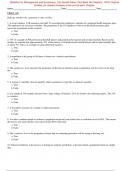
INS3705
Assignment 2
Semester 2 2024
QUESTIONS AND ANSWERS
[School]
[Course title]
,INS3705 Assignment 2 Semester 2 2024
QUESTION 1
Identify four knowledge management processes in any organisation of your
choice and discuss the purpose of each knowledge management process
and two examples of artificial intelligent technologies that can be used in
each of the knowledge management processes (mini essay). [10)
QUESTION 2
A senior employee with valuable tacit knowledge is retiring in your
organisation. Define tacit knowledge and suggest five methods or tools that
you would use to enhance knowledge retention and prevent knowledge
loss (mini essay). [10]
QUESTION 3
Critically discuss the purpose and objectives of an information and
knowledge audit in an organisation (mini essay). [10]
QUESTION 4
Define knowledge management from four different perspectives and
further explain how knowledge management differs from information
management (mini essay). [10]
QUESTION 1
, Identify four knowledge management processes in any organisation of your
choice and discuss the purpose of each knowledge management process
and two examples of artificial intelligent technologies that can be used in
each of the knowledge management processes.
Knowledge Management Processes:
1. Knowledge Creation
o Purpose: To generate new insights, ideas, and concepts
through collaborative efforts, research, and innovation. This
process ensures that the organization continuously evolves by
creating new knowledge.
o AI Technologies:
1. Machine Learning Algorithms: These can analyze vast
amounts of data to identify patterns and generate new
knowledge.
2. Natural Language Processing (NLP): NLP can be used to
mine text data from various sources, providing insights
and generating new knowledge from unstructured data.
2. Knowledge Storage
o Purpose: To store and organize knowledge in a way that it is
easily accessible and retrievable when needed. Effective
storage ensures that valuable knowledge is preserved over
time.
Assignment 2
Semester 2 2024
QUESTIONS AND ANSWERS
[School]
[Course title]
,INS3705 Assignment 2 Semester 2 2024
QUESTION 1
Identify four knowledge management processes in any organisation of your
choice and discuss the purpose of each knowledge management process
and two examples of artificial intelligent technologies that can be used in
each of the knowledge management processes (mini essay). [10)
QUESTION 2
A senior employee with valuable tacit knowledge is retiring in your
organisation. Define tacit knowledge and suggest five methods or tools that
you would use to enhance knowledge retention and prevent knowledge
loss (mini essay). [10]
QUESTION 3
Critically discuss the purpose and objectives of an information and
knowledge audit in an organisation (mini essay). [10]
QUESTION 4
Define knowledge management from four different perspectives and
further explain how knowledge management differs from information
management (mini essay). [10]
QUESTION 1
, Identify four knowledge management processes in any organisation of your
choice and discuss the purpose of each knowledge management process
and two examples of artificial intelligent technologies that can be used in
each of the knowledge management processes.
Knowledge Management Processes:
1. Knowledge Creation
o Purpose: To generate new insights, ideas, and concepts
through collaborative efforts, research, and innovation. This
process ensures that the organization continuously evolves by
creating new knowledge.
o AI Technologies:
1. Machine Learning Algorithms: These can analyze vast
amounts of data to identify patterns and generate new
knowledge.
2. Natural Language Processing (NLP): NLP can be used to
mine text data from various sources, providing insights
and generating new knowledge from unstructured data.
2. Knowledge Storage
o Purpose: To store and organize knowledge in a way that it is
easily accessible and retrievable when needed. Effective
storage ensures that valuable knowledge is preserved over
time.