1 of 11
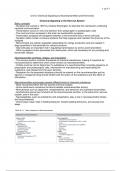
Unit 3: Chemical Signaling by Neurotransmitters and Hormones
Chemical Signaling in the Nervous System
Basic concepts
- Synapse was coined in 1897 by Charles Sherrington to describe the mechanism underlying
neuronal communication
- Transmission occurs in only one direction from presynaptic to postsynaptic cells
- The most common synapses in the brain are axodendritic synapses
- Axosomatic synapses are synapses between a nerve terminal and a nerve cell body
- Synaptic clefts contain numerous proteins that help organize and maintain the structure of the
synapse
- Mitochondria are cellular organelles responsible for energy production and are needed in
large quantities in the terminals for various functions
- Glial cells play an important role in regulating transmission by amino acid transmitters
- Other synapses involve processes from astrocytes, which are necessary for ion pumping and
transmitter release.
Neurotransmitter synthesis, release, and inactivation
- The nervous system contains thousands of chemical substances, making it important for
neuroscientists to determine which ones function as neurotransmitters.
- Criteria must be met to determine if a substance is a neurotransmitter, including presence of
presynaptic and postsynaptic cells, mechanism for manufacturing and inactivating the
substance, and release from the axon terminal.
- Receptors for the proposed substance should be present on the neurotransmitter and an
agonist or antagonist drug should inhibit both the action of the substance and the e ect of
stimulation.
Neurotransmitters encompass several di erent kinds of chemical substances
- Most neurotransmitters fall into several chemical classes
- Amino acids serve numerous functions besides neurotransmitter activity
- Monoamines such as dopamine, norepinephrine, and serotonin are important transmitters
- Acetylcholine serves key functions at the neuromuscular junction, in the autonomic nervous
system, and in the brain
- Neuropeptides, such as endorphins and enkephalins, play a role in neuropsychiatric illness
and drug treatment
- Orexin plays major roles in feeding behavior, reward-seeking behaviors, and arousal and
sleep.
ff ff
, 2 of 11
Neuropeptides are synthesized by a di erent mechanism than other transmitters
- Neuromitters are synthesized through enzymatic reactions in the cell.
- Neuropeptides are di erent from small-molecule transmitters and cannot be replenished
until large vesicles have been transported.
Neuromodulators are chemicals that do not act like typical neurotransmitters
- Neuromodulators are substances that do not act exactly like typical neurotransmitters
ff ff
Unit 3: Chemical Signaling by Neurotransmitters and Hormones
Chemical Signaling in the Nervous System
Basic concepts
- Synapse was coined in 1897 by Charles Sherrington to describe the mechanism underlying
neuronal communication
- Transmission occurs in only one direction from presynaptic to postsynaptic cells
- The most common synapses in the brain are axodendritic synapses
- Axosomatic synapses are synapses between a nerve terminal and a nerve cell body
- Synaptic clefts contain numerous proteins that help organize and maintain the structure of the
synapse
- Mitochondria are cellular organelles responsible for energy production and are needed in
large quantities in the terminals for various functions
- Glial cells play an important role in regulating transmission by amino acid transmitters
- Other synapses involve processes from astrocytes, which are necessary for ion pumping and
transmitter release.
Neurotransmitter synthesis, release, and inactivation
- The nervous system contains thousands of chemical substances, making it important for
neuroscientists to determine which ones function as neurotransmitters.
- Criteria must be met to determine if a substance is a neurotransmitter, including presence of
presynaptic and postsynaptic cells, mechanism for manufacturing and inactivating the
substance, and release from the axon terminal.
- Receptors for the proposed substance should be present on the neurotransmitter and an
agonist or antagonist drug should inhibit both the action of the substance and the e ect of
stimulation.
Neurotransmitters encompass several di erent kinds of chemical substances
- Most neurotransmitters fall into several chemical classes
- Amino acids serve numerous functions besides neurotransmitter activity
- Monoamines such as dopamine, norepinephrine, and serotonin are important transmitters
- Acetylcholine serves key functions at the neuromuscular junction, in the autonomic nervous
system, and in the brain
- Neuropeptides, such as endorphins and enkephalins, play a role in neuropsychiatric illness
and drug treatment
- Orexin plays major roles in feeding behavior, reward-seeking behaviors, and arousal and
sleep.
ff ff
, 2 of 11
Neuropeptides are synthesized by a di erent mechanism than other transmitters
- Neuromitters are synthesized through enzymatic reactions in the cell.
- Neuropeptides are di erent from small-molecule transmitters and cannot be replenished
until large vesicles have been transported.
Neuromodulators are chemicals that do not act like typical neurotransmitters
- Neuromodulators are substances that do not act exactly like typical neurotransmitters
ff ff