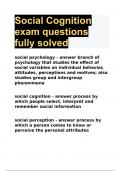
Social Cognition exam questions fully solved
Original social psychology branch of psychology that studies the effect of social variables on individual behavior, attitudes, perceptions and motives; also studies group and intergroup phenonmena social cognition process by which people select, interpret and remember social information social perception process by which a person comes to know or perceive the personal attributes attribution theory social-cognitive approach to describing the ways the social perceiver uses information to generate casual explanations covariation model theory that suggests that people attributes a behavior to a casual factor if that factor was present whenever the behavior occurred but was absent whenever it didn't occur fundamental attribution error (FAE) dual tendency of observers to underestimate the impact of situational factors and to overestimate the influence of dispositional factors on a person's behavior self-serving bias an attributional bias in which people tend to take credit for their successes and deny responsibility for their failures. self-fulfilling prophecy a prediction made about some future behavior or event that modifies interaction so as to produce what is expected social role a socially defined pattern of behavior that is expected of a person who is functioning in a given setting or a group rule behavioral guideline for acting in a certain way in a certain situation social norm the expectation a group has for its members regarding acceptable and appropriate attitudes and behaviors conformity the tendency for people to adopt the behaviors, attitudes, and values of other members of a reference group informational influence group effects that arise from individual's desire to be correct and right and to understand how best to act in a given situation normative influence group effects that arise from individual's desire to be liked, accepted, and approved by others norm crystallization the convergence of the expectations of a group of individuals into a common perspective as they talk and carry out activities together group polarization tendency for groups to make decisions that are more extreme than the decision that would be made by the members acting alone groupthink tendency of a decision-making group to filter out undesirable input so that a consensus may be reached, especially if it is in line with the leader's viewpoint assessing covariation with respect to 3 dimensions of information distinctiveness, consistency, and consensus distinctiveness refers to whether the behavior is specific to a particular situation consistency refers to whether the behavior occurs repeatedly in response to this situation consensus refers to whether other people also produce he same behavior in the same situation Solomon Asch created circumstances in which participants made judgments under conditions in which the physical reality was absolutely clear--but the rest of a group reported that they saw that reality differently information-influence model suggests that group members contribute different information to a decision
Written for
- Institution
- Social Cognition
- Course
- Social Cognition
Document information
- Uploaded on
- July 11, 2024
- Number of pages
- 6
- Written in
- 2023/2024
- Type
- Exam (elaborations)
- Contains
- Questions & answers
Subjects
-
social cognition exam questions fully solved

Also available in package deal