Accounting BEC-22806 summary
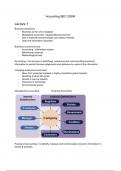
Accounting = the process of identifying, measuring and communicating economic
information to permit informed judgements and decisions by users of the information.
Management accounting: Financial accounting:
o Planning Financial report
o Control Fiscal report
o Organization Social report
o Motivation Environment report
Management Financial
Users Internal External
Legal Optional Statutory requirement
requirements
Focus Individual parts Whole business
Accounting Serving management’s needs Generally accepted accounting
principles principles
Time History & future History
Frequency Regular & ad hoc Regular
Detail High Low
Goals of management accounting:
Cost allocation for inventory valuation and profit measurement
Relevant information for decision makers/managers
Information for planning and performance management
Goals of financial accounting:
Cost allocation for inventory valuation and profit measurement
True and fair view on financial position that is uniform and consistent
Decision making of external stakeholders
Costs = sacrifices of assets which are unavoidable, measurable and foreseeable
o A monetary measure of the recourses sacrificed or forgone to achieve a specific
objective.
Cost price = costs per unit output
Decision making process:
1. Identify objectives
2. Search for alternative courses of action Planned process
3. Select appropriate course of action
4. Implement the decision
5. Compare actual and planned outcomes Control process
6. Respond to divergences from plan
,Objectives = create profit, create employment, market position, continuity, environment
Purposes of management accounting:
o Profit measurement and inventory valuation
o Decision making
o Planning, control of performance
Cost object = any activity for which a separate measurement of cost is required
Direct costs = can be specifically and exclusively identified with a given cost object
Indirect costs = (sometimes overheads) cannot be specifically and exclusively identified with
a given cost object
o Are assigned to cost objects on the basis of cost allocations
Cost allocation = the process of assigning costs to cost objects where a direct measure of the
resources consumed by these cost objects does not exist.
Manufacturing costs = direct materials, direct labour & manufacturing overhead
Non-manufacturing costs = administrative overheads & marketing overhead
Product costs = costs that are identified with goods purchased or produced for resale and
which are attached to products and included in the inventory valuation of goods.
Period costs = costs that are not included in the inventory valuation of goods and which are
treated as expenses for the period in which they are incurred.
Semi-variable costs = include both a fixed and a variable component (dashed line)
Semi-fixed costs = remain constant within specified activity levels for a given amount of time.
(dashed line)
Variable costs = vary in direct proportion to the volume of activity
, Fixed costs = remain constant over wide ranges of activity
Relevant costs = future costs and revenues that will be changed by a decision
Irrelevant costs = costs and revenues will not be changed by a decision
Avoidable costs = those costs that can be saved by not adopting a given alternative
Unavoidable costs = those costs that cannot be saved
Sunk costs = the costs of resources already acquired and are unaffected by the choice
between the various alternatives.
Opportunity costs = a cost that measures the opportunity that is lost or sacrificed when the
choice of one course of action requires that an alternative is given up.
Incremental costs and revenues = the additional costs and revenues from the production or
sale of a group of additional units.
Marginal costs and revenues = difference of one additional unit
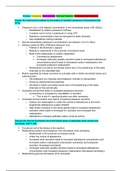
The balance sheet = states what the firm owns (the assets) and how it is financed (liabilities
and stockholder’s equity)
o Assets = liabilities + stockholder’s equity
Accounting liquidity = refers to the ease and quickness with which assets can be converted
to cash.
Income statement = measures performance over a specific period of time
Income = revenue – expenses
o Revenue = the value of the product sold
o Expense = those incurred in generating that revenue
Net working capital = current assets – current liabilities
Financial ratios in corporations
Short term solvency (=liquidity) The ability of the firm to meet its short-
term obligations
Activity The ability of the firm to control its
investments in assets
Financial leverage (=solvency) The extent to which a firm relies on debt
financing
Profitability The extent to which a firm is profitable
Market value The value of the firm
Liquidity ratios
Net working capital = Current assets – current liabilities
Current ratio = Current assets / current liabilities
Quick ratio = Quick assets (current assets – inventory)/
current liabilities
Accounting = the process of identifying, measuring and communicating economic
information to permit informed judgements and decisions by users of the information.
Management accounting: Financial accounting:
o Planning Financial report
o Control Fiscal report
o Organization Social report
o Motivation Environment report
Management Financial
Users Internal External
Legal Optional Statutory requirement
requirements
Focus Individual parts Whole business
Accounting Serving management’s needs Generally accepted accounting
principles principles
Time History & future History
Frequency Regular & ad hoc Regular
Detail High Low
Goals of management accounting:
Cost allocation for inventory valuation and profit measurement
Relevant information for decision makers/managers
Information for planning and performance management
Goals of financial accounting:
Cost allocation for inventory valuation and profit measurement
True and fair view on financial position that is uniform and consistent
Decision making of external stakeholders
Costs = sacrifices of assets which are unavoidable, measurable and foreseeable
o A monetary measure of the recourses sacrificed or forgone to achieve a specific
objective.
Cost price = costs per unit output
Decision making process:
1. Identify objectives
2. Search for alternative courses of action Planned process
3. Select appropriate course of action
4. Implement the decision
5. Compare actual and planned outcomes Control process
6. Respond to divergences from plan
,Objectives = create profit, create employment, market position, continuity, environment
Purposes of management accounting:
o Profit measurement and inventory valuation
o Decision making
o Planning, control of performance
Cost object = any activity for which a separate measurement of cost is required
Direct costs = can be specifically and exclusively identified with a given cost object
Indirect costs = (sometimes overheads) cannot be specifically and exclusively identified with
a given cost object
o Are assigned to cost objects on the basis of cost allocations
Cost allocation = the process of assigning costs to cost objects where a direct measure of the
resources consumed by these cost objects does not exist.
Manufacturing costs = direct materials, direct labour & manufacturing overhead
Non-manufacturing costs = administrative overheads & marketing overhead
Product costs = costs that are identified with goods purchased or produced for resale and
which are attached to products and included in the inventory valuation of goods.
Period costs = costs that are not included in the inventory valuation of goods and which are
treated as expenses for the period in which they are incurred.
Semi-variable costs = include both a fixed and a variable component (dashed line)
Semi-fixed costs = remain constant within specified activity levels for a given amount of time.
(dashed line)
Variable costs = vary in direct proportion to the volume of activity
, Fixed costs = remain constant over wide ranges of activity
Relevant costs = future costs and revenues that will be changed by a decision
Irrelevant costs = costs and revenues will not be changed by a decision
Avoidable costs = those costs that can be saved by not adopting a given alternative
Unavoidable costs = those costs that cannot be saved
Sunk costs = the costs of resources already acquired and are unaffected by the choice
between the various alternatives.
Opportunity costs = a cost that measures the opportunity that is lost or sacrificed when the
choice of one course of action requires that an alternative is given up.
Incremental costs and revenues = the additional costs and revenues from the production or
sale of a group of additional units.
Marginal costs and revenues = difference of one additional unit
The balance sheet = states what the firm owns (the assets) and how it is financed (liabilities
and stockholder’s equity)
o Assets = liabilities + stockholder’s equity
Accounting liquidity = refers to the ease and quickness with which assets can be converted
to cash.
Income statement = measures performance over a specific period of time
Income = revenue – expenses
o Revenue = the value of the product sold
o Expense = those incurred in generating that revenue
Net working capital = current assets – current liabilities
Financial ratios in corporations
Short term solvency (=liquidity) The ability of the firm to meet its short-
term obligations
Activity The ability of the firm to control its
investments in assets
Financial leverage (=solvency) The extent to which a firm relies on debt
financing
Profitability The extent to which a firm is profitable
Market value The value of the firm
Liquidity ratios
Net working capital = Current assets – current liabilities
Current ratio = Current assets / current liabilities
Quick ratio = Quick assets (current assets – inventory)/
current liabilities