LEARNING AND TRANSFER
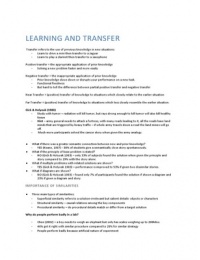
Transfer refers to the use of previous knowledge in new situations
- Learn to drive a mini then transfer to a Jaguar
- Learn to play a clarinet then transfer to a saxophone
Positive transfer = the appropriate application of prior knowledge
- Solving a new problem faster and more easily
Negative transfer = the inappropriate application of prior knowledge
- Prior knowledge slows down or disrupts your performance on a new task.
- Functional fixedness
- But hard to tell the difference between partial positive transfer and negative transfer
Near Transfer = (positive) transfer of knowledge to situations which closely relate to the earlier situation
Far Transfer = (positive) transfer of knowledge to situations which less closely resemble the earlier situation.
Gick & Holyoak (1980)
- Study with tumor – radiation will kill tumor, but rays strong enough to kill tumor will also kill healthy
tissue
- Hint – army general needs to attack a fortress, with many roads leading to it, all the roads have land
minds that are triggered by heavy traffic – if whole army travels down a road the land mines will go
off.
- Much more participants solved the cancer story when given the army analogy.
What if there was a greater semantic connection between new and prior knowledge?
- YES (Keane, 1987) - 88% of students give a semantically close story spontaneously.
What if the principle of base problem is stated?
- NO (Gick & Holyoak 1983) – only 33% of subjects found the solution when given the principle and
story compared to 29% with the story alone.
What if multiple problems with related solutions are shown?
- YES (Gick & Holyoak 1983) – performance is improved to 53% if given two dissimilar stories.
What if diagrams are shown?
- NO (Gick & Holyoak 1983) – found only 7% of participants found the solution if shown a diagram and
23% if given a diagram and story.
IMPORTANCE OF SIMILARITIES
Three main types of similarities:
- Superficial similarity refers to a solution-irrelevant but salient details- objects or characters
- Structural similarity – causal relations among the key components
- Procedural similarity – do procedural details match or differ from a target solution
Why do people perform badly in a lab?
- Chen (2002) – a boy needs to weigh an elephant but only has scales weighing up to 200kilos.
- 46% get it right with similar procedure compared to 28% for similar strategy
- People perform badly because artificial nature of experiment
Transfer refers to the use of previous knowledge in new situations
- Learn to drive a mini then transfer to a Jaguar
- Learn to play a clarinet then transfer to a saxophone
Positive transfer = the appropriate application of prior knowledge
- Solving a new problem faster and more easily
Negative transfer = the inappropriate application of prior knowledge
- Prior knowledge slows down or disrupts your performance on a new task.
- Functional fixedness
- But hard to tell the difference between partial positive transfer and negative transfer
Near Transfer = (positive) transfer of knowledge to situations which closely relate to the earlier situation
Far Transfer = (positive) transfer of knowledge to situations which less closely resemble the earlier situation.
Gick & Holyoak (1980)
- Study with tumor – radiation will kill tumor, but rays strong enough to kill tumor will also kill healthy
tissue
- Hint – army general needs to attack a fortress, with many roads leading to it, all the roads have land
minds that are triggered by heavy traffic – if whole army travels down a road the land mines will go
off.
- Much more participants solved the cancer story when given the army analogy.
What if there was a greater semantic connection between new and prior knowledge?
- YES (Keane, 1987) - 88% of students give a semantically close story spontaneously.
What if the principle of base problem is stated?
- NO (Gick & Holyoak 1983) – only 33% of subjects found the solution when given the principle and
story compared to 29% with the story alone.
What if multiple problems with related solutions are shown?
- YES (Gick & Holyoak 1983) – performance is improved to 53% if given two dissimilar stories.
What if diagrams are shown?
- NO (Gick & Holyoak 1983) – found only 7% of participants found the solution if shown a diagram and
23% if given a diagram and story.
IMPORTANCE OF SIMILARITIES
Three main types of similarities:
- Superficial similarity refers to a solution-irrelevant but salient details- objects or characters
- Structural similarity – causal relations among the key components
- Procedural similarity – do procedural details match or differ from a target solution
Why do people perform badly in a lab?
- Chen (2002) – a boy needs to weigh an elephant but only has scales weighing up to 200kilos.
- 46% get it right with similar procedure compared to 28% for similar strategy
- People perform badly because artificial nature of experiment