NIB Dominique van Schagen
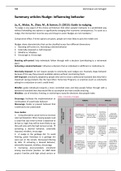
Summary articles Nudge: influencing behavior
Ly, K., Mažar, N., Zhao, M., & Soman, D. (2013). Guide to nudging.
“A nudge is any aspect of the choice architecture that alters people’s behavior in a predictable way
without forbidding any options or significantly changing their economic consequences. To count as a
nudge, the intervention must be easy and cheap to avoid. Nudges are not mandates.”
Compromise effect: if three options are given, people are most likely to pick the middle one.
Nudges share characteristics that can be classified across four different dimensions:
1. Boosting self-control vs. Activating a desired behavior
2. Externally-imposed vs. Self-imposed
3. Mindful vs. Mindless
4. Encourage vs. Discourage
Boosting self-control: help individuals follow through with a decision (contributing to a retirement
plan)
Activating a desired behavior: influence a decision that an individual is indifferent or inattentive to
Externally-imposed: do not require people to voluntarily seek nudges out. Passively shape behavior
because of the way they present available options without constraining them
Self-imposed: voluntarily adopted by people who wish to enact a behavioral standard that they feel is
important (using products like the Save More Tomorrow Program), or practices (such as voluntarily
asking for a reduction on one’s credit limit)
Mindful: guide individuals towards a more controlled state and help people follow through with a
behavioral standard that they would like to accomplish but have trouble enacting.
Mindless: use of emotion, framing, or anchoring to sway the decisions that people make.
Encourage: facilitate the implementation or
continuation of a particular behavior
Discourage: hinder or prevent behavior that
is believed to be undesirable
Case studies
1. Using descriptive social norms to increase
voter participation: When having people read
a script that says voter turnout is expected to
be low vs. high, they will be more likely to say
they will vote with the high turnout script. à
activating a desired behavior, externally
imposed, mindless, encourage
2. A nudge to the garbage bin: To avoid
littering, green footsteps to a garbage bin
were put on the streets. Decreased littering
by 46% à activating a desired behavior,
externally imposed, mindless, discourage
3. Increasing post-secondary enrolment
among low-income families: an H&R block
project: Families with high school seniors or
, NIB Dominique van Schagen
recent graduates were 40% more likely to submit an FAFSA: a federal application for financial aid (must
be completed to qualify for many states and institutional grants) and were 33% more likely to receive
a Pell Grant: a major needs-based federal grant à boosting self-control, externally imposed, mindful,
encourage
4. A planning aid to increase savings participation: A planning aid – where people can start planning
their savings in less than 30 minutes instead of having to do all research by themselves – doubled
enrolment for pension savings within 60 days of implementation à boosting self-control, externally
imposed, internally imposed, mindful, encourage
5. Gym-Pact: Instead of paying gym at the start of the year, people have to say how many times they
will visit the gym each week and need to pay a penalty fee when they miss a session. With this project,
participants’ membership was paid. However, if they failed to follow four sessions a week, they would
have to pay $25. If they left the program, they had to pay $75. In its first five months, participants have
followed through with their commitments 90% of the time à boosting self-control, self-imposed,
mindful, encourage
6. Self-Help and peer pressure as a savings commitment device: People from Chile with low income
were put in three different groups:
a. Group 1: basic savings account, interest rate 0.3%
b. Group 2: same as 1, but they were part of a self-help peer group where they could announce their
saving goals and monitor their progress on a weekly basis
c. Group 3: high interest account, interest rate 5%
Group 2 deposited money 3.5 times more than others. Also, average savings balance of group 2 was
almost double of group 1.
Another experiment was conducted: group 1 got a text message of their progress and that of others.
Group 2 was the same as group 1 but they were also assigned a savings buddy with whom they would
meet regularly and who would hold them accountable to their savings goals. Outcome: having a
savings buddy made little difference: just text was enough.
à boosting self-control, self-imposed, mindless, encourage
7. The Waterpebble: a water conservation device: an inexpensive device designed to help individuals
conserve water when showering. It memorizes the length of the first shower and uses it as benchmark
for the next showers. It doesn’t display the amount of water used, instead it automatically reduces
shower length and uses a series of traffic light signals to suggest it is time to get out of the shower. à
boosting self-control, self-imposed, mindless, discourage
A guide to the nudge process:
Map the context
Four different aspects of the decision-making process:
Summary articles Nudge: influencing behavior
Ly, K., Mažar, N., Zhao, M., & Soman, D. (2013). Guide to nudging.
“A nudge is any aspect of the choice architecture that alters people’s behavior in a predictable way
without forbidding any options or significantly changing their economic consequences. To count as a
nudge, the intervention must be easy and cheap to avoid. Nudges are not mandates.”
Compromise effect: if three options are given, people are most likely to pick the middle one.
Nudges share characteristics that can be classified across four different dimensions:
1. Boosting self-control vs. Activating a desired behavior
2. Externally-imposed vs. Self-imposed
3. Mindful vs. Mindless
4. Encourage vs. Discourage
Boosting self-control: help individuals follow through with a decision (contributing to a retirement
plan)
Activating a desired behavior: influence a decision that an individual is indifferent or inattentive to
Externally-imposed: do not require people to voluntarily seek nudges out. Passively shape behavior
because of the way they present available options without constraining them
Self-imposed: voluntarily adopted by people who wish to enact a behavioral standard that they feel is
important (using products like the Save More Tomorrow Program), or practices (such as voluntarily
asking for a reduction on one’s credit limit)
Mindful: guide individuals towards a more controlled state and help people follow through with a
behavioral standard that they would like to accomplish but have trouble enacting.
Mindless: use of emotion, framing, or anchoring to sway the decisions that people make.
Encourage: facilitate the implementation or
continuation of a particular behavior
Discourage: hinder or prevent behavior that
is believed to be undesirable
Case studies
1. Using descriptive social norms to increase
voter participation: When having people read
a script that says voter turnout is expected to
be low vs. high, they will be more likely to say
they will vote with the high turnout script. à
activating a desired behavior, externally
imposed, mindless, encourage
2. A nudge to the garbage bin: To avoid
littering, green footsteps to a garbage bin
were put on the streets. Decreased littering
by 46% à activating a desired behavior,
externally imposed, mindless, discourage
3. Increasing post-secondary enrolment
among low-income families: an H&R block
project: Families with high school seniors or
, NIB Dominique van Schagen
recent graduates were 40% more likely to submit an FAFSA: a federal application for financial aid (must
be completed to qualify for many states and institutional grants) and were 33% more likely to receive
a Pell Grant: a major needs-based federal grant à boosting self-control, externally imposed, mindful,
encourage
4. A planning aid to increase savings participation: A planning aid – where people can start planning
their savings in less than 30 minutes instead of having to do all research by themselves – doubled
enrolment for pension savings within 60 days of implementation à boosting self-control, externally
imposed, internally imposed, mindful, encourage
5. Gym-Pact: Instead of paying gym at the start of the year, people have to say how many times they
will visit the gym each week and need to pay a penalty fee when they miss a session. With this project,
participants’ membership was paid. However, if they failed to follow four sessions a week, they would
have to pay $25. If they left the program, they had to pay $75. In its first five months, participants have
followed through with their commitments 90% of the time à boosting self-control, self-imposed,
mindful, encourage
6. Self-Help and peer pressure as a savings commitment device: People from Chile with low income
were put in three different groups:
a. Group 1: basic savings account, interest rate 0.3%
b. Group 2: same as 1, but they were part of a self-help peer group where they could announce their
saving goals and monitor their progress on a weekly basis
c. Group 3: high interest account, interest rate 5%
Group 2 deposited money 3.5 times more than others. Also, average savings balance of group 2 was
almost double of group 1.
Another experiment was conducted: group 1 got a text message of their progress and that of others.
Group 2 was the same as group 1 but they were also assigned a savings buddy with whom they would
meet regularly and who would hold them accountable to their savings goals. Outcome: having a
savings buddy made little difference: just text was enough.
à boosting self-control, self-imposed, mindless, encourage
7. The Waterpebble: a water conservation device: an inexpensive device designed to help individuals
conserve water when showering. It memorizes the length of the first shower and uses it as benchmark
for the next showers. It doesn’t display the amount of water used, instead it automatically reduces
shower length and uses a series of traffic light signals to suggest it is time to get out of the shower. à
boosting self-control, self-imposed, mindless, discourage
A guide to the nudge process:
Map the context
Four different aspects of the decision-making process: