EQ1 The Carbon Cycle and Energy Security 5.3.19
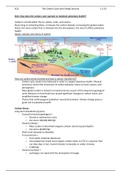
EQ1: How does the carbon cycle operate to maintain planetary health?
Carbon is stored within the air, plants, rocks, and oceans.
By burning or extracting these, it releases the carbon dioxide, increasing the global carbon
levels, the more carbon that is released into the atmosphere, the more it affects planetary
health.
Inputs, outputs and stores of carbon
How are carbon stores formed and how is carbon transferred?
- Carbon cycle needs to be balanced in order to support planetary health. Physical
processes control the movement of carbon between stores on land, oceans, and
atmosphere.
- Most global carbon is locked in terrestrial stores as part of the long-term geological
cycle. Reliance on fossil fuels has caused significant changes to carbon stores and
amplified climate change.
- Theory that anthropogenic (pollution caused by humans) climate change poses a
great risk to planetary health.
Carbon Stores
Long-term (hundreds of years)
- Crustal/ terrestrial geological =
o Stored in sedimentary rocks
o Can store 100,000,000 PgC
- Oceanic (deep) =
o Most carbon is dissolved inorganic carbon stored at great depths
o Can store 38,000 PgC
- Short-term (seconds to decades)
- Terrestrial soil =
o From plant materials (biomass);
o microorganisms break most organic matter down to CO2 in a process that
can take days in hot, humid climates to decades in colder climates
o 1,500 PgC
- Oceanic (surface) =
o exchanges are rapid with the atmosphere through:
EQ1: How does the carbon cycle operate to maintain planetary health?
Carbon is stored within the air, plants, rocks, and oceans.
By burning or extracting these, it releases the carbon dioxide, increasing the global carbon
levels, the more carbon that is released into the atmosphere, the more it affects planetary
health.
Inputs, outputs and stores of carbon
How are carbon stores formed and how is carbon transferred?
- Carbon cycle needs to be balanced in order to support planetary health. Physical
processes control the movement of carbon between stores on land, oceans, and
atmosphere.
- Most global carbon is locked in terrestrial stores as part of the long-term geological
cycle. Reliance on fossil fuels has caused significant changes to carbon stores and
amplified climate change.
- Theory that anthropogenic (pollution caused by humans) climate change poses a
great risk to planetary health.
Carbon Stores
Long-term (hundreds of years)
- Crustal/ terrestrial geological =
o Stored in sedimentary rocks
o Can store 100,000,000 PgC
- Oceanic (deep) =
o Most carbon is dissolved inorganic carbon stored at great depths
o Can store 38,000 PgC
- Short-term (seconds to decades)
- Terrestrial soil =
o From plant materials (biomass);
o microorganisms break most organic matter down to CO2 in a process that
can take days in hot, humid climates to decades in colder climates
o 1,500 PgC
- Oceanic (surface) =
o exchanges are rapid with the atmosphere through: