Pharmacology- MH Nursing Questions and Correct Answers | Latest Update | A+
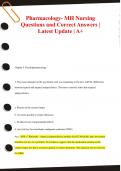
Chapter 4. Psychopharmacology 1. The nurse manager on the psychiatric unit was explaining to the new staff the differences between typical and atypical antipsychotics. The nurse correctly states that atypical antipsychotics: a. Remain in the system longer b. Act more quickly to reduce delusions c. Produce fewer extrapyramidal effects d. Are risk free for neuroleptic malignant syndrome (NMS) Ans: ANS: C Rationale : Atypical antipsychotics produce less D2 blockade; thus movement disorders are less of a problem. No evidence suggests that the medication remains in the system longer nor that it actsmore quickly to reduce delusions. The atypicals are not risk free for NMS. 2. The nurse would assess for neuroleptic malignant syndrome (NMS) if a patient on haloperidol(Haldol) develops a: a. 30 mm Hg decrease in blood pressure reading b. Respiratory rate of 24 respirations per minute c. Temperature reading of 104 F d. Pulse rate of 70 beats per minute Ans: ANS: C Rationale: Increased temperature is the cardinal sign of NMS. This BP is not a significant feature of NMS. There are no significant findings to support the options related to respirations or pulse rate. 3. A patient taking fluphenazine (Prolixin) complains of dry mouth and blurred vision. What would the nurse assess as the likely cause of these symptoms? a. Decreased dopamine at receptor sites b. Blockade of histamine c. Cholinergic blockade d. Adrenergic blocking Ans: ANS: C Rationale: Fluphenazine administration produces blockade of cholinergic receptors giving rise to anticholinergic effects, such as dry mouth, blurred vision, and constipation. 4. Which behavior displayed by a patient receiving a typical antipsychotic medication would be assessed as displaying behaviors characteristic of tardive dyskinesia (TD)? a. Grimacing and lip smacking b. Falling asleep in the chair and refusing to eat lunch c. Experiencing muscle rigidity and tremors d. Having excessive salivation and drooling Ans: ANS: A Rationale TD manifests as abnormal movements of voluntary muscle groups after a prolonged period o
Written for
- Institution
- Pharmacology
- Course
- Pharmacology
Document information
- Uploaded on
- July 5, 2024
- Number of pages
- 97
- Written in
- 2023/2024
- Type
- Exam (elaborations)
- Contains
- Questions & answers
Subjects
-
pharmacology mh nursing questions and correct ans

Also available in package deal