Human Anatomy and Physiology Chapter 1 Questions and Answers Graded A
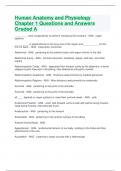
Human Anatomy and Physiology Chapter 1 Questions and Answers Graded A _____ ____ work cooperatively to perform necessary life functions - ANS- organ systems ___________is perpendicular to the long axis of the region and ___________ is from front to back. - ANS- transverse, horizontal Abdominal - ANS- pertaining to the anterior body trunk region inferior to the ribs Abdominal Cavity - ANS- Contains stomach, intestines, spleen, and liver, and other organs Abdominopelvic Cavity - ANS- seperated from thoracic cavity by the diaphram, a dome shaped muscle important in breathing. Has abdominal and pelvic cavities Abdominopelvic Quadrants - ANS- Divisions used primarily by medical personnel Abdominopelvic Regions - ANS- Nine divisions used primarily by anatomists Acromial - ANS- pertaining to the point of the shoulder Acromial - ANS- pertaining to the point of the shoulder all ____ depend on organ systems to meet their survival needs - ANS- cells Anatomical Position - ANS- erect, feet forward, arms at side with palms facing forward, head facing forward, internationally know Antebrachial - ANS- pertaining to the forearm Antecubital - ANS- pertaining to the anterior surface of the elbow Anterior/Ventral Body - ANS- Appendicular - ANS- fundamental division of our body. relating to the limbs and their attachments to the axis. Ausultation - ANS- Listening to organ sounds with a stethoscope Axial - ANS- fundamental division of our body. Makes up the main axis of our body, includes the head, neck, and trunk. Axillary - ANS- pertaining to the armpit Brachial - ANS- pertaining to the arm Buccal - ANS- pertaining to the cheek Calcaneal - ANS- pertaining to the heel of the foot Cardiovascular system - ANS- Blood vessels transport blood, which carries oxygen, carbon dioxide, nutrients, wastes, etc. The heart pumps blood. Made up of blood vessels and heart Carpal - ANS- Pertaining to the wrist Cephalic - ANS- pertaining to the head Cervical - ANS- pertaining to the neck region Coxal - ANS- pertaining to the hip Cranial Cavity - ANS- in the skull, encases the brain Crural - ANS- pertaining to the leg Deep (internal) - ANS- away from the body surface; more internal Digestive system - ANS- Breaks down food into absorbable units that enter the blood for distribution to body cells. Indigestible foodstuffs are eliminated as feces Made up of oral cavity, esophagus, liver, stomach, small intestine, large intestine, rectum , and anus Digital - ANS- pertaining to the fingers or toes Directional Terms - ANS- allow us to explain where one body structure is in relation to another Distal - ANS- farther from the origin of a body part or the point of attachment of a limb to the body trunk Do RBC's reproduce? - ANS- No, they do not have a nucleus. Dorsal (posterior) - ANS- Toward or at the back of the body; behind Dorsal Body Cavity - ANS- protects the fragile nervous system organs, has 2 subdivisions Dorsum - ANS- pertaining to the back Endocrine system - ANS- Glands secrete hormones that regulate processes such as growth, reproduction, and nutrient use (metabolism) by body cells. Mad up of pineal, pituitary, thyroid and adrenal glands, thymus, pancreas, ovaries and testis Epigastric Region - ANS- LOcater superior to the umbilical region Femoral - ANS- pertaining to the thigh Fibular (peroneal) - ANS- pertaining to the side of the leg Four types of cells: - ANS- Epithelial cell, Muscle cell, Nerve cell, Connective tissue cell Frontal - ANS- pertaining to the forehead Frontal plane - ANS- vertically divide the body into ventral and dorsal parts Frontal Planes (Coronal Plane) - ANS- like sagittal plane lie vertically, divide body into anterior and posterior parts Gluteal - ANS- pertaining to the buttocks or rump Hallux - ANS- pertaining to the great toe Homeostatic imbalance is the ...what does this cause? - ANS- disturbance of homeostasis increases risk of disease, contributes to changes associated with aging, may allow destructive positive feedback mechanisms to take over (heart failure) In a negative feedback system, the response of the effector - ANS- reverses the original stimulus. In referring to the back of the legs, you could use the term _________ or __________. - ANS- Posterior or Ventral in the body the serous membranes are separated by a thin layer of lubricating fluid called,,, - ANS- serous fluid In the upper limbs, the _____ side is considered medial and the radial side is considered lateral due to the palms facing forward in the anatomical position. - ANS- ulnar In what way does physiology depend of anatomy? - ANS- the operation or function of a structure is dictated by its anatomy Inferior (caudal) - ANS- away from the head end or toward the lower part of a structure or the body; below Inguinal - ANS- pertaining to the groin Integumentary system - ANS- Forms the external body covering and protects deeper tissues from injury - made up of hair, nails and skin Intermediate - ANS- between a more medial and a more lateral structure joe went to the emergency room where he complained of severe pains in the lower right quadrant of this abdomen
Written for
- Institution
- Human Anatomy and Physiology Chapter 1
- Course
- Human Anatomy and Physiology Chapter 1
Document information
- Uploaded on
- July 5, 2024
- Number of pages
- 14
- Written in
- 2023/2024
- Type
- Exam (elaborations)
- Contains
- Questions & answers
Subjects
-
human anatomy and physiology chapter 1 questions a

Also available in package deal